
Most foreign visitors I meet in Japan dismiss ichigo-gari on sight. They see the cartoon strawberry on the farm sign, hear the words “all-you-can-eat” attached to a winter morning at a greenhouse in the suburbs, and write it off as something for primary-school field trips. They skip it. And they’re wrong.
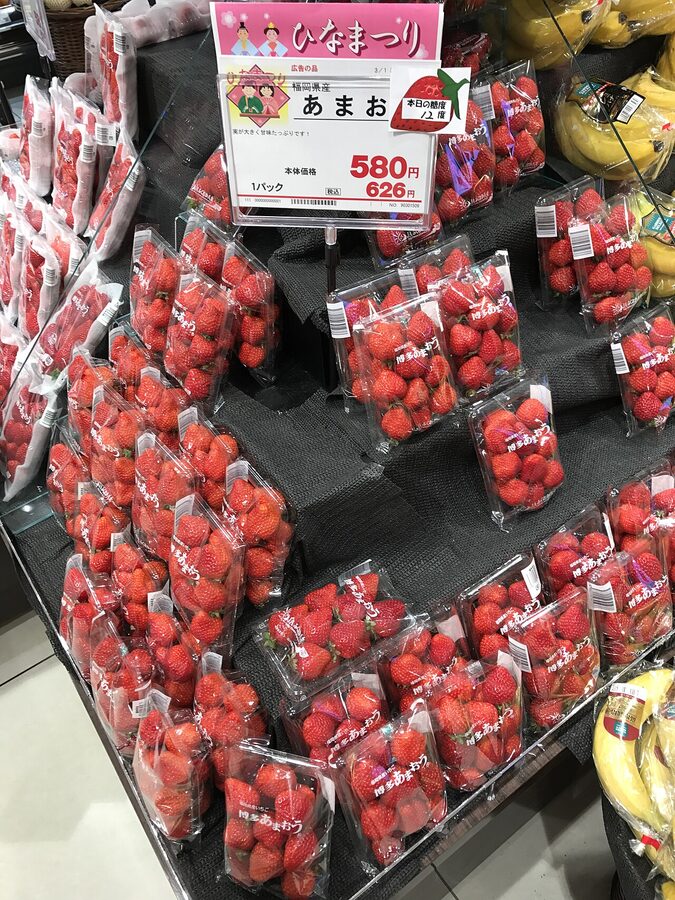
Strawberry picking is one of the few seasonal Japan activities where the price actually undercuts the alternative. A market punnet of grade-A Amaou from a Fukuoka department-store food hall in February runs ¥2,000–3,500 for fifteen berries. Thirty minutes of all-you-can-eat at a Tochigi or Yamanashi greenhouse, picked off the plant in your own time, sits at ¥2,000–3,000 for the same period. The maths is the maths. And the experience is the entire point: Japan has bred over 200 named strawberry cultivars, most of them grown for the domestic market and almost none of them exported. The only way to taste a Tochiaika or a Saga Honoka or the milk-white Tochigi-only Tochihime is to stand in the greenhouse where it’s growing and pick it.
This guide covers what’s actually worth knowing if you’re planning to do ichigo-gari on a Japan trip. The season runs roughly December to early June, peaking January through March. Cultivars vary by region, and they matter more than the location. Booking is straightforward at most farms but not at the headline destinations. And there’s a small etiquette layer that, if you ignore it, gets you a stern look from the okami running the place.
In This Article
- Why most foreigners skip it, and why that’s a mistake
- The season, in three windows
- December to mid-January: the rare-and-expensive window
- Mid-January to late March: the peak
- April to early June: the cheap-and-cheerful close
- The cultivars worth knowing
- Tochiotome (Tochigi)
- Tochiaika (Tochigi)
- Skyberry (Tochigi)
- Tochihime (Tochigi-only)
- Amaou (Fukuoka)
- Beni Hoppe (Shizuoka)
- Akihime / Sho-hime (Shizuoka)
- Saga Honoka (Saga)
- Yotsuboshi (multi-prefecture)
- Milky Berry / Tochigi-i37 (Tochigi)
- How ichigo-gari actually works on the day
- Regional farms worth choosing on purpose
- Tochigi: the strawberry kingdom
- Yamanashi: the Mt. Fuji combination
- Fukuoka and Itoshima: the Amaou hunt
- Saga: the Saga Honoka pick
- Aichi: the comparison-tasting heartland
- Kansai (Kyoto, Osaka, Hyogo): the day-trip pick
- Yamagata: the late-season Sato Nishiki transition
- Okinawa: the earliest-and-warmest oddity
- How to book, when to come, what to wear
- Booking
- What time to come
- What to wear
- The etiquette nobody tells you
- The price-versus-experience reality, in numbers
- What to combine it with
- Strawberry-themed everything else
- One last thing about the cultivar conversation
Why most foreigners skip it, and why that’s a mistake
The dismissal is fair on the face of it. Many farms market themselves to families with small children. The Aichi Prefecture tourism site lists fourteen ichigo-gari spots and most of them quote a children’s price next to the adult one before they tell you anything else. The visual language of ichigo-gari in Japan, on signage and in the pamphlets at michi-no-eki roadside stops, leans heavily into pink, into mascots, into a cartoon-strawberry-with-a-face shorthand that does the activity no favours with adult travellers. So the assumption forms easily: this is a kids’ thing.
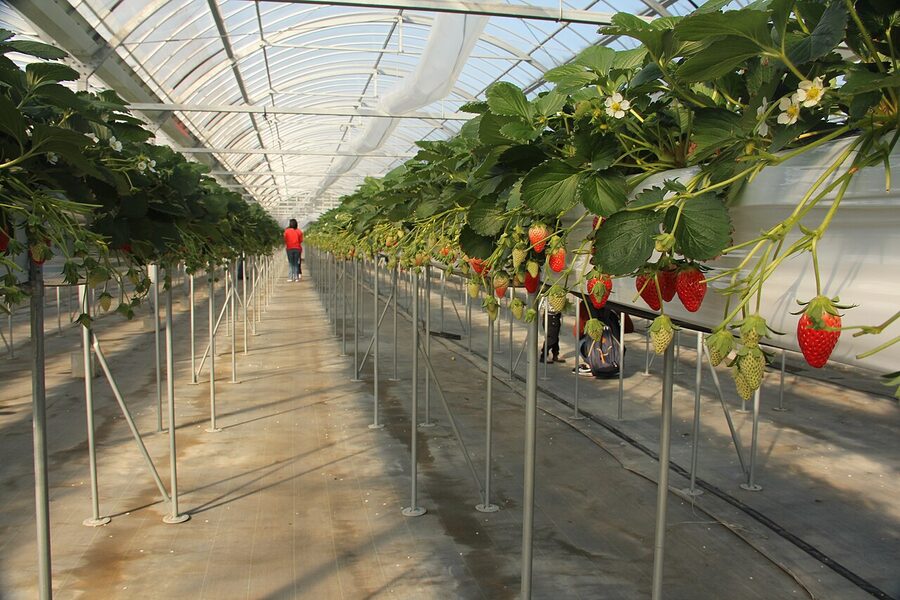
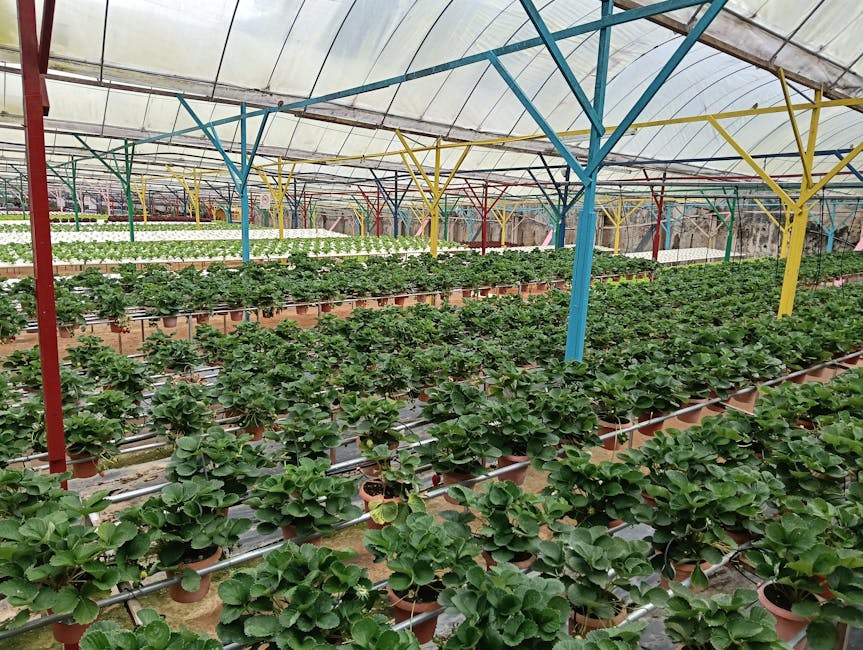
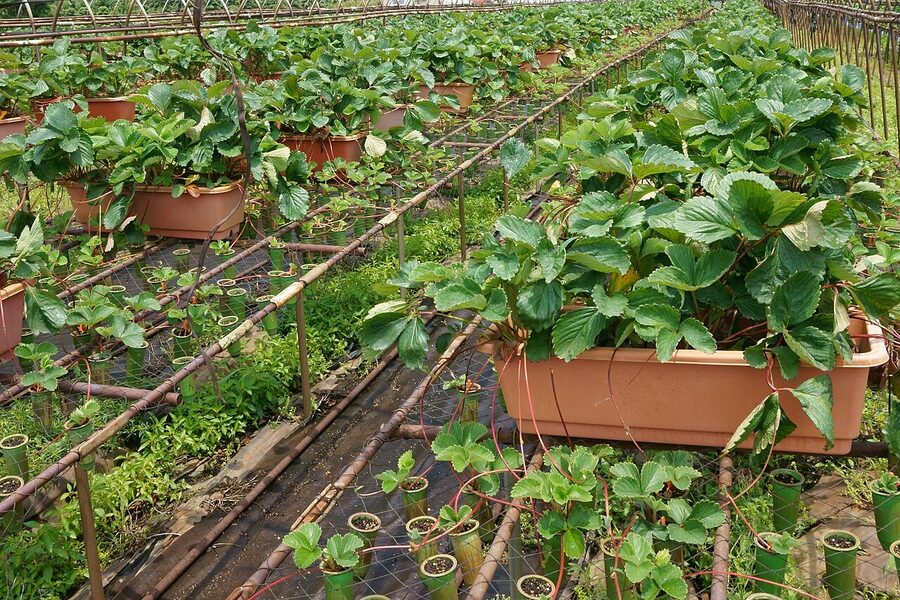
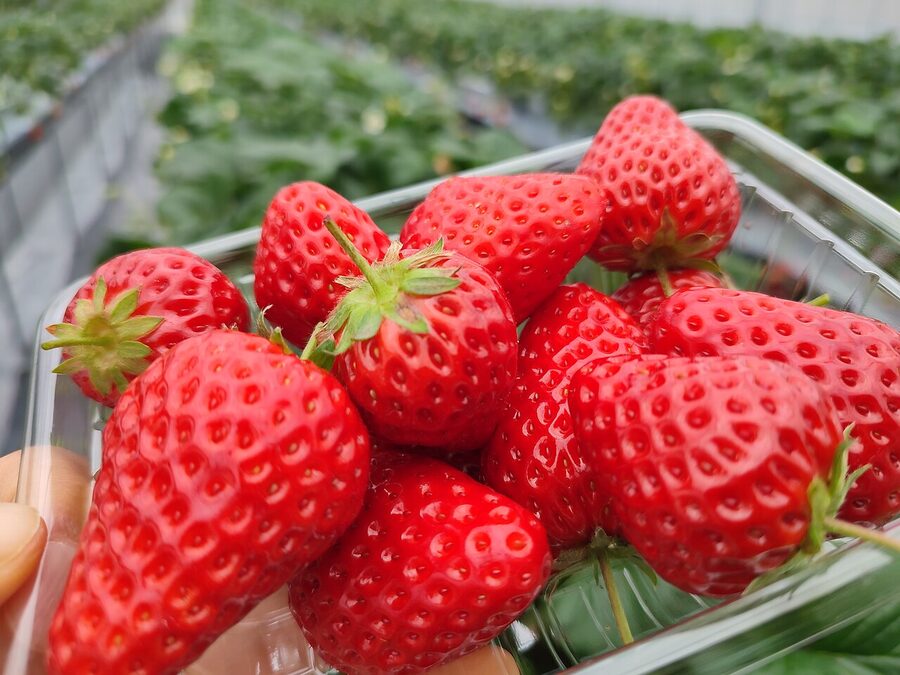
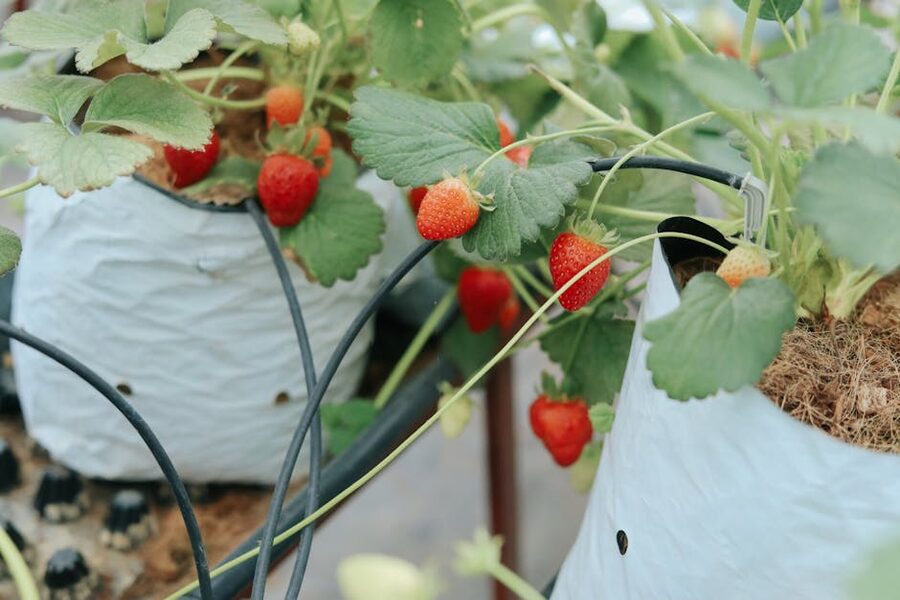
That assumption confuses the marketing with the product. Walk into the greenhouse. The plants are on raised gutter benches at chest height, a system called kosetsu saibai (high-bed cultivation), now near-universal at ichigo-gari farms because it’s hygienic, accessible, and easier on a fifty-year-old’s back. The fruit is grade A. Most farms grow two to five named cultivars side by side, in adjacent rows, so you can taste them against each other directly. Honest version: there is no other way to do this. The supermarket only stocks one or two cultivars at a time, by season. The depa-chika food halls in Tokyo and Osaka stock three or four, all at gift prices and individually wrapped. The greenhouse is the only place in Japan where you can put a Tochiotome and a Skyberry and a Tochihime in your mouth in succession and decide for yourself which one wins.
The other thing the dismissal misses is the price. I keep coming back to this because the maths really is the strongest argument. A 280g punnet of Amaou at Iwataya in Fukuoka or at Isetan in Shinjuku in February will run you ¥1,800–3,000. That’s twelve to fifteen berries, picked, sorted, packed, and gift-wrapped. The greenhouse 30-minute pass at one of the better Itoshima Amaou farms, peak-season weekday, is ¥2,800–3,800 depending on the month. You will eat more than fifteen berries in thirty minutes. I have seen otherwise sensible adults knock back twenty-five and stop because they can’t physically continue, not because the time was up. The pass also includes the entry to the greenhouse, the tray, the condensed milk, and the right to wander up and down the rows for half an hour pretending you’re inspecting them like a sommelier.
The season, in three windows
Japanese strawberry season is longer than people expect. The earliest fruit shows up in December and the last picking sessions run into early June. But the season is not uniform: the experience changes substantially depending on which window you hit.
December to mid-January: the rare-and-expensive window
The December openers are heated greenhouses pushing the season early to catch the gift-giving Christmas-cake market. Strawberries on Christmas cakes are a Japanese tradition that does not exist in most other countries, and the supply chain for those cakes consumes most of the December crop at premium prices. The greenhouses that open for ichigo-gari this early are charging top-of-season fees: ¥2,800–3,500 for an adult is normal, sometimes higher on weekends. The fruit is excellent (early-season strawberries hold their sugar well in the cool morning greenhouse) but the all-you-can-eat windows are short, often 30 minutes only, and reservations are essential.
This is also the only window where the southernmost farms make sense. Okinawa has a small handful of strawberry growers, mostly on the main island around Nago, where the season runs roughly mid-December through April. It’s an oddity, strawberries are a temperate-climate crop and Okinawa is subtropical, and the cultivars tend to be Akihime and Beni Hoppe rather than the Kyushu Amaou you might expect. Worth knowing exists, not necessarily worth the trip on its own.
Mid-January to late March: the peak
This is the window that matters. Every farm I’d recommend is open and running full-tariff sessions. The fruit has matured fully, the supply has caught up with demand so prices ease back from the December peak, and you have your full pick of cultivars. Weekends in February and March are the busiest of the year, especially in the Kanto and Kansai farms within day-trip range of Tokyo, Yokohama, and Osaka. Reservations are strongly recommended. Some farms (Ichigo-no-Sato in Oyama, Tochigi, for instance) operate a strict full-reservation system through this window with no walk-up acceptance.
The cherry-blossom overlap kicks in toward the end of this window. Late March through early April you can pair a hanami day with strawberry picking, which makes for the kind of half-and-half itinerary that travels well: greenhouse first thing in the morning when the strawberries are coolest and sweetest, blossom in the afternoon. I’d put this on the short list of best-Japan-day-trip combinations. Pair it with the cherry blossom guide and you’ve got a day plan that lands.
April to early June: the cheap-and-cheerful close
Prices drop hard from early April. Adult tariffs that ran ¥2,800 in March routinely fall to ¥1,800 or even ¥1,500 by early May. Aichi’s farms are particularly clear about this on their official tourism page: nearly every operator quotes a tiered price card with three or four step-downs through April and May. The fruit is still good (warmer days mean sweeter berries) but the cultivars on the bushes thin out as the early-bred varieties stop fruiting and only the late ones remain. By mid-May you’re often looking at one cultivar choice rather than the four-way comparison you’d get in February.
Late season has its own quiet appeal. The greenhouses are warm but not hot, the farms are uncrowded mid-week, and you can walk in without a reservation at most of them. If you’re in Japan in early May after Golden Week and the cherry blossoms have moved north, late-season ichigo-gari in Yamanashi or Saitama is a perfectly reasonable thing to do with a free morning.
The cultivars worth knowing
Cultivar specificity is the thing that makes Japanese ichigo-gari different from the equivalent activity anywhere else in the world. There are over 200 registered strawberry cultivars in Japan and the regional ones don’t travel: a Tochigi greenhouse is the only place you’ll meet a Tochihime, a Fukuoka greenhouse is the only place you’ll meet a fresh Amaou, and so on. Here are the ones to look for.
Tochiotome (Tochigi)
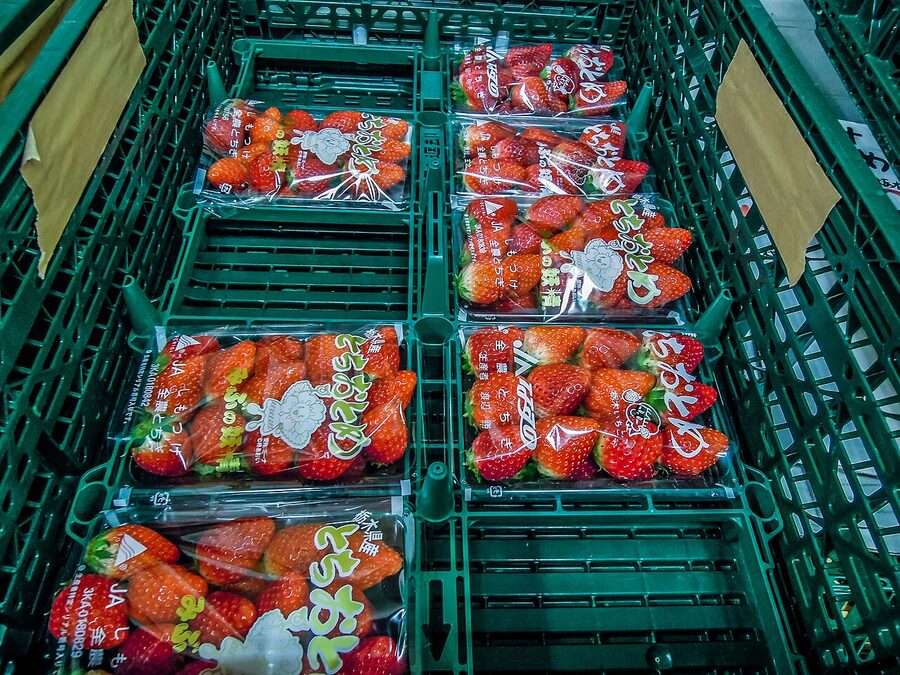
The default Japanese strawberry. Bred at the Tochigi Prefectural Strawberry Research Institute, yes that’s a real institution, Tochigi has the only one in Japan, and registered in 1996. Bright red, conical, glossy. The flavour is balanced, sweet and acid more or less equal, and the texture is firm enough to ship well, which is why supermarket strawberries across most of Japan are likely to be Tochiotome. At the greenhouse, you’ll get bigger and riper specimens than the supermarket version, with a small acidic edge that the larger Skyberry doesn’t have. Picking time runs October through June.
Tochiaika (Tochigi)
Tochigi’s newer cultivar, released for sale in 2019 and pushed hard by the prefecture as the next-generation flagship. The name combines tochi (Tochigi), ai (love), and ka (fruit), making the loose meaning “Tochigi’s beloved fruit.” Bigger than Tochiotome, 30–40g compared to Tochiotome’s 18–25g, markedly sweeter, low-acid. When you cut it open the cross-section is heart-shaped, which the prefecture has leaned into hard for the marketing. Increasingly the cultivar of choice at Tochigi ichigo-gari farms; if you’ve come to Tochigi for the strawberries, this is the one to seek out.
Skyberry (Tochigi)
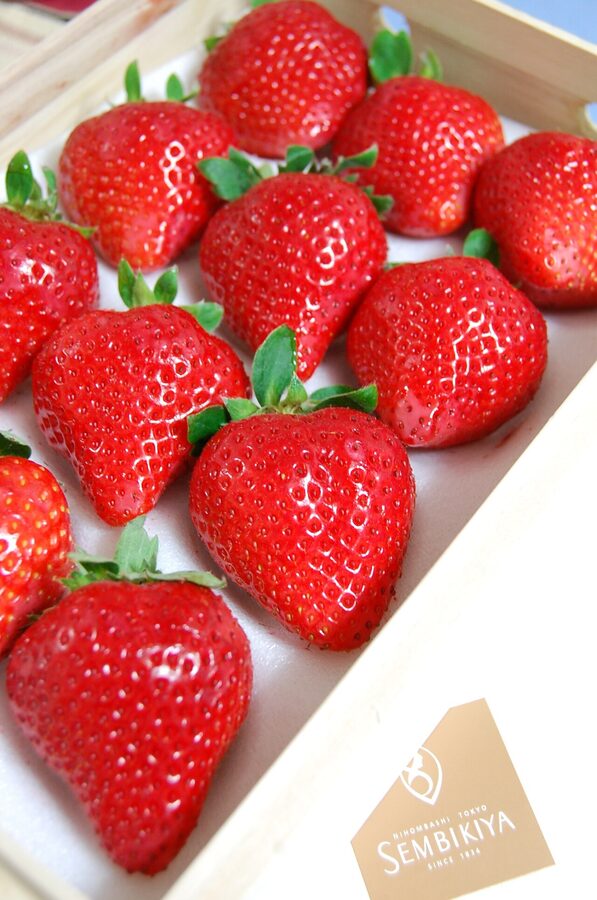
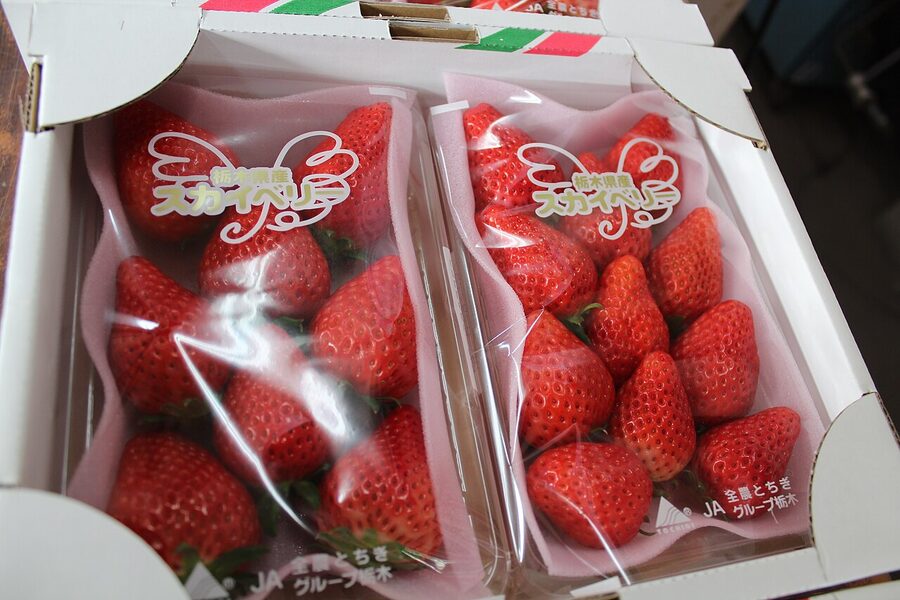
Tochigi’s premium register. Released in 2014 and named for the Sukai-san peak, one of Tochigi’s hyakumeizan-listed mountains, written with the same characters. Extremely large, a 25g berry counts as 3L grade and Skyberries hit that size routinely. Conical, light bright red. Often used as a gift fruit, individually wrapped, in the Tokyo department-store food halls. Sweet, with the kind of mellow finish that doesn’t tire you the way the cheaper bred-for-yield cultivars do. At the greenhouse it’s usually the most expensive option.
Tochihime (Tochigi-only)
The fabled one. Tochihime (“Tochigi princess”) has skin so delicate it cannot be transported and shipped, which means the only place in Japan you can eat it is at a Tochigi ichigo-gari farm. It does not appear in any supermarket, anywhere. Large, soft, juicy, very sweet. The Tochigi tourism board calls it “the phantom strawberry.” If you’re going to Tochigi for the picking and a farm offers a Tochihime course, take it; you cannot try this fruit any other way.
Amaou (Fukuoka)
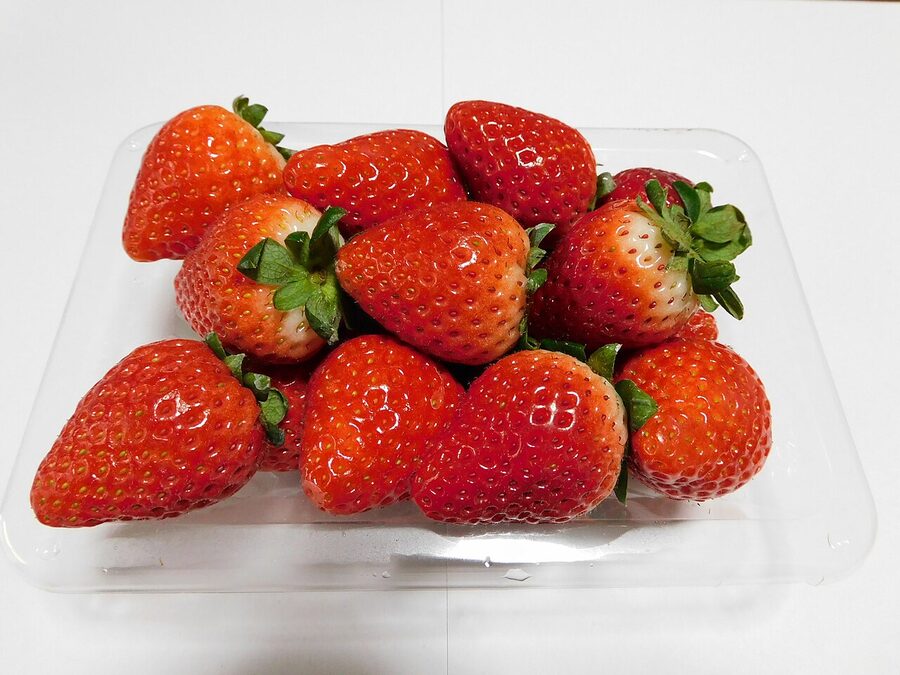
The cultivar most foreign visitors have eaten without knowing the name. Bred in Fukuoka and registered in 2005, marketed as the prefecture’s hero variety. The name is a four-character invented word: aka (red), marui (round), okii (big), umai (delicious). Almost spherical, very dark red, thick-walled, intensely sweet. Amaou commands premium prices at the food halls and is the strawberry of choice for the Strawberry Sando craze that swept Tokyo cafes a few years back. At ichigo-gari in Itoshima or Yame, you can pick them straight off the plant; the difference between a fresh-picked Amaou and one that’s spent three days in transit is substantial.
Beni Hoppe (Shizuoka)
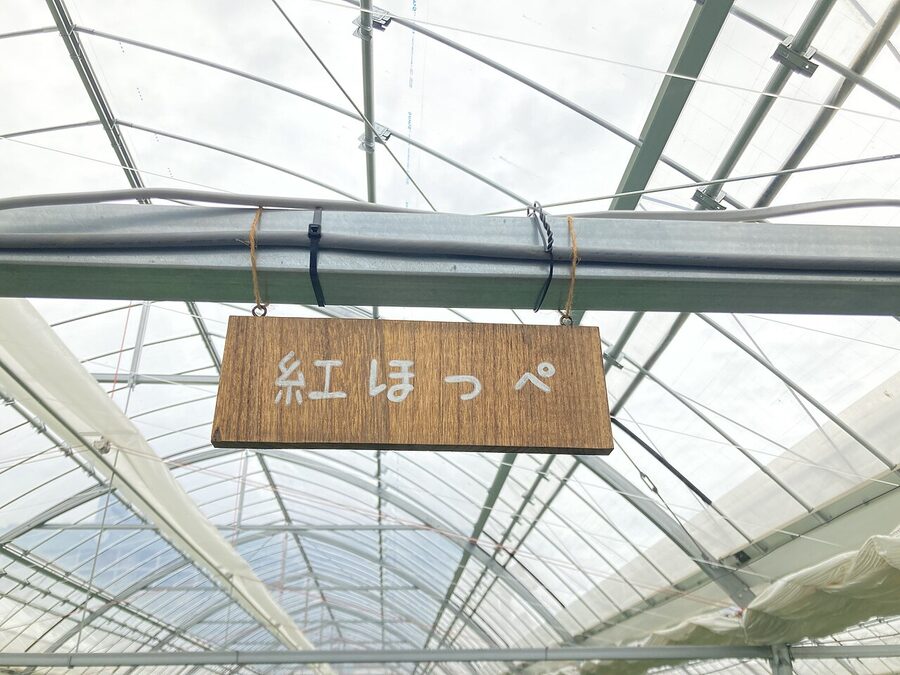
Bred in Shizuoka in 2002, the name translates loosely to “red cheek” and refers to the deep red colour and the slightly rounded almost cheek-shaped form. Sweet with a clean acid finish, juicier than Tochiotome, slightly softer texture. Common at farms across central Honshu including most of the Yamanashi farms in the Mt. Fuji area. The cross with Akihime makes for an obvious comparison course at farms that grow both.
Akihime / Sho-hime (Shizuoka)
Also a Shizuoka cultivar, slightly older than Beni Hoppe and registered in 1996. The name reads either as “Akihime” or “Sho-hime” depending on the operator. Long, narrow, conical fruit, high sugar but lower acid than Beni Hoppe, very fragrant. The two together are the standard Shizuoka pair and you’ll see them paired on virtually every farm in the prefecture and across into the Aichi greenhouses.
Saga Honoka (Saga)
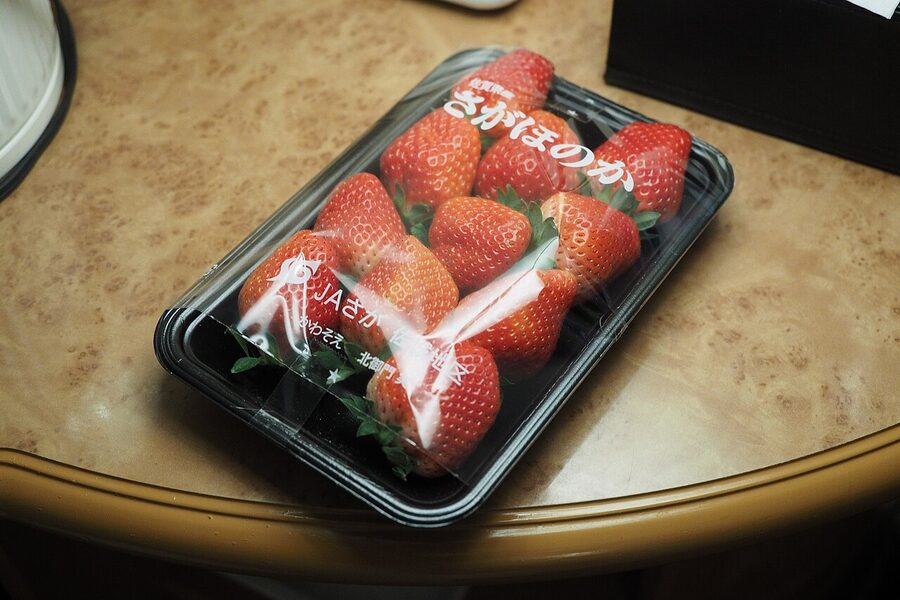
Saga prefecture’s flagship cultivar, registered in 2001. Big, conical, pale red rather than the deep red of Amaou. Texture firm. The flavour is mild compared to Amaou’s intensity, which makes it a popular cultivar for the cake industry, it doesn’t dominate the cream the way Amaou would, but at ichigo-gari it can read as a slightly underwhelming comparison sample. Worth knowing exists, especially if you’re picking in Kyushu and looking for a comparison point against the Amaou.
Yotsuboshi (multi-prefecture)
Released in 2014, unusually for Japan as an open-pollinated cultivar (not a single-line clone). It can be grown from seed, which is rare for strawberries, and that has driven adoption across multiple prefectures. Yotsuboshi appears at farms in Aichi, Shizuoka, Mie, and elsewhere. Mid-size, conical, balanced flavour. A good “house” cultivar that you’ll meet on the comparison tasting at most farms outside Tochigi or Fukuoka.
Milky Berry / Tochigi-i37 (Tochigi)
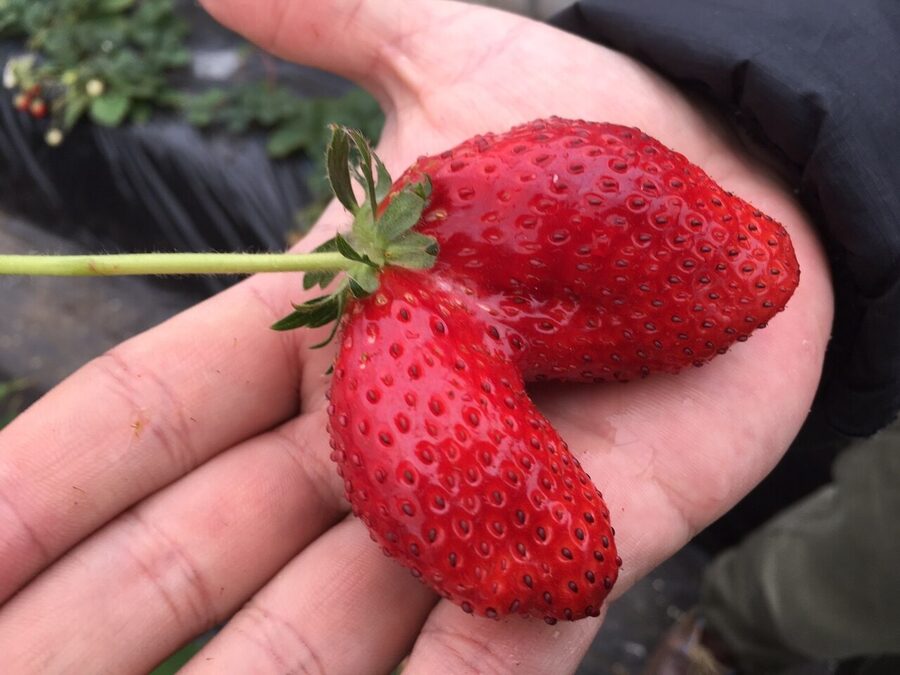
The white one. Bred in Tochigi from a sport-mutation programme, released for commercial sale around 2014. Looks like a strawberry that’s been bleached. The flesh is creamy white, the seeds (well, the achenes) are red, the skin is a pale pink. The flavour is unusual: low-acid, very sweet, with a faintly milky mouthfeel that explains the marketing name. Worth trying once for the novelty. The flavour profile is real but it doesn’t quite deliver the kick of a properly red cultivar.
How ichigo-gari actually works on the day
The format has converged across Japan to a near-standard pattern. Knowing it removes most of the guesswork.
You arrive at a greenhouse. Almost all ichigo-gari farms are at semi-rural addresses, a 10–30 minute taxi or local bus from the nearest train station. The farm building is usually a small reception hall with a counter, a payments machine or a card reader, and a shoe-rack. You take your shoes off here in some farms, leave them on in others. The rule is on the door.
You pay. The standard tariff is ¥2,000–3,000 for an adult, lower for children, free for under-twos. Most farms tier the price by season: peak season (mid-January to early April) at the high end, late season (April–May) at the lower. Cash is still common; some operators (Ichigo-no-Sato in Tochigi, for instance) explicitly do not accept cards or e-money. Bring cash to be safe.
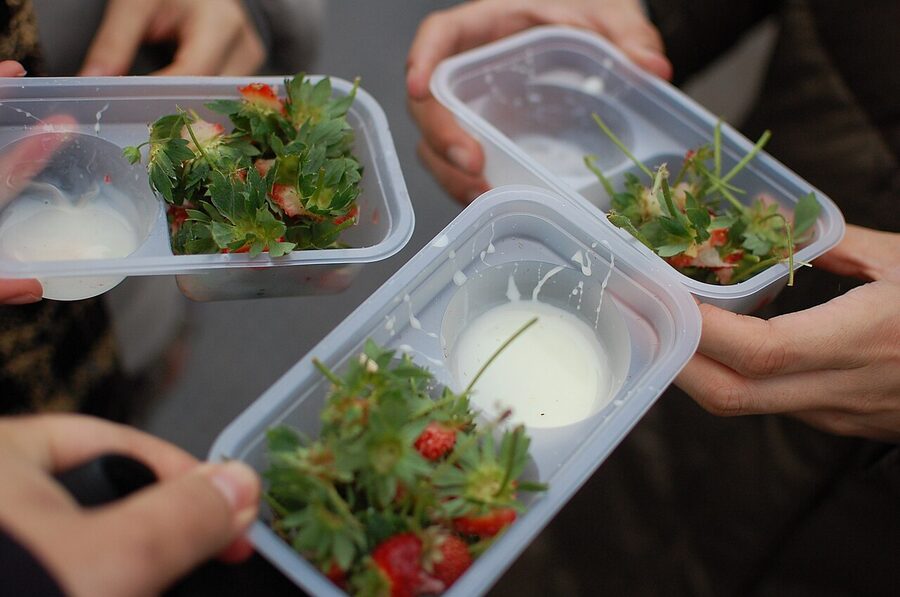
You’re given a tray and a small condensed-milk container. The tray, usually plastic, holds the hulls. The condensed milk (renyu) is the universal standard dipping option. Some farms offer chocolate sauce as an optional extra, ¥350 or so at MARUHARESORT in Mihama, Aichi, for instance. Condensed-milk refills are usually free; ask if it’s included or not. At many farms the milk is provided free.
You’re shown to a row. The staff walks you to a specific row or section and tells you that’s your patch. The rows are demarcated; don’t wander into someone else’s. The greenhouse is heated to about 20–22°C even in February, so bring a layer you can take off.
You have 30, 40, 45, or 60 minutes. The standard tier is 30 or 40 minutes. Some farms offer extended sessions: Osazen in Kyoto runs a 45-minute window with periodic 60-minute promotions; Ichigo-no-Sato runs a 60-minute deluxe five-cultivar comparison course. The clock starts when you enter the row, not when you paid.
You pick. Pinch the stem just above the calyx with your thumbnail, twist gently, the strawberry comes off in your hand. Don’t squeeze. Don’t pull straight down (you’ll damage the plant). Take only the deeply red ones; the pale or partly-green ones are not yours to take. Eat over the tray; the hulls go on the tray, not on the floor.
You stop. When the time’s up, an attendant comes and walks you back. You can sometimes buy a punnet of pre-picked fruit on the way out as a gift, depending on the farm.
Regional farms worth choosing on purpose
The choice of farm matters less than the choice of region. Tochigi has more strawberry farms than any other prefecture, but if you’re already going to Kyushu for other reasons there’s no benefit in detouring to Tochigi. The right approach is to fold an ichigo-gari stop into the route you’re already on.
Tochigi: the strawberry kingdom
Tochigi has called itself ichigo okoku (strawberry kingdom) for a reason. The prefecture has been Japan’s biggest strawberry producer for more than fifty consecutive years. The Tochigi Strawberry Research Institute is the only research institute in Japan dedicated solely to one fruit. There are dozens of ichigo-gari operations, almost all clustered in the southern half of the prefecture within an hour or so of Tokyo by Tohoku Shinkansen.
The farms I’d actually pick:
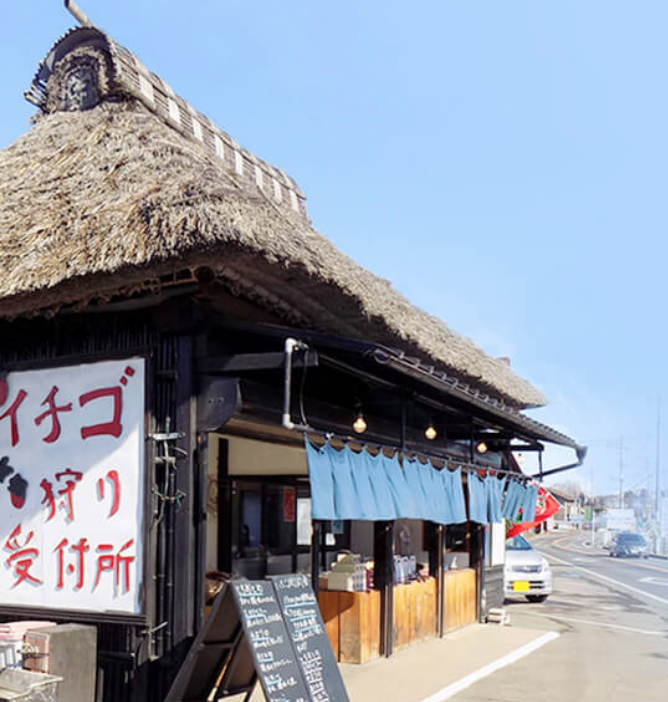
- Ichigo-no-Sato (Oyama): the gold-standard operation. They run a 60-minute five-cultivar tasting through their greenhouse: Tochiaika, Skyberry, Tochiotome, Tochihime, and Milky Berry, all together. As of November 2025 the weekday adult cash tariff for the headline two-cultivar comparison course (Tochiaika and Skyberry) is ¥2,640 through 5 April 2026, dropping to ¥2,090 from 6 April through the end of the season. Online pre-payment with credit card gets you a small discount. Reservations strongly recommended. About 15–20 minutes by taxi from Oyama Station on the Tohoku Shinkansen. Phone: 0285-33-1070.
- Yoshimura Strawberry Park (Mashiko): the unusual one. Famous for offering all-you-can-eat sessions with no time limit, extremely rare in Japan, and an unusually wide cultivar range. Address is in Mashiko, the pottery town, so you can pair it with a pottery walk. About an hour by car from Utsunomiya.
- Mt.Berry Okunikko: the only farm in Tochigi that does natsu ichigo-gari, summer strawberry picking. The cultivar is Natsuotome, bred specifically for summer fruiting. Open July through October. Useful if you’ve come to Nikko in summer and your kids are bored.
- Senbonmatsu Ichigo-en (Nasushiobara): the geothermal one. Heated by hot-spring overflow water from the surrounding Nasu onsen. 20-minute all-you-can-eat. Two minutes off the Nishi-Nasuno-Shiobara IC, so it’s an easy car-trip stop on the way to Nasu.
Tokyo to Tochigi by Tohoku Shinkansen takes 50–60 minutes to Oyama or Utsunomiya, then a taxi. A car makes the day easier if you have a Japanese-licence driver in the group; without one, the bus and taxi combination still works.
Yamanashi: the Mt. Fuji combination
Yamanashi runs from late December through May and is the obvious pick if you’re in the Mt. Fuji area for any other reason. The cluster of farms around Fujikawaguchiko, Showa, and Minami-Alps is dense enough that you can pick a farm by which bus or train station is most convenient. The cultivars are mostly Akihime, Beni Hoppe, and Sho-hime, with some Skyberry at the higher-end farms.
The strongest argument for Yamanashi is the geography. Mt. Fuji is visible from many of the farms on a clear winter morning. Combining a Fuji-view shrine visit, a strawberry pick, and a hoto noodle lunch at Kosaku makes for one of the better day-trips out of Tokyo for first-timers. Coming up from Tokyo on the Chuo Highway Bus to Kawaguchiko is about 1h 45m and runs roughly hourly. From there, most farms are 15–30 minutes by local bus or taxi. See the Mt. Fuji from Tokyo guide for the full route options.
Fukuoka and Itoshima: the Amaou hunt
If you’ve gone to Fukuoka for the food and want to fold in an Amaou pick, Itoshima is the answer. The Itoshima peninsula sits about 40 minutes west of Fukuoka by train (JR Chikuhi Line from Hakata to Chikuzen-Maebaru, then a local bus or taxi). Itoshima is Japan’s biggest single Amaou-growing area outside the Yame plain, and most of the visitor-facing farms run sessions from December through May with peak pricing in February and March. Cultivars are almost exclusively Amaou.
For the Yame side, head south from Fukuoka to Yame City; the agricultural area around the JR Yame Hassei Centre runs ichigo-gari programmes through several JA-affiliated growers’ associations during peak season. Less polished than the Itoshima visitor farms, more authentic if you don’t mind a slightly rougher edge.
Saga: the Saga Honoka pick
Saga prefecture is more agricultural and less visited, which is a feature not a bug for ichigo-gari. The farms cluster around Karatsu, Saga City, and Ureshino. Saga Honoka is the dominant cultivar; some operators now offer Saga-bred newer cultivars like Iihime alongside it. An hour from Hakata by JR limited express.
Aichi: the comparison-tasting heartland
Aichi is one of the country’s biggest strawberry-producing prefectures and has the densest concentration of farms running multi-cultivar comparison courses. The official Aichi tourism page, updated for the 2026 season, lists fourteen visitor-facing farms across the prefecture, mostly clustered on the Chita Peninsula south of Nagoya and in the Toyota / Nishio area inland. Pricing is well-documented and tiered: peak-season weekday adult tariffs run ¥2,300–2,800 for 40 to 60 minutes, dropping to ¥1,500–2,000 by mid-April.
Notable farms include Strawberry Park Mifune in Toyota (premium tier, four cultivars in the picking course plus three extra cultivars for retail purchase only, the rare ones being Tenshi-no-Ichigo, Sachinoka, and Yotsuboshi), Ainoichigo Farm in Tokoname (which runs a Friday-Saturday-only night-time ichigo-gari session, unusual in the country), and Yamawarausato in Mihama (the one with free condensed milk and chocolate sauce on tap). Most are accessible by Meitetsu local trains plus a short taxi.
Kansai (Kyoto, Osaka, Hyogo): the day-trip pick
Kansai’s biggest single farm is Osazen in Yawata, southern Kyoto, which calls itself the largest ichigo-gari operator in western Japan. They run 21 greenhouses, 45-minute all-you-can-eat sessions, multiple cultivars including Akihime, Beni Hoppe, Yotsuboshi, and Starnight. The Kyoto-area farms run from November through mid-June, longer than most of the country thanks to the Inland Sea climate. Train to JR Yawata-shi, then a short taxi or local bus to the farm.
For Osaka day-trippers, the Kishiwada and Sennan-area farms are 45 minutes by Nankai Line; for those based in Kyoto proper, the Uji and Yawata farms are 30–45 minutes south. Most Kansai farms are smaller than the headline Tochigi operators and the cultivar range is narrower, but the combination with a temple morning makes for a tidy half-day.
Yamagata: the late-season Sato Nishiki transition
Yamagata’s strawberry farms are the bridge to the prefecture’s better-known cherry crop. Sato Nishiki cherries (the celebrated June fruit) come from the same orchards and farm cooperatives that run strawberries through the winter. Yamagata strawberry season runs January through early June, with the late-season picking overlapping the start of cherry season. Cultivars lean toward Tochiotome and Tochiaika imported from Tochigi, plus locally-bred Yamagata Bijin in some farms. The Yamagata City and Tendo clusters are accessible by JR Yamagata Shinkansen plus a 15–20 minute taxi.
Okinawa: the earliest-and-warmest oddity
Strawberries are not a tropical crop and Okinawa is not a strawberry-growing region by any normal measure. But a small handful of farms on the main island run from mid-December through April, drawing on the cool dry-season weather to push an early-season window. Okinawa growers are a curiosity rather than a destination, but the very early opening, sometimes from 1 December at the keenest farms, makes them useful for a Christmas-trip schedule that other regions can’t match.
How to book, when to come, what to wear
Booking
Most farms accept walk-ups on weekdays through the season. Reservations become essential at the Tokyo Strawberry Park-style flagship destinations and at any farm on a peak-season weekend. Saturday and Sunday between mid-January and end of March are the days when even mid-tier farms run booked-out. The booking pattern in 2026 is largely as follows.
For mid-tier and rural farms (Tochigi outside Oyama, Yamanashi, Saga, Yamagata): walk up Tuesday to Friday and you’re fine. Show up by 10:00 to be sure of getting a session.
For flagship-tier and metro farms (Tokyo Strawberry Park in Yokohama, Ichigo-no-Sato in Tochigi, Osazen in Kyoto, the Itoshima Amaou farms): book ahead. Most have online reservation systems in Japanese only, although a handful have English-language portals. Tokyo Strawberry Park accepts reservations directly through its English page; for the others, sometimes the easiest route is to ask a hotel concierge to phone for you. Phone reservations are universally accepted and most farms have at least one English-speaking staff member during the picking season.
For weekend visits in February and March: booking is not optional. Plan a week ahead and don’t expect to be flexible on time slots.
What time to come
Morning. The greenhouse is warmest mid-afternoon and the strawberries that have been hanging on the plant in 22°C conditions for four hours since the morning sun came up are softer, juicier, and slightly less acidic than the cool-morning equivalent. That sounds like a feature; in practice the morning fruit holds its sweet-acid balance better, the texture is firmer, and you can eat more of them before palate fatigue sets in. Aim for the 09:30 or 10:00 session.
The other reason to come early: visibility. Most farms are working farms, and by mid-afternoon a session that’s been running since 09:00 has thinned the easy-to-reach fruit. The 10:00 session has its pick of the rows.
What to wear
Layers. The greenhouses run at 20–22°C even when the outside temperature is below freezing. A T-shirt under a fleece under a coat is the right outdoor configuration; you’ll be down to the T-shirt by twenty minutes in. Trainers or boots, never sandals. The floor is wet, sometimes muddy at older farms with soil-bed cultivation. Tie long hair back. Avoid a white shirt: strawberry juice on white cotton is a permanent record.
If you’re picking with kids, wear something washable. Strawberry juice will end up on you regardless of best intentions. The farms tend to have hand-wash basins outside the greenhouse for the inevitable post-session clean-up.
The etiquette nobody tells you
The unwritten rules at ichigo-gari are not strict but ignoring them gets you a polite but firm correction from the okami. The list, gathered from staff at five different farms over a couple of seasons:
Don’t pick green or partially red ones. A strawberry that hasn’t gone fully red won’t ripen further once picked, and the farm loses the fruit that would have ripened in another two days. If you genuinely can’t tell, leave it; staff will gladly point out which rows are at peak picking that day.
Don’t squeeze the fruit to test ripeness. A squeezed strawberry that you decide not to pick is now a damaged strawberry. Look at the colour and the size; if it looks ready, it’s ready.
Don’t take fruit out of the greenhouse. Most farms explicitly forbid mochidashi (taking-out). The fruit you’ve paid for is for eating in the greenhouse, full stop. Some farms sell pre-picked punnets at reception for taking home; that’s the legitimate route.
Use the condensed milk freely. This one runs the other way: novice visitors sometimes assume the milk is rationed because it comes in a small container. It isn’t. Refills are free at most farms, you can dip every strawberry in it, and the staff will offer more if you finish what you have.
Stay in your row. Even if a neighbouring row looks more promising, you have been allocated a section. Stepping into another group’s row reads as rude.
Eat over the tray. The tray catches the hulls and the juice. Dropping hulls on the floor is the single most common mistake foreign visitors make and it’s also the one that most upsets the staff, who have to clean up before the next session.
Don’t run. Sounds obvious, but the rows are narrow and if there are children loose in the greenhouse running into adults will end someone’s session early. Walk.
The price-versus-experience reality, in numbers
To put the whole “is it worth it” question to rest with actual numbers: a 280g punnet of Amaou at the Iwataya Hakata food hall in February 2026 ran ¥2,160. That’s about twelve to fifteen berries. A peak-season weekday 40-minute Amaou session at one of the better Itoshima farms in February 2026 ran ¥2,800–3,800 depending on operator. In forty minutes most adults will eat between twenty and thirty berries, and the berries are larger and riper than the gift-shop selection because you’re picking the peak fruit yourself.
The same maths plays out for Skyberry in Tochigi (where a department-store punnet runs ¥3,500–5,000 in February and a comparison course at Ichigo-no-Sato runs ¥2,750 weekday peak-season), and for Beni Hoppe in Shizuoka (¥1,200 punnet vs ¥2,200–2,500 30-minute session, where the farm session works out marginally more expensive but you’re getting fresher fruit and tasting two or three other cultivars alongside).
The economic case is not a stretch. The experiential case is much stronger: ichigo-gari is the only place in Japan where you can put four named cultivars side-by-side in your mouth in twenty minutes and decide which one wins. That is not a thing the supermarket or the food hall offers.
What to combine it with
Strawberry picking is not really a half-day activity in itself: forty minutes inside a greenhouse plus the travel time means a half-day at best. The trick is folding it into a route you’re already on.
From Tokyo for the day. Up to Tochigi for picking at Ichigo-no-Sato or Yoshimura, then back via Mashiko if it’s the Mashiko-area farm and you want to fold in the pottery shopping, or via Utsunomiya for gyoza. The Tohoku Shinkansen is fast enough that this is a comfortable single-day round trip.
From Tokyo to the Mt. Fuji area. Day trip up to Yamanashi, picking at one of the Showa-cho or Fujikawaguchiko farms, then a Mt. Fuji viewing stop and hoto noodles for dinner. The combination works well in late February and March when the Fuji five lakes have clearer weather and the strawberry farms are at peak.
From Fukuoka to Itoshima. Half-day to Itoshima for Amaou picking, then beach driving and the Sakurai Futamigaura tori-i in the afternoon, then back to Fukuoka for ramen. This is one of the better Kyushu day-trip combinations, especially in February when the beach is bright but quiet.
From Kyoto for the morning. Osazen in Yawata or Berry Farm in Uji combines well with a temple visit. Kyoto proper to Yawata is 30 minutes by JR; you can pick early, then be back at Byodo-in or Tofuku-ji by lunchtime.
Late-season after cherry blossoms. Once cherry blossoms have moved north of Tokyo, the late-April and early-May Yamanashi and Saitama farms are still running at half the peak-season tariff. A morning pick in Saitama plus a Chichibu temple walk plus a late lunch at a Soka soba shop is a quietly excellent Golden Week alternative for visitors who want to avoid the crowded scenic spots.
Strawberry-themed everything else
Once the picking pulls you into the season, the rest of Japan’s strawberry economy reveals itself. Convenience stores stock limited-edition strawberry-flavour Kit Kats, milk drinks, mochi, and ice cream from December through April. Cafes shift to strawberry-themed menus: shortcakes, parfaits, mille-feuille. The classic Christmas-cake-strawberry combination drives a whole December industry; the spring-into-March ichigo daifuku makes its way into every wagashi shop.
The standout food experiences:
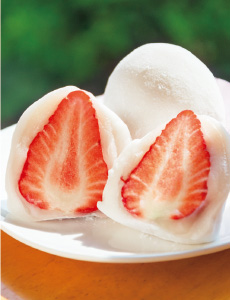
Ichigo daifuku: a glutinous rice cake (mochi) wrapped around sweet red bean paste and a whole fresh strawberry. The strawberry’s acid cuts the sweetness of the bean paste and the rice; when fresh, the texture combination is genuinely good. Many ichigo-gari farms now run small reception cafes selling daifuku made with that morning’s pick. Tokyo’s wagashi shops produce them seasonally; Aoyama’s Toraya has a daifuku-equivalent nama-gashi through January and February that’s worth the queue.
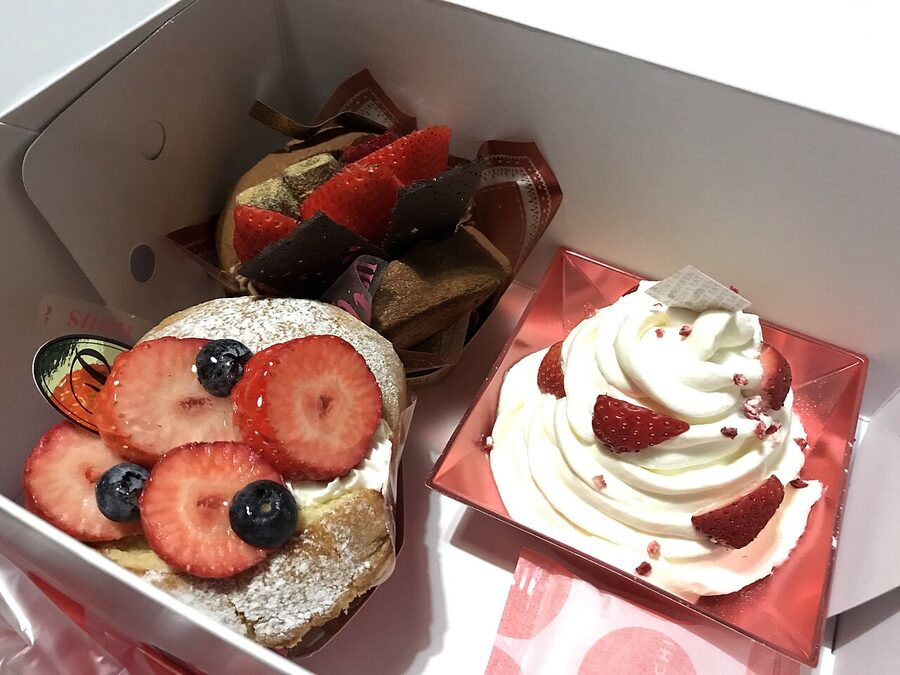
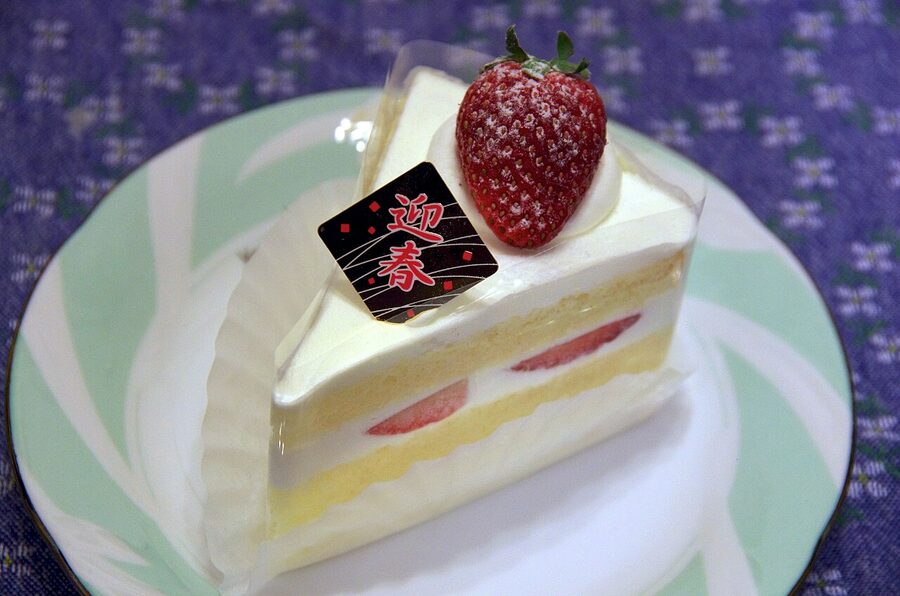
Strawberry shortcake: not the same dessert as the American shortcake. The Japanese version is a sponge cake layered with whipped cream and fresh strawberries; the cake should be light, the cream should be unsweetened, the strawberries should be the day’s. Patisseries across Tokyo, Kyoto, and Osaka make the case in February and March; Henri Charpentier and Lavenue do reliably good versions.
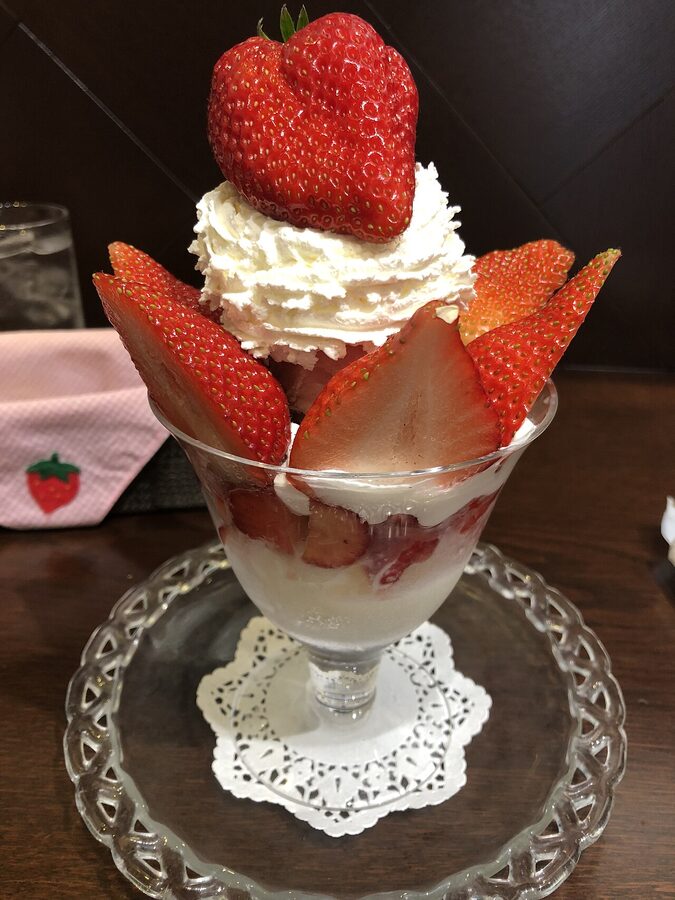
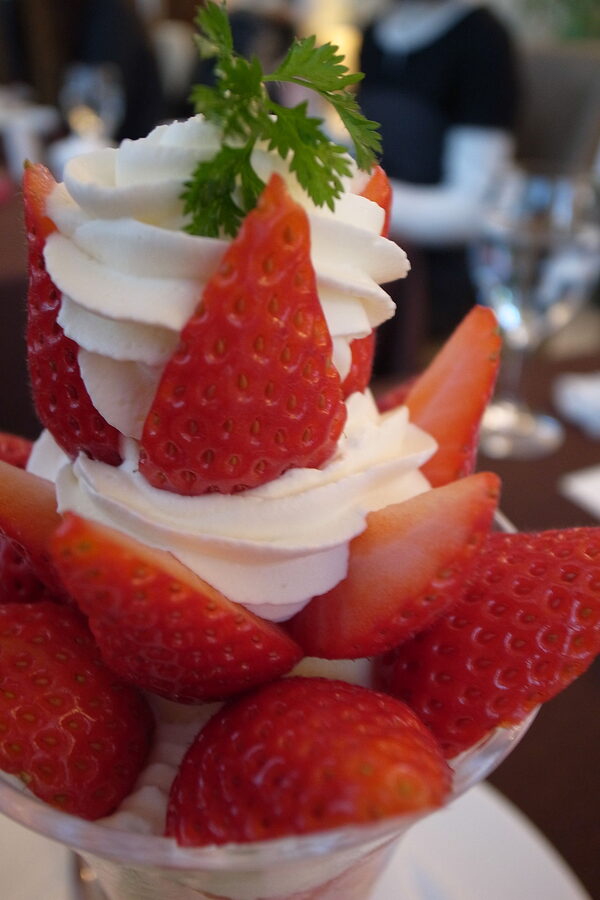
Strawberry parfait: stacked layers of cream, sponge, ice cream, jelly, and fresh fruit, served in a tall glass. A Japanese cafe staple that hits its peak in strawberry season. Prices run ¥1,200–2,500 in central Tokyo; the cafe Berry’s Cafe in Ginza puts together a notable one between February and April.
Strawberry sandwich (furuutsu sando): slices of bread, whipped cream, halved strawberries. A Japanese cafe culture export of recent years. The Amaou versions at Fukuoka cafes are the gold standard; Daiwa Super in Hakata makes a good one.
One last thing about the cultivar conversation
The conversation that comes up at most farms once you’ve eaten a few berries goes something like: which one is best? The answer changes by region (Tochigi farms will defend Tochiaika; Fukuoka farms will defend Amaou; Shizuoka farms will defend Beni Hoppe) and changes by year (Skyberry was the consensus pick about ten years ago; Tochiaika is taking that crown now). The honest answer is none of them are categorically best. They’re different fruits with different sweetness-to-acid balances and different sizes and different textures. The reason you’re at ichigo-gari is to taste them against each other and form your own view.
I’ll tell you mine: Tochiaika at peak ripeness, picked off the plant warm at about 11:00 in February at a Tochigi farm, no condensed milk, is the best strawberry I’ve eaten in any country, and the supermarket version of it isn’t even close. Your mileage may vary, which is the point. That’s the case for going.
.jpg)
.jpg)
_Strawberry_(4291003170).jpg)
.jpg)
.jpg)
.jpg)


.jpg)

.jpg)
.jpg)

.jpg)
.jpg)

.jpg)
.jpg)
.jpg)