
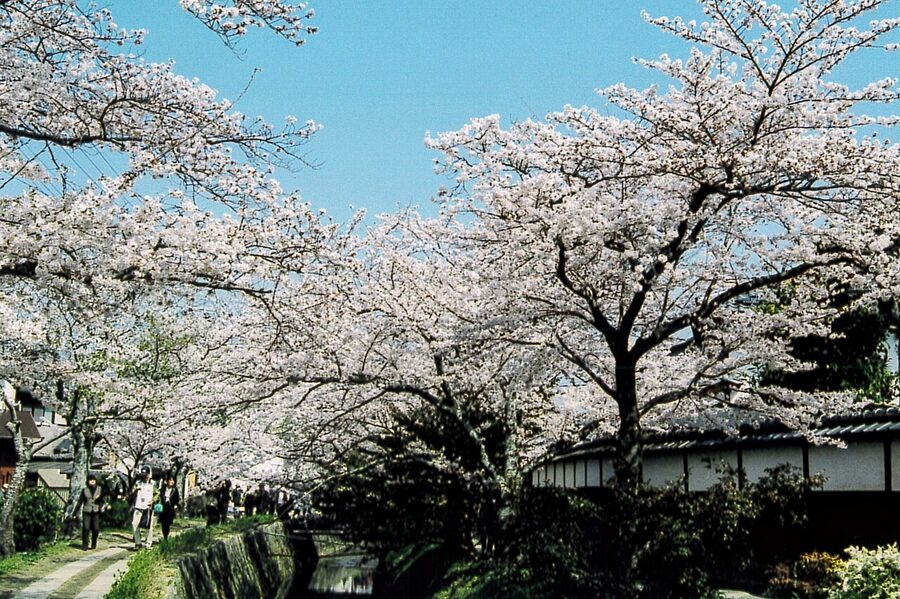
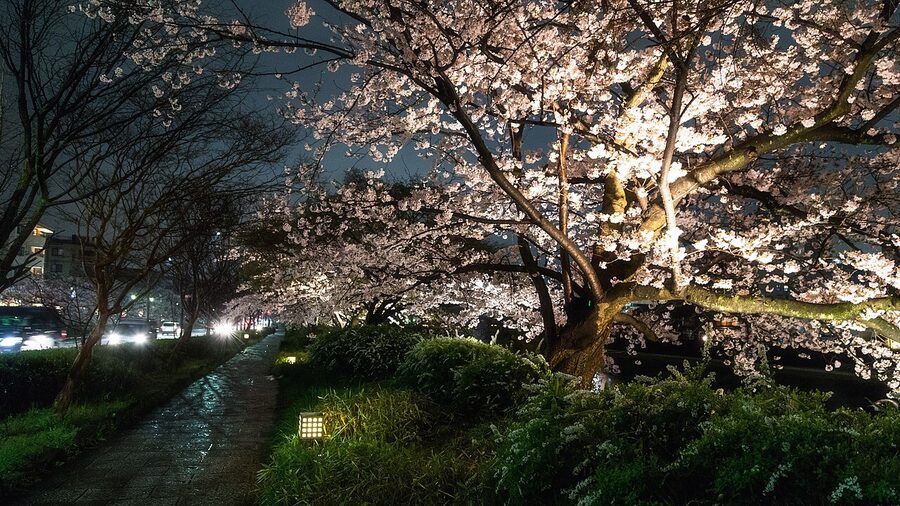
The first thing you hear at six in the morning, walking up the canal at Tetsugaku-no-Michi, is your own footsteps. Then water. Then, eventually, a bicycle bell. The petals are already coming down by the cupful, white in the gutter, white on the wet stone, white on the shoulder of a man stopped to retie his shoe. By eight there will be a coach park’s worth of people on this same stretch of canal, the air thick with phone-camera shutter sounds. By nine you won’t recognise the place. But for these ninety minutes, you have one of the most photographed paths in Japan to yourself, and the only sound is the canal and the petals dropping into it.
Kyoto’s cherry blossom map is not Tokyo’s. Tokyo is parks and rivers; Kyoto is temples, shrines, canals and one specific weeping cherry tree in one specific park that everyone in the country knows by sight. Almost every great viewing spot here pairs the trees with a roof, a torii, a gate, or a pond reflection. That’s the city’s particular gift in early April, and it is also the reason the crowds get so dense: every spot is also a cultural site, so every spot is on every itinerary, and every itinerary is happening on the same week.
This is a planner’s article, not a photographer’s poem. Twelve named spots, the bloom timing for each one (with a note on which are the late bloomers and worth saving for if you arrive after the main wave is gone), and a way of grouping them by district so you can spend a day in one part of the city instead of zigzagging across Kyoto on a bus that’s stuck behind another bus. I’ve walked all of these spots, several of them in different bloom years, and the timing notes come from the City of Kyoto’s official calendar plus what I’ve actually seen on the ground.
In This Article
- The shape of cherry blossom in Kyoto
- Kyoto’s bloom calendar, week by week
- The twelve spots
- 1. Maruyama Park (Maruyama-koen)
- 2. Path of Philosophy (Tetsugaku-no-Michi)
- 3. Kiyomizu-dera
- 4. Gion Shirakawa (Shimbashi)
- 5. Heian Shrine
- 6. Keage Incline and Okazaki Canal
- 7. Nijo Castle
- 8. Hirano Shrine
- 9. Ninna-ji and the Omuro cherries
- 10. Daigo-ji
- 11. Arashiyama and the Togetsukyo Bridge
- 12. Yodo Suiro (and one alternative)
- Beyond the twelve, plus a few honourable mentions
- How to plan a single day, by district
- Practical: getting around, food, where to stay
- What to do if you miss the peak
- One last thing
The shape of cherry blossom in Kyoto
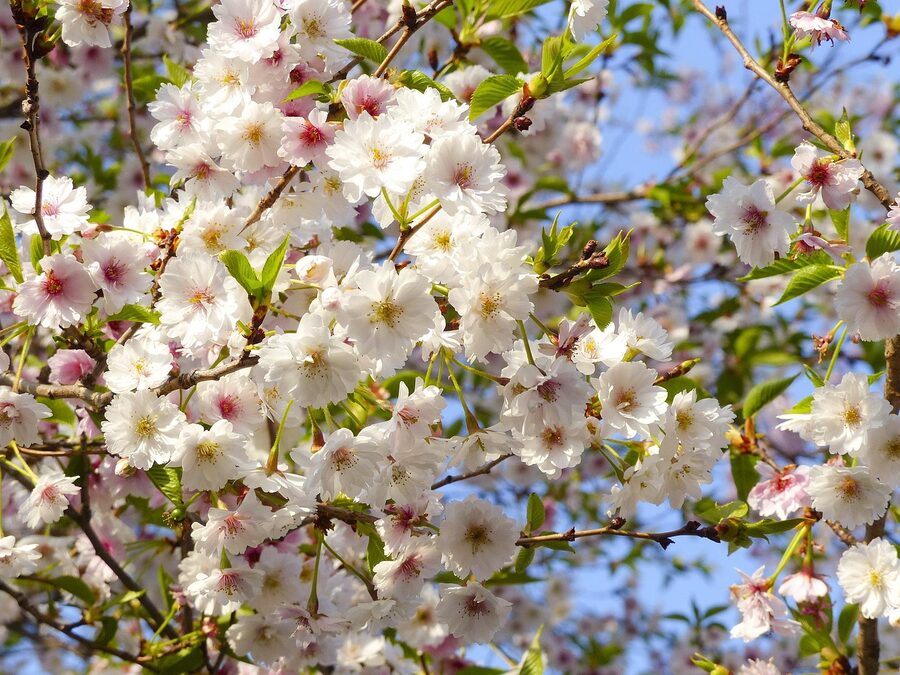
The mainstream variety, the one the forecasts track and the one that does the iconic single-week explosion, is someiyoshino. Kyoto’s average first-bloom date for somei yoshino is 26 March; average full bloom is 4 April; the petals usually fall over by about 12 April. So the safe-bet window is 28 March to 8 April. In a warm spring, all of that shifts forward four or five days, which is why 2026’s forecast calls for a 23 March opening and a 1 April peak. In a cold spring, it slides four or five days the other way.
What that average misses is two things. First, weeping cherries (shidare-zakura) and yae-zakura come into their own a few days earlier or later, depending on the variety. Second, certain spots in Kyoto specifically blossom late on purpose, by virtue of the cherries planted there. Two stand out:
- Ninna-ji’s Omuro cherries are the late ones. They typically open about a week after the city’s somei yoshino, and the late variants run into mid April, sometimes the third week. If you’ve arrived in Kyoto after the headlines say “blossoms are over”, Ninna-ji is the answer.
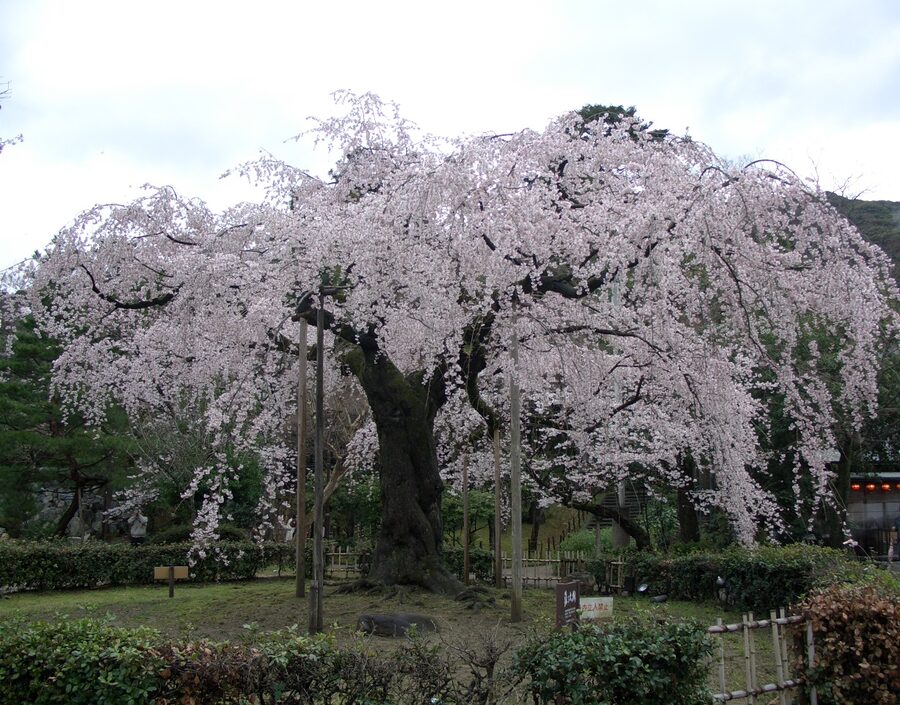
- Heian Shrine’s red-shidare peaks in mid April, four or five days after the somei yoshino crash, and is what Tanizaki wrote about in The Makioka Sisters. It’s a back-half-of-the-window spot.
And one variety in the other direction: the kawazu-zakura at Yodo Suiro, in suburban Fushimi, are early bloomers. Mid February to late March is their window. If you can only come in March, before the city wakes up, these are your fallback.
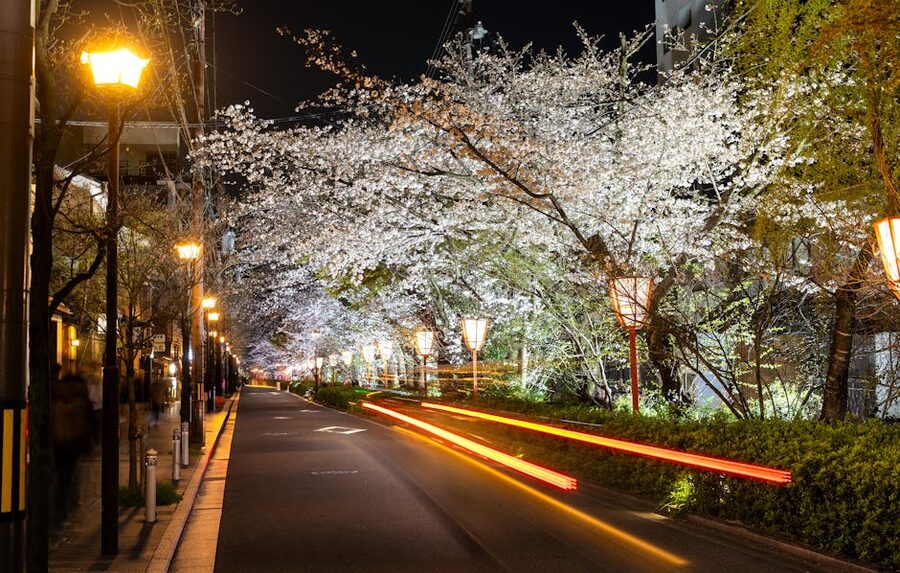
Beyond that, your enemy is not the bloom, it’s the crowd. Kyoto receives a documented surge of inbound visitors in cherry blossom season, and the popular spots reach unpleasant density by 10:00. Two ways out of that: get up very early, or save your visit for after dinner. Several spots run evening illuminations until 21:00 or 22:00 and the crowd halves once the buses leave.
Kyoto’s bloom calendar, week by week
A working timeline for an average year:
- Mid February to late March: Yodo Suiro kawazu-zakura. Quiet, suburban, an early-spring detour rather than a destination.
- Around 26 March: Somei yoshino first bloom in central Kyoto. Trees start showing pink along the Kamogawa and at Maruyama Park.
- 28 March to 4 April: Full bloom builds across the city. Maruyama Park, Path of Philosophy, Kiyomizu-dera, Kamogawa, Nijo Castle, Arashiyama all peak together.
- 4 to 8 April: Peak of the peak. Petals on the ground, hanami parties everywhere, accommodation tight, illuminations running. Best week of the year if you’re set up for it.
- 8 to 14 April: Somei yoshino past peak, but Heian Shrine’s shidare and Hirano Shrine’s later varieties are still going strong.
- 10 to 20 April: Ninna-ji Omuro cherries do their own thing. The whole calendar resets for one temple.
The official 2026 forecast (Japan Meteorological Corporation, January release) puts Kyoto’s first bloom at 23 March and full bloom at 1 April, three or four days earlier than average. By mid March, the City of Kyoto runs a daily updated calendar that maps actual bloom progress against each major site. Use that calendar in the week before you arrive, not the January forecasts; it’s the most accurate signal you’ll find.
The twelve spots
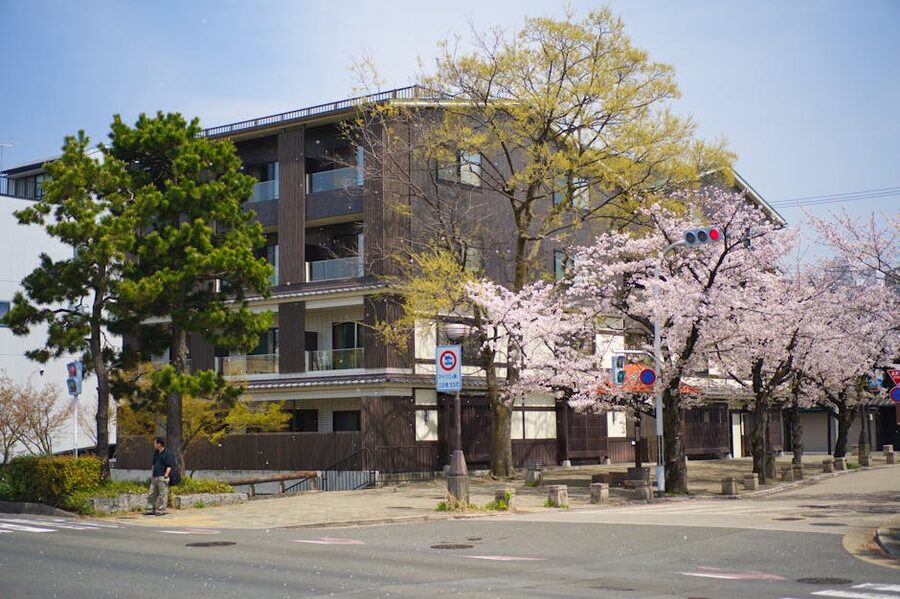
I’ve grouped these by district because that is the only sensible way to plan a Kyoto sakura day. The buses will not save you in the first week of April, the taxis are scarce, and you will spend half your time walking. Better to walk well within one cluster than waste two hours on the route 100 bus to Arashiyama at full pelt.
1. Maruyama Park (Maruyama-koen)
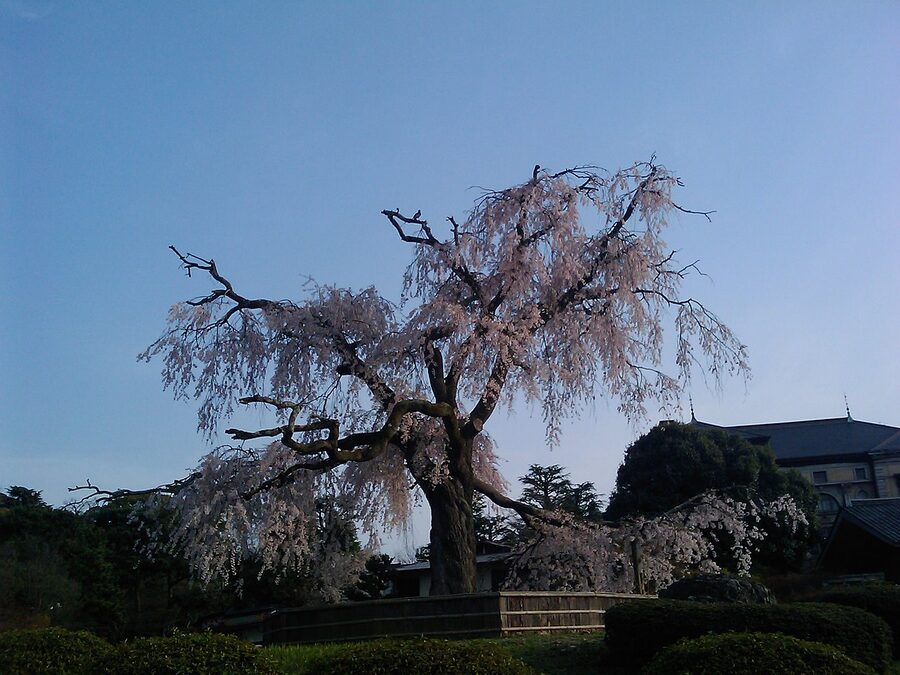
District: Higashiyama, next to Yasaka Shrine. Average peak: early April. Cost: free. Illumination: sunset to 22:00 during the blossom period (the 2026 dates run 24 March to 8 April).
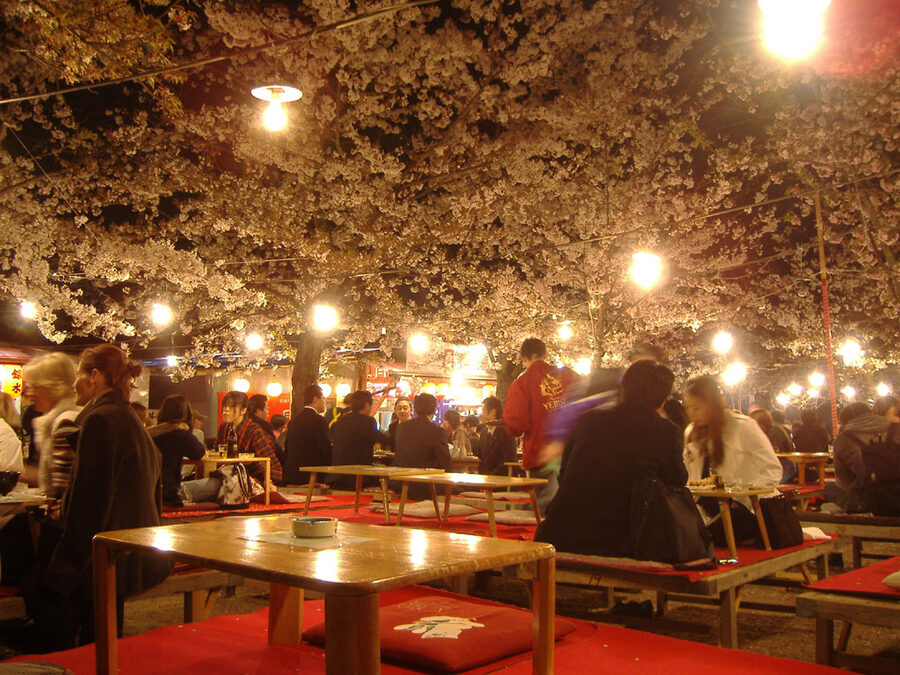
Every Kyoto cherry blossom article eventually returns to one tree, the Gion shidarezakura in the centre of Maruyama Park, and so will yours. It’s a single weeping cherry, its branches arching over a circular space ringed by low food stalls, and after dark it gets uplit from below in a way that makes the whole tree glow against the black sky. The current tree is the second generation; the original from 1872 died in the 1940s and the one you’ll see was planted in 1949 from a graft. It’s now nearly eighty years old itself.
The park around the tree fills with hanami parties: blue tarpaulins, beer crates from the convenience stores, food from the temporary stalls (yakisoba, takoyaki, kushiyaki, sakura mochi). The atmosphere on a Saturday evening at peak is festival-loud and feels nothing like the Kyoto-of-the-postcards. That’s part of its appeal. If you want quiet sakura with a temple roofline, this is not the place; if you want to see a Japanese city actually celebrating its national flower with a beer in its hand, this absolutely is.
How to get there: 8 minutes’ walk east of Gion-Shijo Station on the Keihan Line. Or 12 minutes’ walk south from Higashiyama Station on the Tozai Subway Line. Bus 100 or 206 to Gion stops just outside the park entrance.
My take: go after dark. The lit tree at 20:00 is more dramatic than the same tree in midday haze, and the crowd is loud rather than dense. Combine with a walk through Gion’s lanes on the way back to your hotel.
2. Path of Philosophy (Tetsugaku-no-Michi)
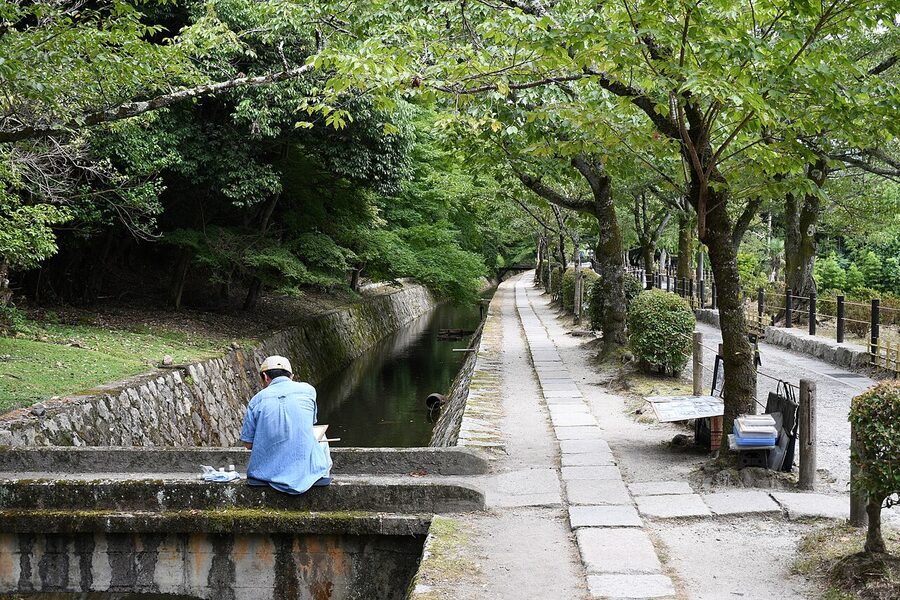
District: Northern Higashiyama, between Ginkaku-ji and Nanzen-ji. Average peak: early April. Cost: free. Length: roughly 2 km, walkable end to end in 30 minutes if you don’t stop, an hour if you do.
The Path of Philosophy is named after Nishida Kitaro, a Kyoto University philosophy professor who walked it daily in the 1910s and 1920s. It follows a small canal at the foot of the eastern hills, lined for almost its entire length with cherry trees that lean out over the water. At full bloom the canopy completely closes overhead and the canal turns pink with fallen petals.
It is one of Kyoto’s most photographed walks, which means by 09:30 in early April it has become a slow-moving queue. The fix is the same fix that works at every Kyoto sakura spot: be there at 06:30. The temples (Ginkaku-ji at the north end, Honen-in slightly south, Nanzen-ji at the southern end) don’t open until 08:30 or 09:00, but the path itself is open all the time. Walk it before breakfast.
How to get there: Bus 5, 17 or 100 to Ginkaku-ji-michi for the northern end, or to Eikando-michi / Nanzenji-michi for the south. Walking is the better option from anywhere in northern Higashiyama: 25 minutes uphill from Sanjo Station.
What I’d skip: the cafes along the path itself charge a peak-season premium and the queues are long. Eat before you come, walk the path, then descend to one of the proper kissaten in Okazaki for coffee.
If Tokyo is also on your itinerary, the canal-walk pattern is the equivalent of Meguro River, covered in the Tokyo viewing map: same idea, different scale, different trees.
3. Kiyomizu-dera
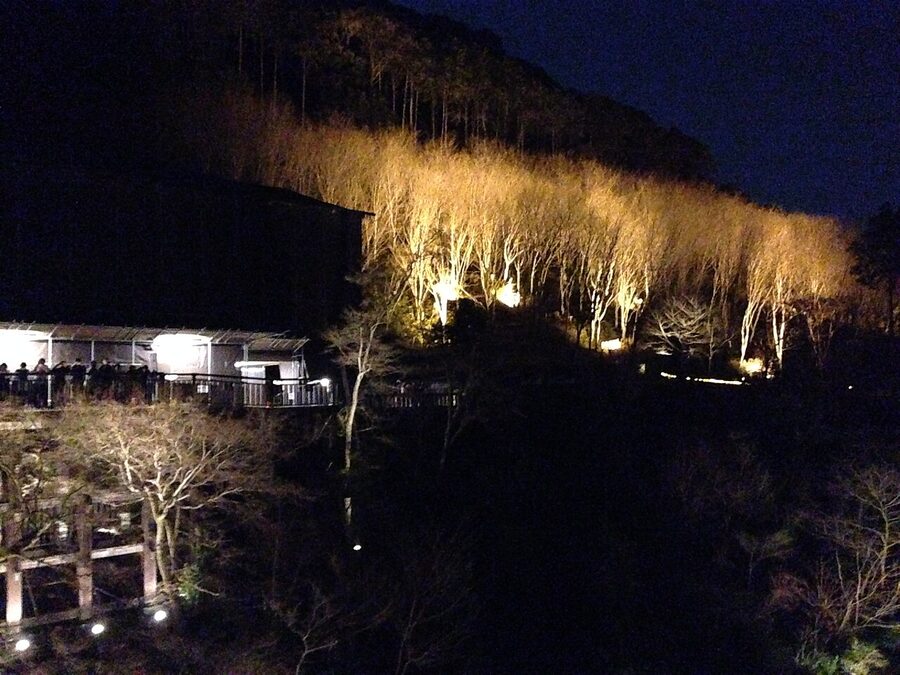
District: Higashiyama. Average peak: early April. Hours: 06:00 to 18:00 daily, plus the spring evening admission. Admission: ¥500. 2026 illumination: 27 March to 5 April, evening session 18:00–21:30, last entry 21:00.
Kiyomizu-dera’s main hall hangs out over a slope densely planted with cherries, and the standard photograph is taken from the Okuno-in observation deck looking back at the wooden balcony framed in pink. In the daytime the place is at its most overrun in the entire city: the approach roads (Sannenzaka, Ninenzaka) are packed shoulder to shoulder, and you’ll wait for everything.
The smart play is the evening light-up. The temple specifically opens for cherry blossom season after the regular daytime closing, the lighting picks out individual trees, and a blue searchlight beam shoots into the night sky from the temple grounds (visible across half the city). Crowd levels are still high but the light at 19:30 is something the daytime simply doesn’t have.
How to get there: Bus 100 or 206 to Kiyomizu-michi (closest stop), then 10 minutes uphill on foot through the souvenir streets. Or 20 minutes’ walk from Kiyomizu-Gojo Station on the Keihan Line, the same uphill push but starting from sea level.
Honest verdict: the temple is rightly on every list, but in the daytime in cherry blossom week it becomes a queue. Either come at 06:00 (it really does open that early, and you will have the slope mostly to yourself for half an hour) or come at 18:00 for the illumination. The mid-day visit is the worst of all options.
4. Gion Shirakawa (Shimbashi)
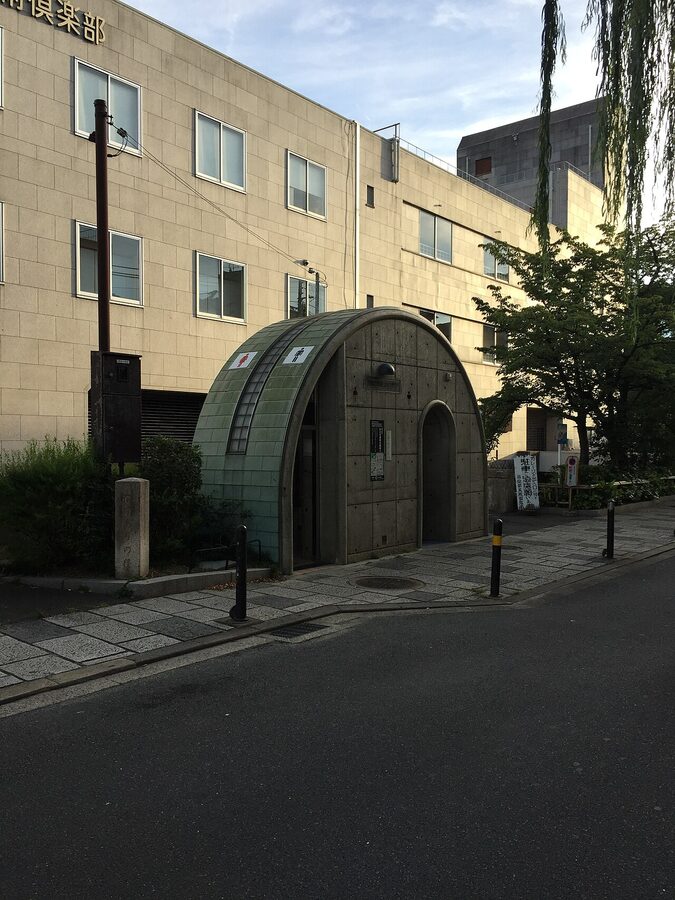
District: Gion, central Kyoto. Average peak: late March to early April. Cost: free. Illumination: the trees on the Shirakawa side are floodlit until about 22:00 during peak season.
This is the most famous block of street in Gion, and one travel guide once called it the most beautiful in Asia. It runs along the Shirakawa canal on the north side of Gion, with a row of machiya teahouses on one side, the canal and a row of cherry trees on the other. At peak it’s a three-hundred-metre tunnel of pink with old wooden facades behind, and the small Tatsumi Bridge near the eastern end is a photo postcard in its own right.
Most people walk it. Few people sit. There’s a low stone wall along the canal that’s perfectly designed to sit on and watch petals come down onto the water; the locals know this and use it. The block is short enough that the crush eases by simply walking ten minutes past it into the rest of Gion.
How to get there: 5 minutes’ walk east of Gion-Shijo Station on the Keihan Line. Sandwich it between dinner in central Gion and the walk south to Maruyama Park; the two sit a quarter of an hour apart.
What to watch out for: Gion’s geisha district has photography rules now. The signage about not photographing geisha applies on the side streets, not on Shirakawa-dori itself, but be sensible if you do see a geiko or maiko in the lanes off it.
5. Heian Shrine
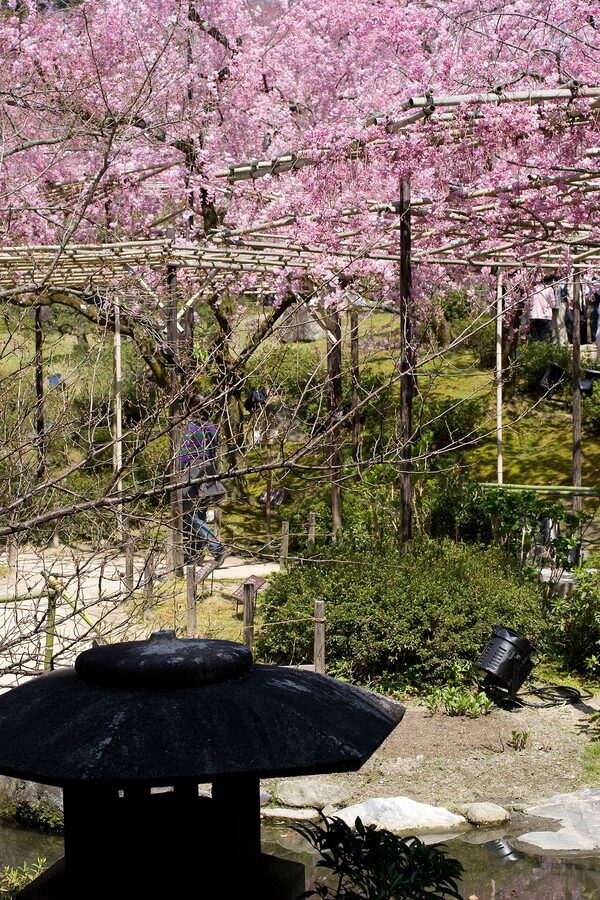
District: Okazaki, central-east. Average peak: early to mid April (red shidare peaks a few days after somei yoshino). Hours: garden 08:30–18:00 (until 17:30 before 15 March). Admission: garden ¥600.
Heian Shrine isn’t the headline cherry blossom destination, but the garden behind the main hall, the Heian Jingu Shin’en, is the city’s best rescue plan when you’ve timed the trip badly. The garden’s signature is the yae-beni-shidare, dense pink double-petalled weeping cherries that bloom a few days behind the rest of Kyoto. If everything else has gone over, Heian’s garden is still in full pink for another four or five days.
The garden itself is a stroll garden built around a series of ponds, with stepping-stone bridges (hashimoto) and a Meiji-era covered bridge over the largest pond. The best photograph is from the bridge itself, looking back at a wall of red shidare reflected in the water.
The Beni Shidare Concert runs in the garden one evening in early April, with classical and Japanese instruments performing under the lit blossom. Tickets sell in advance and the event is unique to this shrine; check the official site for the year’s date.
How to get there: 10 minutes’ walk north of Higashiyama Station on the Tozai Subway Line. Or bus 5, 100 or 110 to Okazaki-koen, Bijutsukan, Heian Jingu-mae.
6. Keage Incline and Okazaki Canal
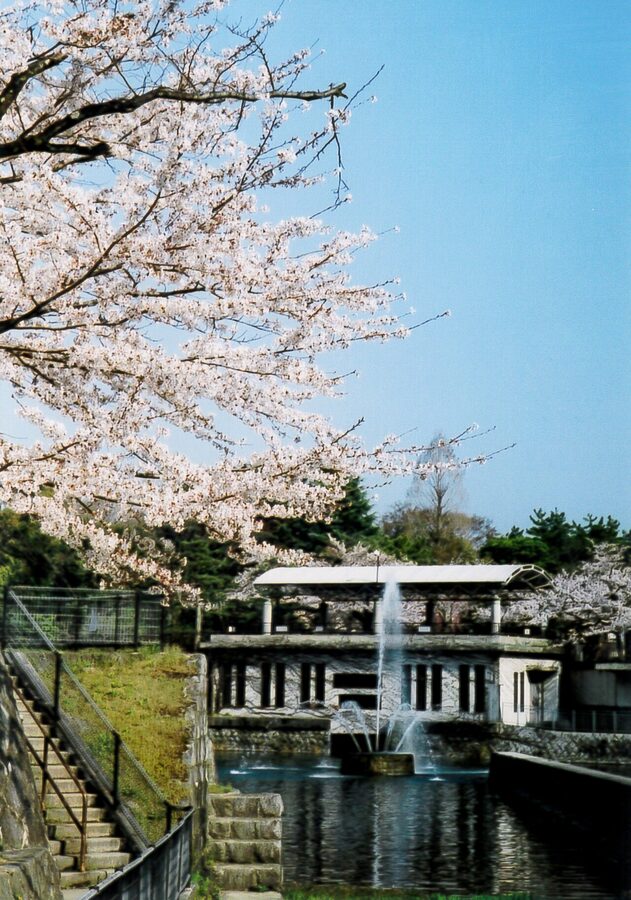
District: Okazaki / Higashiyama. Average peak: early April. Cost: free.
The Keage Incline is the best of Kyoto’s “found” cherry blossom spots: an abandoned boat-transport railway built in the 1890s to lift canal boats over the Higashiyama hills, lined now with about ninety cherry trees that have grown in the gaps between sleepers. You walk up the rails between the trees. There is no admission, no formal entry; you just walk on at the bottom.
The Okazaki Canal sits directly below it and runs through to the great red torii outside Heian Shrine. There’s a 25-minute boat tour that runs through the canal during the bloom (the jikkokubune cruise), departing every 20 minutes from 09:30. It’s ¥2,000 and gives you the canal at water level under a tunnel of cherries.
The combination, walking the incline downhill to the canal, then either taking the boat or walking the canal path back to Heian Shrine, is the best self-contained cherry blossom hour I know in central Kyoto.
How to get there: 2 minutes’ walk from Keage Station on the Tozai Subway Line. The bottom of the incline drops you essentially at the gates of Nanzen-ji, which means you can extend the walk into Nanzen-ji’s grounds and from there onto the southern end of the Path of Philosophy.
7. Nijo Castle
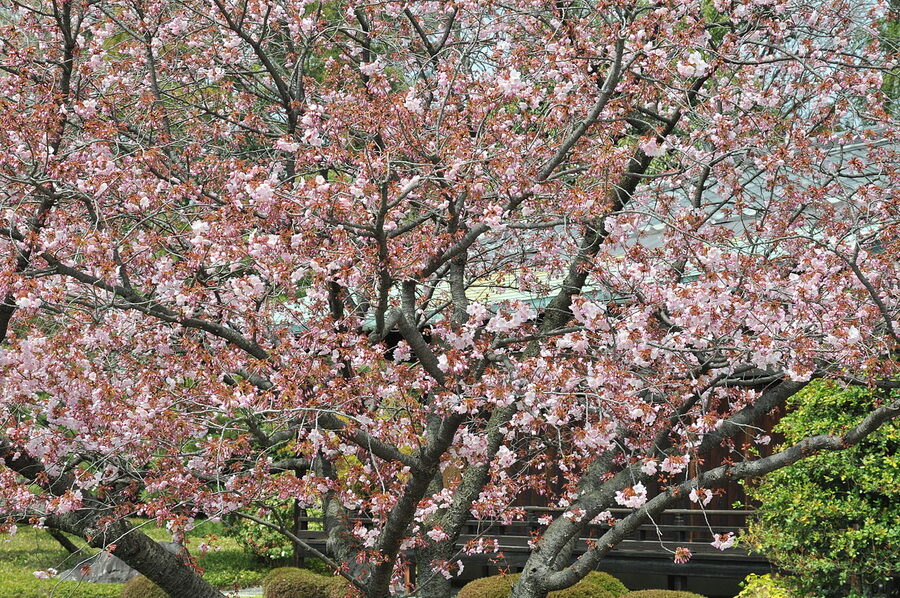
District: Central Kyoto. Average peak: late March to mid April (depending on variety). Hours: 08:45–17:00. Admission: ¥800. 2026 illumination: 19 March to 19 April, 18:00–22:00 (entry until 21:00), ¥2,400 to ¥3,200 depending on date and how you book; advance online tickets are cheaper.
Nijo Castle is the former Kyoto residence of the Tokugawa shoguns and now a UNESCO site. The grounds hold roughly 300 cherry trees of about fifty varieties, which means there’s almost always something blooming somewhere from late March through to mid April, but it also means the trees aren’t synchronised. You won’t get a wall of pink, you’ll get pockets of it.
Where Nijo earns its keep is the evening illumination, run as a separate ticketed event called Naked Flowers: a projection-mapped walk through the castle gardens with the trees as the canvas. It’s polished, theatrical, and not subtle. Some Kyoto regulars hate it; some love it; almost everyone agrees it’s worth seeing once.
How to get there: Nijojo-mae Station on the Tozai Subway Line is at the gates. Bus 9, 12, 50 or 101 to Nijojo-mae stops there too.
8. Hirano Shrine
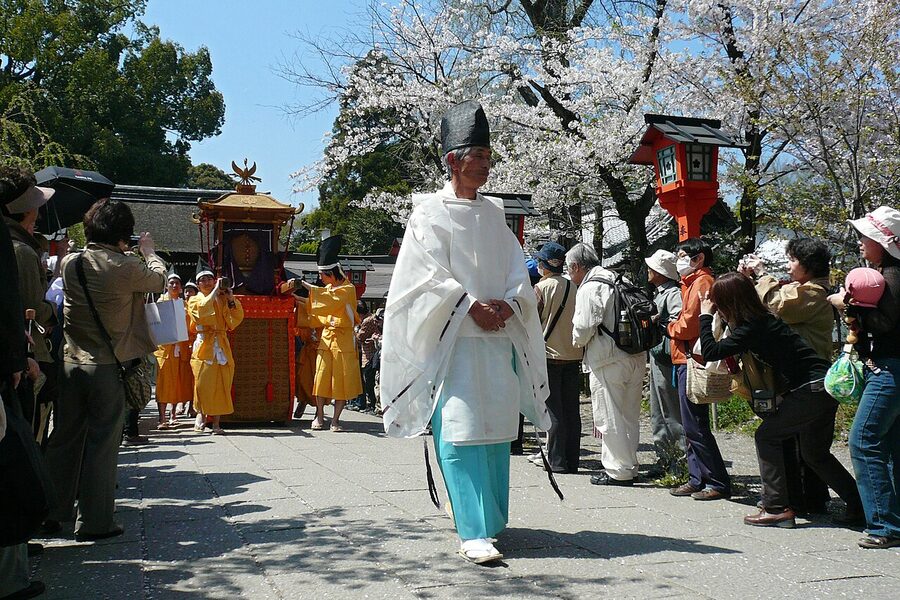
District: Northwest Kyoto, between Kinkaku-ji and Kitano Tenmangu. Average peak: mid March (early variety, “Sakigake-zakura”) through mid to late April (yae-zakura). Cost: free. Illumination: until 21:00 during peak.
Hirano Shrine has been linked with cherry trees since the early Heian period, supposedly when the trees were brought from the Yoshino mountains during the city’s founding. The shrine grows about 60 different varieties across roughly 400 trees. The first to bloom each year is the Sakigake-zakura (“herald of cherries”), which opens in mid March, weeks before everywhere else. The latest variety blooms into late April.
This is Kyoto’s most reliable cherry blossom shrine for visitors arriving outside the average window. It also runs old-school evening illuminations: simple paper lanterns in the trees rather than projection-mapped LED arrays, which means it feels like a Showa-era spring festival rather than an Instagram event.
How to get there: Bus 50 or 205 to Kinugasa-koen-mae, then 5 minutes east on foot. Combine with Kinkaku-ji (the Golden Pavilion, 10 minutes’ walk north) for a half-day in the northwest.
9. Ninna-ji and the Omuro cherries
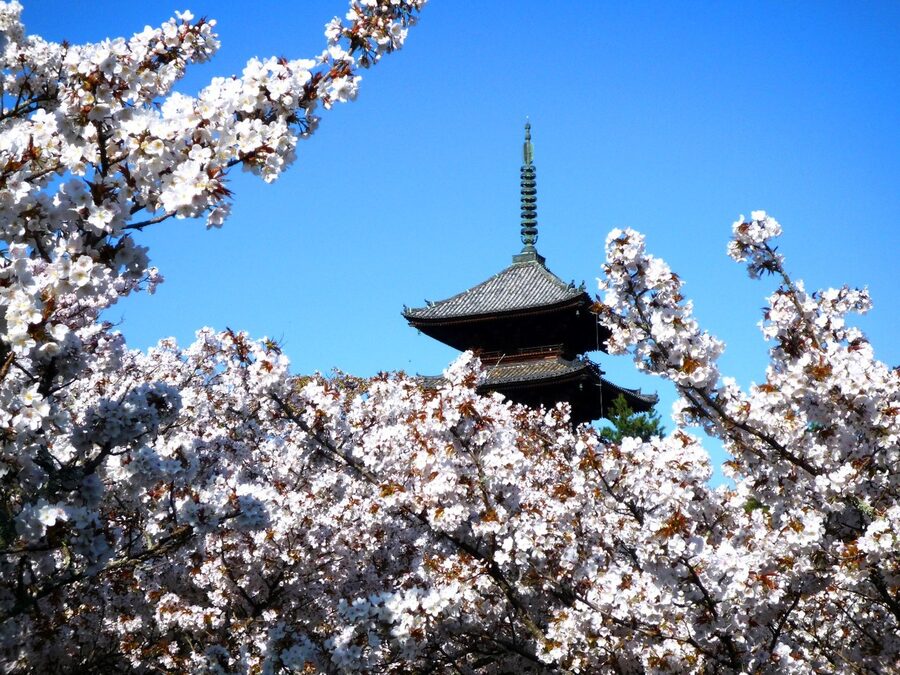
District: Northwest Kyoto. Average peak: early to mid April (one to two weeks after somei yoshino). Hours: 09:00–17:30 (last entry 17:00). Admission: ¥800; ¥1,400 during the cherry blossom period (27 March to 6 May 2026), which includes palace buildings.
The Omuro cherry trees at Ninna-ji are short. That’s the whole point. They top out at about 2.5 metres, which means you walk among them with the branches at eye level and your face inside the canopy. The grove of about 200 trees sits to the west of the temple’s main hall, with the five-storied pagoda visible above and behind. There is no other temple cherry experience like it in Japan.
What matters about Ninna-ji is the timing. Omuro cherries are a late-blooming variety. They open about a week to ten days after the city’s somei yoshino, which means in an average year they peak around 8 to 14 April. If you arrive on 8 April expecting Maruyama and the Path of Philosophy at peak, you’ll find petals on the ground, but you can pivot to Ninna-ji and still see full bloom. In a warm year (like 2026’s forecast), they peak slightly earlier, but the gap is preserved.
How to get there: Omuro Ninnaji Station on the Keifuku Kitano Line is at the gates. Or bus 26 from Kyoto Station to Omuro Ninnaji-mae.
Honest verdict: if you have only one day in Kyoto in the second week of April, go to Ninna-ji. If you have one day in the first week, save it for the second-tier spots and you can reach the Omuro grove later if your trip extends.
10. Daigo-ji
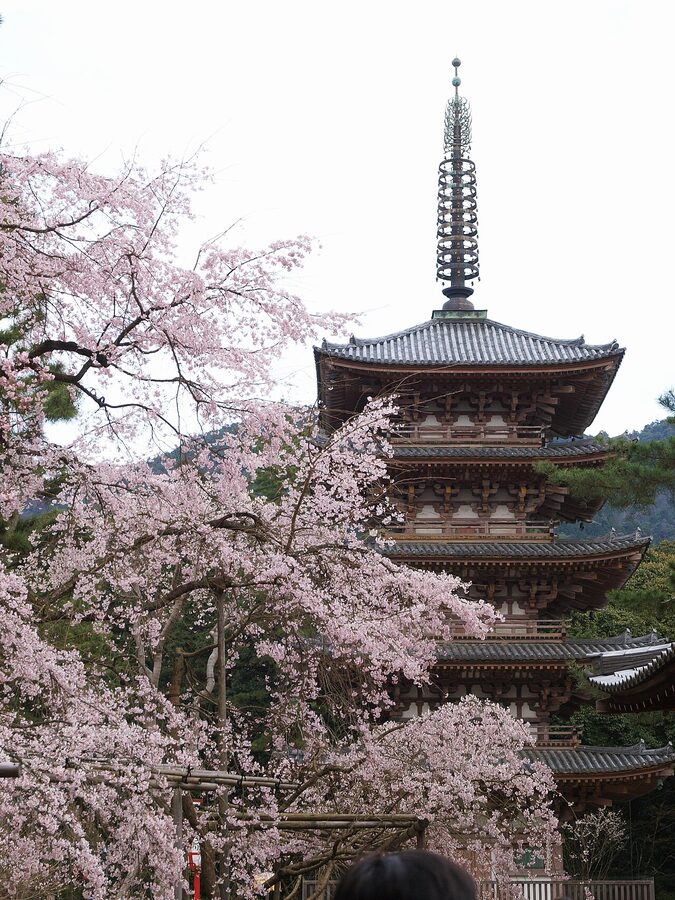
District: Yamashina, southeast Kyoto. Average peak: late March to early April (Sanboin), early to mid April (upper temple). Hours: 09:00–17:00. Admission: ¥1,500 (combined ticket for Sanboin, Reihokan and Garan).
Daigo-ji is where Toyotomi Hideyoshi held a famously huge hanami party in spring 1598, with about 1,300 invited guests, just months before he died. The temple commemorates this with an annual procession in early April. More importantly for a traveller, it’s a genuine mountain temple. The lower complex (Sanboin and Reihokan) is in the foothills; the upper temple (Kami-Daigo) requires a one-hour uphill hike through cedars and is at a different elevation. The bloom timing reflects this: lower temple peaks at the same time as central Kyoto, upper temple often a few days later.
The signature image is the temple’s five-storied pagoda, the oldest building in Kyoto (constructed in 951), framed by cherries on the approach path. The pond in front of Sanboin holds the temple’s most famous weeping cherry, the Taiko-zakura, named after Hideyoshi’s hanami.
Daigo-ji’s distance from central Kyoto is what keeps it less crushed than the Higashiyama spots. It’s also why it’s worth the half-day commitment.
How to get there: Daigo Station on the Tozai Subway Line, then 15 minutes’ walk east. Allow at least three hours on the ground (more if you climb to the upper temple).
11. Arashiyama and the Togetsukyo Bridge
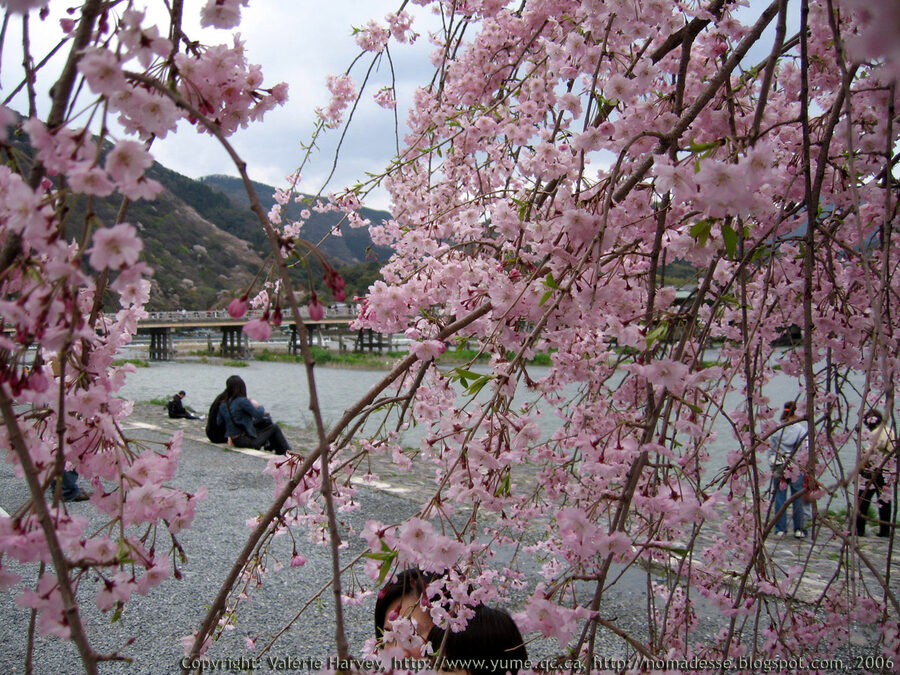
District: West Kyoto, about 8 km out of central. Average peak: late March to early April (mountain trees a few days later). Cost: the area is free; individual temples (Tenryu-ji, Daikaku-ji) charge ¥500 to ¥800.
Arashiyama is the only one of the twelve spots that’s a destination in its own right and not a temple-and-blossom photograph. The classic shot is the Togetsukyo (the “moon-crossing bridge”) with cherry trees on the riverbank in the foreground and the cherry-and-mountain-cherry covered hills of Arashiyama as the backdrop. The Hozugawa river runs underneath; rowboats and small flat-bottomed sightseeing craft go up and downstream.
Two named temples in the area carry the cherry blossom too. Tenryu-ji, the area’s main Zen temple, has cherries throughout its garden grounds and a small grove behind the main hall. Daikaku-ji, fifteen minutes’ walk further out, has Osawa Pond, which is ringed with old cherries and was the site of Heian-period imperial moon-viewing parties. Daikaku-ji is the quieter of the two and worth the walk if you have an hour in hand.
How to get there: Saga-Arashiyama Station on the JR Sagano Line (16 minutes from Kyoto Station, ¥240) is the closest mainline. Hankyu Arashiyama Station puts you on the south side of the bridge. The Randen tram from Shijo-Omiya in central Kyoto is the slowest but most picturesque option, ending at Arashiyama Station with its sake-bottle lantern courtyard.
12. Yodo Suiro (and one alternative)
District: Fushimi, southern Kyoto. Peak: mid February to late March (kawazu-zakura, an early variety). Cost: free.
The twelfth spot depends on when you arrive. If you’re in Kyoto in March, before the somei yoshino has woken up, the kawazu-zakura along the Yodo Suiro canal in suburban Fushimi are blooming a full month earlier than the rest of the city. About 200 trees line a residential canal between two bridges. There are no temples, no shops, no English signs, just locals walking dogs and a school sometimes brought to the canal on a field trip. It’s the antidote to the central Kyoto crush.
If your trip is later (mid-April or beyond, after even Ninna-ji has dropped), the alternative twelfth spot is Haradani-en in the hills above Kinkaku-ji. It’s a private garden that opens for cherry blossom season only, with about 400 weeping cherries laid out on terraces. Admission varies by bloom progress (up to ¥1,800), and the season opens around 23 March in 2026. Access is awkward (bus M1 from Kitaoji or a taxi from Kinkaku-ji), but the visit is worth it for the late shidare-zakura that the central temples don’t have.
How to get to Yodo Suiro: Yodo Station on the Keihan Main Line, then 10 minutes’ walk south. The canal is residential, so be quiet and don’t trespass.
Beyond the twelve, plus a few honourable mentions
Twelve named spots is a planning anchor; the bloom in Kyoto is much wider than that. Three more worth knowing about:
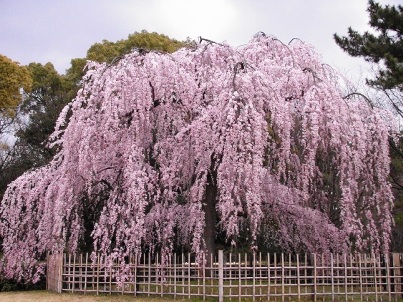
Kyoto Gyoen (Imperial Palace Park): the entire former Imperial enclosure, now a free public park covering 65 hectares in the centre of the city. The most photographed tree is a giant weeping cherry near the Konoe-tei site in the northwest of the park, but cherries are scattered throughout. The park is large enough that you can find a quiet bench under a single tree even at peak. Free, open all hours.
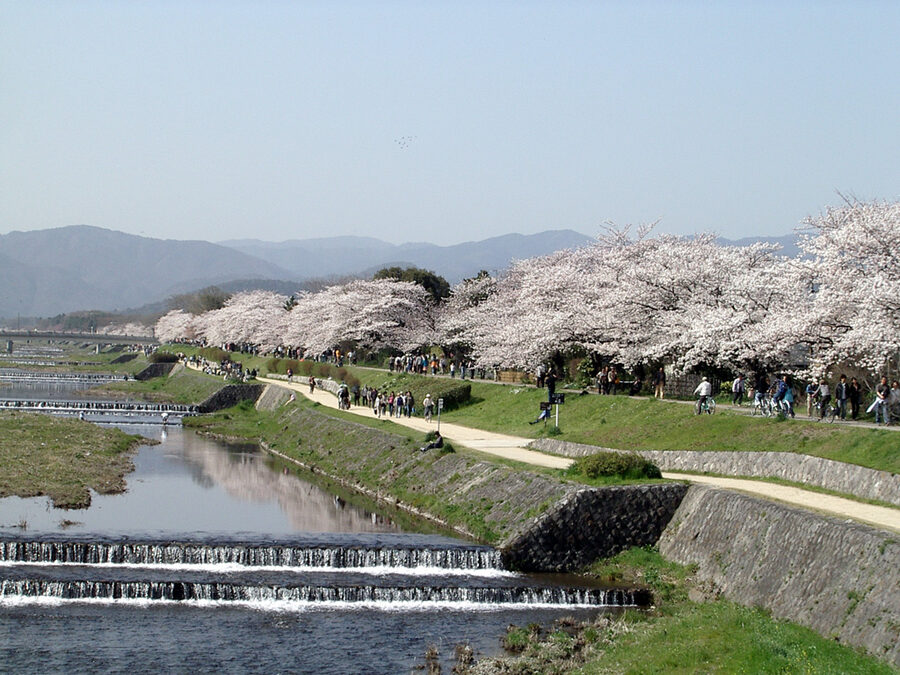
Kamogawa river: the city’s main river is lined with cherry trees for several kilometres, especially north of Imadegawa-dori where the trees are old and dense. The local pattern is to bring a folding chair, a beer from the convenience store, and a bento, and sit on the riverbank for an afternoon. South of Gojo-dori, the same trees often bloom four or five days earlier than the rest of the city, due to micro-climate; if you’ve arrived a touch too early elsewhere, the south Kamogawa is a useful checkpoint.
Hanno-no-michi (Half-wood road): a 700-metre pergola walk along the Kamo’s western bank, just north of the Kyoto Botanical Garden. Roughly 70 weeping cherries form a continuous arch along the path. It peaks slightly later than the somei yoshino, mid-April, and is much quieter than the famous spots.
How to plan a single day, by district
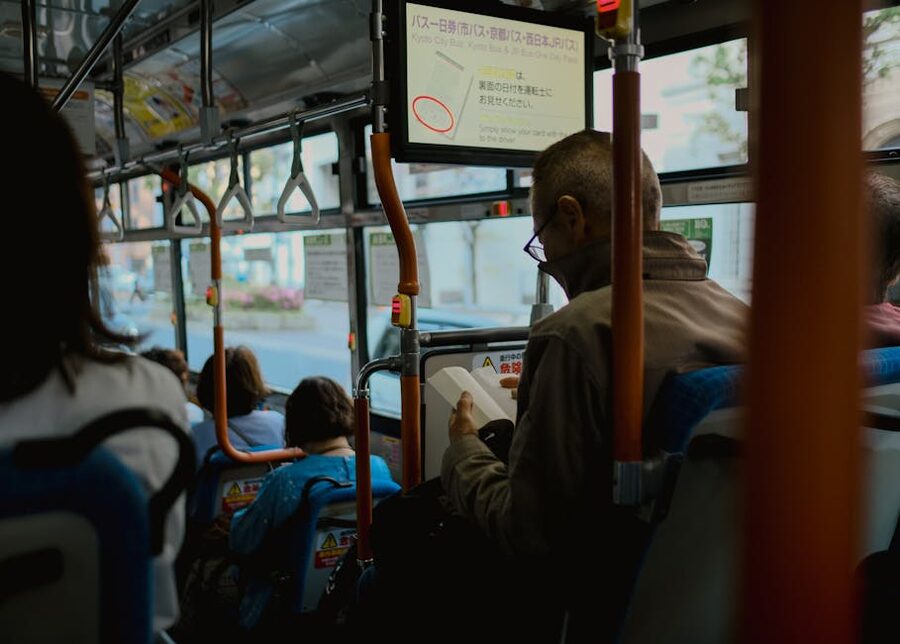
The single biggest mistake people make in Kyoto’s cherry blossom week is bouncing across the city. The bus network was already crowded before international tourism returned; in the first week of April it now grinds. Walk inside one cluster instead. Three sensible day-shapes:
Higashiyama day: Maruyama Park (open early, before crowds) → walk south through Gion → Gion Shirakawa → walk to Kiyomizu-dera (uphill via Yasaka Pagoda) → loop back via Sannenzaka and Ninenzaka → walk north to Heian Shrine → Okazaki Canal boat → Keage Incline → Path of Philosophy. That’s a long day and covers seven of the twelve spots without a single bus ride. Allow 09:00 to 19:00, then return to Maruyama for the evening illumination.
Northwest day: Kinkaku-ji (the Golden Pavilion) → Hirano Shrine → Ninna-ji and the Omuro grove → Ryoan-ji (in foliage rather than blossom, but worth the stop). Bus 59 connects Hirano to Ninna-ji and then Ryoan-ji, which is about all the bus you should need. Half a day if you don’t add Ryoan-ji.
Outer-temple day: Daigo-ji in the morning (allow three hours including the lower temple and a partial walk towards Kami-Daigo); back to Yamashina via the Tozai line; then Nijo Castle in the afternoon, with the evening Naked Flowers illumination. Or substitute Arashiyama for Nijo if you want a contrasting half-day, though combining Daigo-ji and Arashiyama in the same day is geographically painful.
If your trip pairs Kyoto with Tokyo, it’s worth deciding which city is doing what. Tokyo’s spots are more about parks (Yoyogi, Ueno, Inokashira), rivers (Meguro, Sumida), and one specific moat (Chidorigafuchi); Kyoto’s are temples, shrines, canals and one weeping tree. They are different aesthetics, both of them rewarding. The Tokyo viewing map covers that side of the trip.
Practical: getting around, food, where to stay
Buses vs subway vs walking. Kyoto has two subway lines (Karasuma north–south, Tozai east–west) and a dense surface bus network. The buses are slow and packed in cherry blossom week. The subway is fast but doesn’t reach Higashiyama directly. Walking is the answer most of the time inside the central districts. Average walking speed in cherry blossom week, on the popular streets, is genuinely slower than usual; allow 10 to 20 percent more time than Google Maps suggests.
Taxis exist but are scarce in the bloom week, especially around 09:00, 17:00 and after major illuminations end (around 21:30). If you’re catching a bullet train at a fixed time, leave 90 minutes for what should be a 30-minute taxi run. Or use a kakuyasu chiketto bus or the subway and accept the walk at the other end.
Convenience-store hanami is a real strategy. Restaurants in central Kyoto are wall-to-wall fully booked in cherry blossom week; the best Kyoto eateries take spring reservations months out. The local move is to walk into a 7-Eleven, a Lawson, or a FamilyMart, buy two onigiri, a hot bento, a can of beer or a small bottle of sake, and eat on a riverbank or in Maruyama Park. The food is cheap (¥500 to ¥1,000 a person), genuinely good, and the experience is the same one most Kyoto residents are having.
Where to stay. The central neighbourhoods I’d target are Gion / Higashiyama (closest to the most spots, machiya inns and small ryokan), Karasuma / Shijo (downtown, plenty of mid-range business hotels and walkable to Nijo Castle), or Kyoto Station (efficient if you’re using it as a base for day-trips to Daigo-ji or Nara). Book six to nine months ahead for the first ten days of April; a hotel or ryokan that costs ¥18,000 a night in February will price at ¥45,000 in cherry blossom week, and the cheaper rooms vanish first.
What to do if you miss the peak
If your dates are wrong, here’s what’s still on:
- Arrived too early (mid March): Yodo Suiro kawazu-zakura, Hirano Shrine’s sakigake-zakura, and increasingly the southern Kamogawa under Gojo bridge. The somei yoshino on the rest of the city is still bare branches.
- Arrived in the back week (10 to 14 April): Heian Shrine’s red shidare, Hirano’s later varieties, Ninna-ji’s Omuro grove, and Haradani-en. The Path of Philosophy still has petals on the canal but the canopy is past peak.
- Arrived in the third week (15 to 22 April): Ninna-ji is your main play; some Hirano late varieties may still be holding. The wider city has gone green.
- Beyond that (late April): Kyoto’s cherries are over. Hokkaido is your next move. Sapporo, Hakodate and Matsumae bloom from late April through mid May, an entirely different springtime; the Hokkaido cherry blossom guide covers the timing and the spots.
And one note across the whole picture: cherry blossom in Japan is not a Kyoto-only thing. The bloom front sweeps from Okinawa in January through Honshu in March and April, finishing in Hokkaido in May. If you have flexibility, the question isn’t “when’s Kyoto?” but “where is the front when I’m in Japan?”. The cherry blossom Japan guide covers the front and how to chase it.
One last thing
The over-photographed truth about Kyoto’s cherry blossom is that the most beautiful version is in your peripheral vision: the petals on the pavement on the way back to the hotel, the single tree leaning over a low wall in a residential lane in Higashiyama, the gutter in Gion two days after peak when the canal is running pink. The named spots earn their reputations. They are also a little besieged by their own fame.
If you’ve planned the trip around the twelve, you’ve done the right thing. Once you’re there, leave time to walk an unscheduled hour at dusk through whichever neighbourhood your hotel is in. Whatever you find isn’t on this list, and is probably the bit you’ll remember.


.jpg)
.jpg)


