
Japan’s cherry blossom season lasts about four months, not two weeks. The bloom front opens on Okinawa’s hikan-zakura trees in mid-January and finally reaches the Kushiro coast on the far side of Hokkaido in late May. Most international guides flatten that into “late March to early April” and book travellers into the most expensive week of the Japanese year for a flower that started blooming three months earlier and will keep blooming a month after they fly home.
This is the long version: the timing across all 47 prefectures, what makes a viewing spot actually good versus merely photogenic, how the official forecast works (and where it gets things wrong), what hanami looks like in practice, and how to plan a trip around the bloom rather than around airline guesses. I’ve written it as one piece because the answer to “when should I come?” depends entirely on where you want to be when you arrive. If you’re already locked on a city, the dedicated guides for Tokyo, Kyoto, and Hokkaido drill into specific spots and timing for each one.
In This Article
- The bloom front, in plain numbers
- The 2026 dates as they actually happened
- How the official forecast works (and where it gets things wrong)
- Where the forecast goes wrong
- The species, briefly, and why it matters for your trip
- Someiyoshino (染井吉野)
- Yamazakura (山桜) and Edohigan (江戸彼岸)
- Shidarezakura (枝垂桜): weeping cherry
- Yaezakura (八重桜): double-flowered cherries
- Kawazuzakura (河津桜) and Kanhizakura (寒緋桜)
- What makes a viewing spot actually good
- The big-name spots, ranked by what they actually deliver
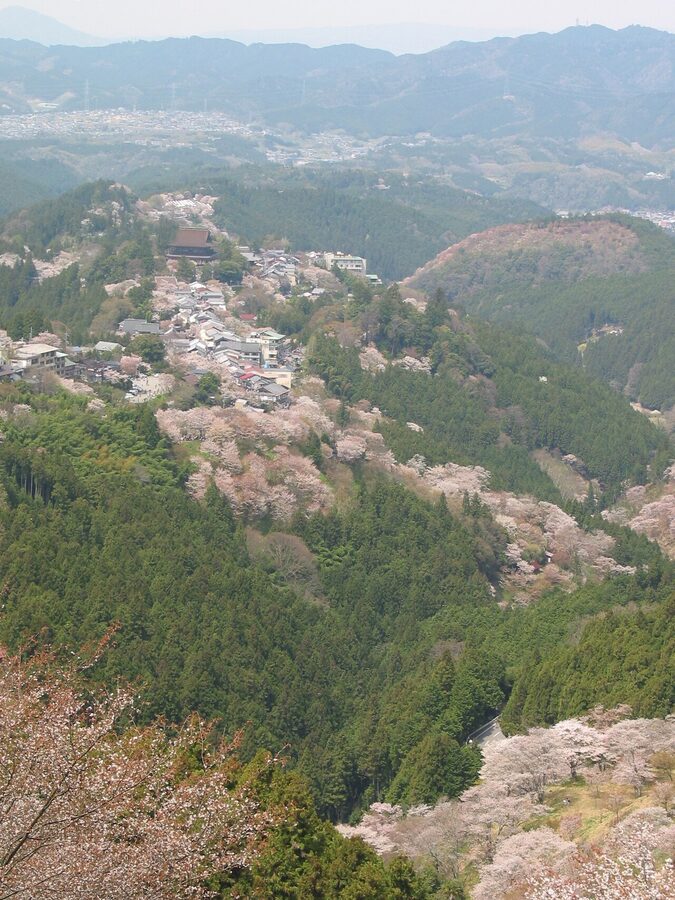
- Yoshinoyama, Nara prefecture: the king
- Hirosaki Park, Aomori: the festival benchmark
- Kakunodate, Akita: the samurai-district angle
- Mount Yoshino vs. Yoshinoyama vs. Yoshino Station
- Tokyo’s headline three: Meguro River, Chidorigafuchi, Ueno Park
- Kyoto’s temple-pairing geography
- Hokkaido’s late window
- Hanami in practice
- The 100-yen shop kit
- The unwritten rules
- Yozakura: night cherry blossoms
- Planning a trip around the bloom
- The seven-to-ten-day default
- The 14-to-21-day “follow the bloom” trip
- The risk-tolerant “shoulder bloom” trip
- Hotels: how booking changes during cherry blossom season
- What about hayfever, weather, and the small print
- The single best advice if you remember nothing else
The bloom front, in plain numbers
Japan stretches roughly 3,000 kilometres on a south-west to north-east axis, from Okinawa at 24 degrees north to Wakkanai at 45 degrees north. That’s the same range as Cuba to Montreal. The cherry tree doesn’t care about your travel calendar; it cares about temperature accumulation. So the front (sakura zensen) moves north at roughly 25–30 km per day in spring, taking about four months to cross the country.
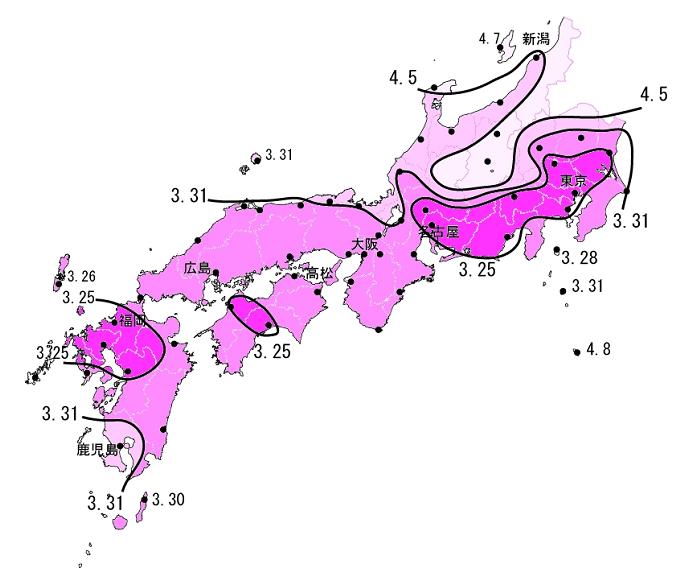
In rough numbers, working from south to north:
- Okinawa (Naha, Ishigaki): mid-January to early February. Different species, different colour, different feel.
- Kyushu (Fukuoka, Kumamoto, Kagoshima): opens around 22–27 March, peak bloom roughly four to seven days later.
- Western Honshu (Hiroshima, Okayama): opens late March, peaks 30 March–4 April.
- Kansai (Kyoto, Osaka, Nara): opens 23–28 March, peak 29 March–5 April. The most-photographed window.
- Tokyo and surrounds: opens around 19–24 March (Tokyo’s standard tree at Yasukuni Shrine fires the official starting gun), peak 28 March–4 April.
- Northern Honshu (Sendai, Fukushima, Aizu): opens 28 March–5 April, peaks 6–14 April.
- Tohoku core (Hirosaki, Kakunodate, Kitakami): peak window 14–21 April.
- Hokkaido (Hakodate, Sapporo, Asahikawa): opens 18–25 April, peaks 22 April to first week of May.
- Far north Hokkaido (Kushiro, Wakkanai, Nemuro): peaks mid to late May. The latest bloom in the country.
Those numbers are averages from the Japan Meteorological Agency’s last 30 years of records, adjusted for the fact that recent springs have been noticeably warmer than the 30-year norm. In 2026 most Honshu cities ran four to nine days early, and Hokkaido ran ten to fourteen days early.
The 2026 dates as they actually happened
For grounding, here’s what the bloom looked like at headline cities this past spring (kaika date = the day the standard tree opens its first six flowers, declared by the Japan Meteorological Agency):
| City | 2026 kaika | 30-year average | Days early |
|---|---|---|---|
| Naha (Okinawa) | 18 January | 16 January | +2 |
| Fukuoka | 24 March | 22 March | +2 |
| Hiroshima | 19 March | 25 March | −6 |
| Kyoto | 23 March | 26 March | −3 |
| Osaka | 26 March | 27 March | −1 |
| Tokyo | 19 March | 24 March | −5 |
| Kanazawa | 29 March | 3 April | −5 |
| Sendai | 31 March | 8 April | −8 |
| Aomori | 13 April | 22 April | −9 |
| Sapporo | 18 April | 1 May | −13 |
| Hakodate | 18 April | 28 April | −10 |
| Kushiro | 3 May | 16 May | −13 |
Two practical takeaways. The Hokkaido lead has shrunk: 2026 was so warm that Hokkaido’s standard trees opened on the same day as Kyoto’s (18 April vs 19 March is a 30-day gap; in normal years it’s closer to 35). And the Sea of Japan / Pacific gap that used to be 5–7 days has narrowed in warm years to 2–3.
If you’re booking a year ahead and want a date you can rely on for Tokyo, Kyoto, or Osaka: target the first week of April. You’ll usually catch full bloom somewhere on your trip, and even if you arrive a few days late you’ll see the petal-fall (hanafubuki), which a lot of Japanese photographers actively prefer.
How the official forecast works (and where it gets things wrong)
There are three forecasts that the Japanese press treats seriously. Travellers should probably pick one and ignore the others. Cross-checking three sources that all use slightly different models is a recipe for confusion, not certainty.
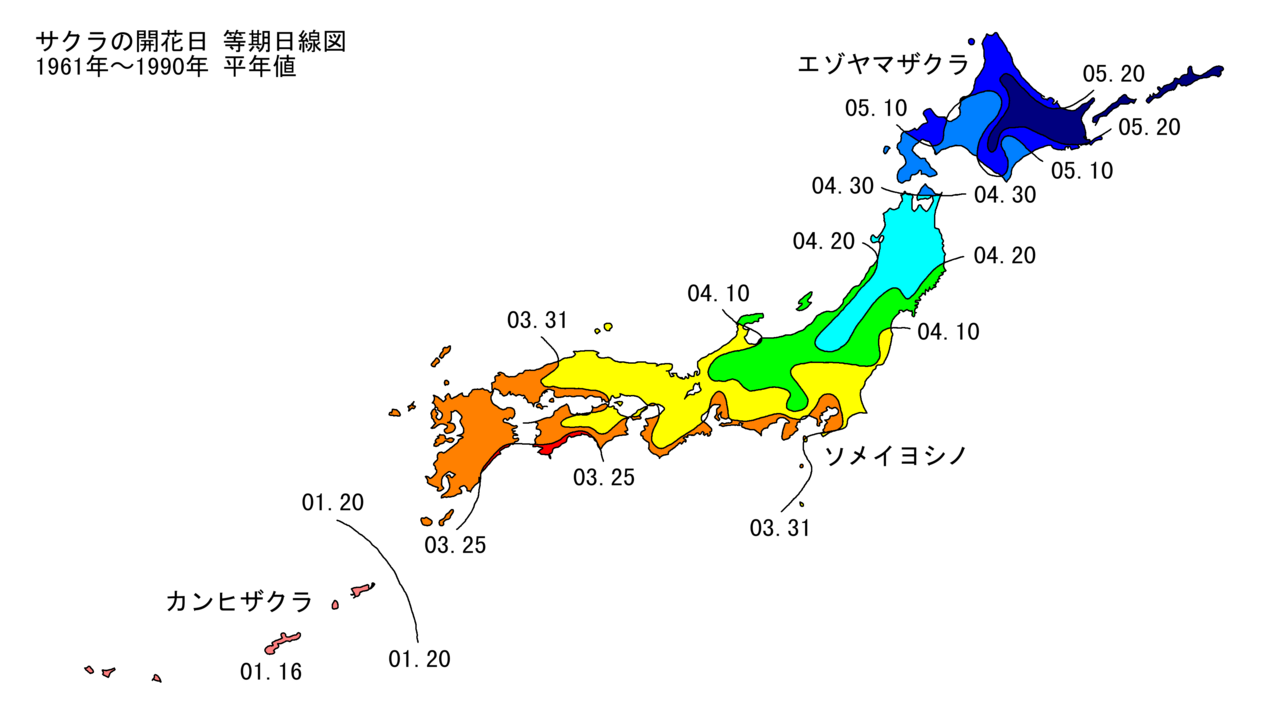
The Japan Meteorological Agency (JMA) is the official source. They monitor 58 standard trees across the country, the same trees they’ve been watching for decades, and they declare kaika (opening) and mankai (full bloom) the moment the criteria are met. Their numbers are the historical record. They don’t, however, publish a full forecast: just the live state, plus the climatological average. JMA’s live page is the cleanest data source if you read Japanese.
Two private companies do the actual prediction work: Weathernews and Japan Weather Association (Nihon Kishou Kyoukai). Both publish prediction maps starting in late January and refine them every two weeks until the front passes through. Weathernews’s forecast tends to skew slightly later than JWA’s; in 2026 they were within two days of each other for every major city, which is about the limit of forecasting precision for a flower that opens on a few hours’ notice.
Where the forecast goes wrong
The thing the forecasts can’t predict is the weather between kaika and mankai. A cold snap stretches that window to two weeks; a warm front compresses it to four days. A heavy rain at peak knocks the petals off in an afternoon. So the practical move is: pick a viewing region, target the predicted peak, and add four to seven days of buffer on either side. Don’t book a non-refundable hotel for one specific night based on a forecast issued in February.
The other systematic error: the forecasts cover the someiyoshino standard trees only. If you’re going to Yoshinoyama (mountain cherries), Hirosaki (a mix of someiyoshino, shidare, and double-flowered varieties), or Ninna-ji’s Omuro grove (a late-blooming variety unique to that temple), the published kaika date is misleading. Yoshinoyama runs about a week behind Osaka because it’s higher and colder. Omuro runs ten days after the Kyoto someiyoshino peak. I cover the Omuro timing in detail in the Kyoto guide.
The species, briefly, and why it matters for your trip
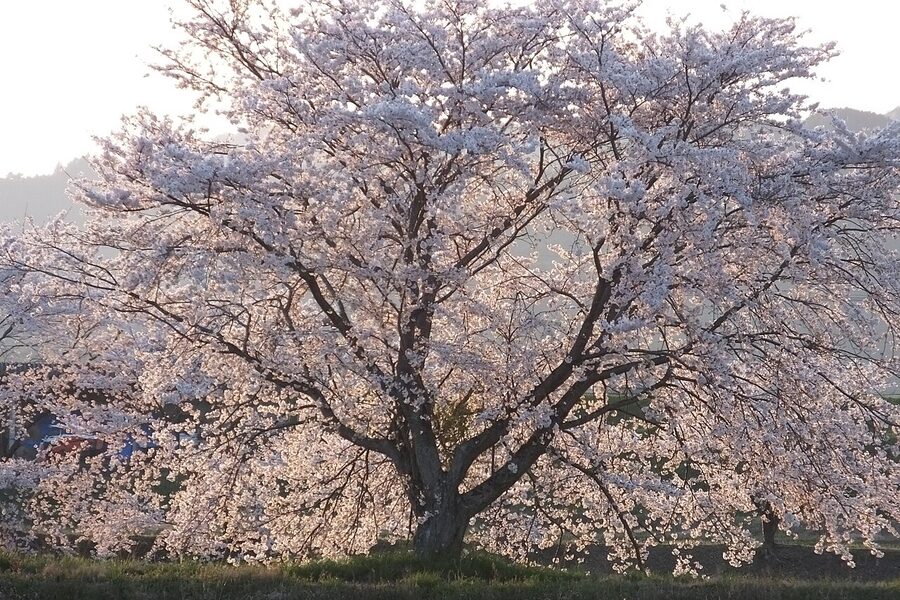
Japan grows somewhere between 200 and 600 cherry varieties depending on how you count cultivars and crosses. Five of them carry essentially the entire travel calendar.
Someiyoshino (染井吉野)
About 80 percent of cultivated cherry trees in Japan are Someiyoshino. It’s a hybrid that emerged in Edo (modern Tokyo) in the 1860s and propagates only by grafting, which means every Someiyoshino tree in the country is a clone of the original. That genetic uniformity is why entire cities bloom on the same day. The tree opens its flowers before its leaves come in, so the canopy goes pure pink for about a week, then green takes over. This is the cherry tree the JMA forecasts, the one in 90 percent of Japan tourism photos, and the one the bloom front maps trace.
Lifespan is short for a cultivated tree, around 60–80 years. A lot of Someiyoshino plantings from the post-war reconstruction era are now dying off, which is a quiet anxiety in Japanese arboriculture circles.
Yamazakura (山桜) and Edohigan (江戸彼岸)
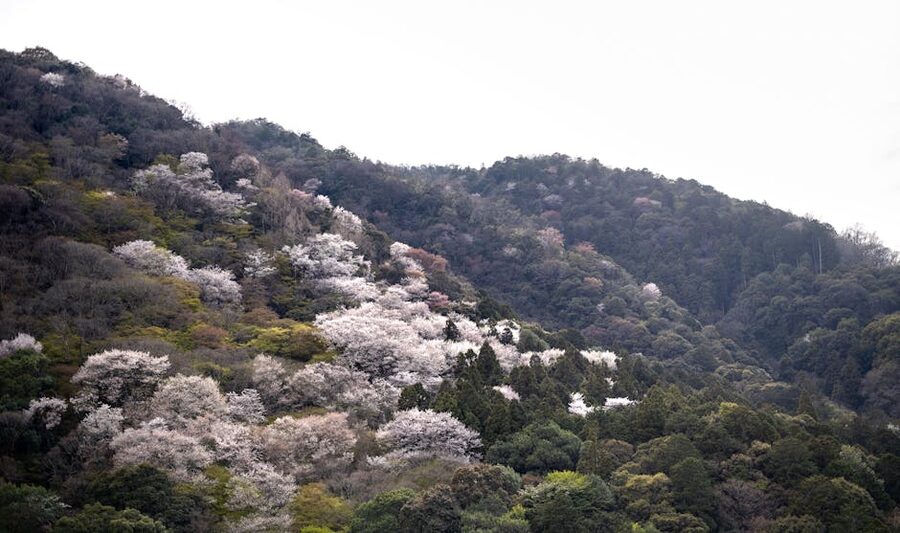
The wild mountain cherry. This is what Yoshinoyama is famous for: 30,000 yamazakura covering four mountain zones, naturally seeded over centuries rather than planted in lines. Yamazakura blooms slightly before its leaves appear, but the leaves come in coppery red, so the trees show pink and bronze together rather than pure pink. It’s a more painterly look. Edohigan is the long-lived ancestral wild cherry; the famous 1,000-year Miharu Takizakura tree in Fukushima is an Edohigan-Shidare cross.
Shidarezakura (枝垂桜): weeping cherry
The pendulous variety. Maruyama Park in Kyoto has a single giant Shidarezakura that anchors the entire yozakura (night-blossom viewing) scene for the city. Shidare blooms a few days before Someiyoshino in most regions, so a Maruyama trip in late March often catches the weeping tree in peak while the surrounding Someiyoshino are still tight buds. The combination is one of the more strangely lopsided sights in Japanese horticulture.
Yaezakura (八重桜): double-flowered cherries
The frilly, tightly clustered variety. Yaezakura blooms about ten days after Someiyoshino, which makes them the rescue option if you arrive too late for the standard bloom. Hirosaki Park’s outer moat is famous for its yaezakura tunnel, and Osaka’s Mint Bureau opens its yaezakura-lined courtyard for a week each April; both keep the season going into mid-April even after the Someiyoshino are spent.
Kawazuzakura (河津桜) and Kanhizakura (寒緋桜)
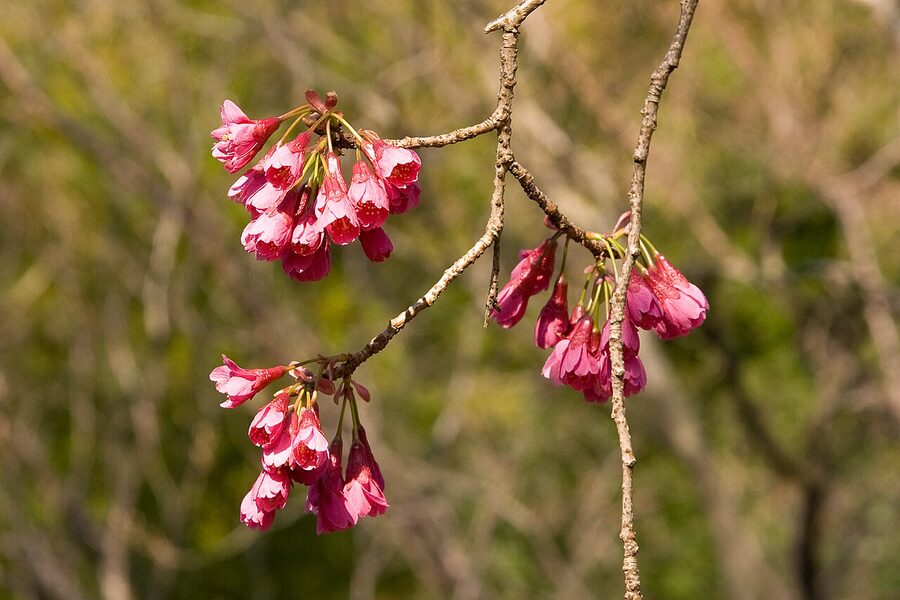
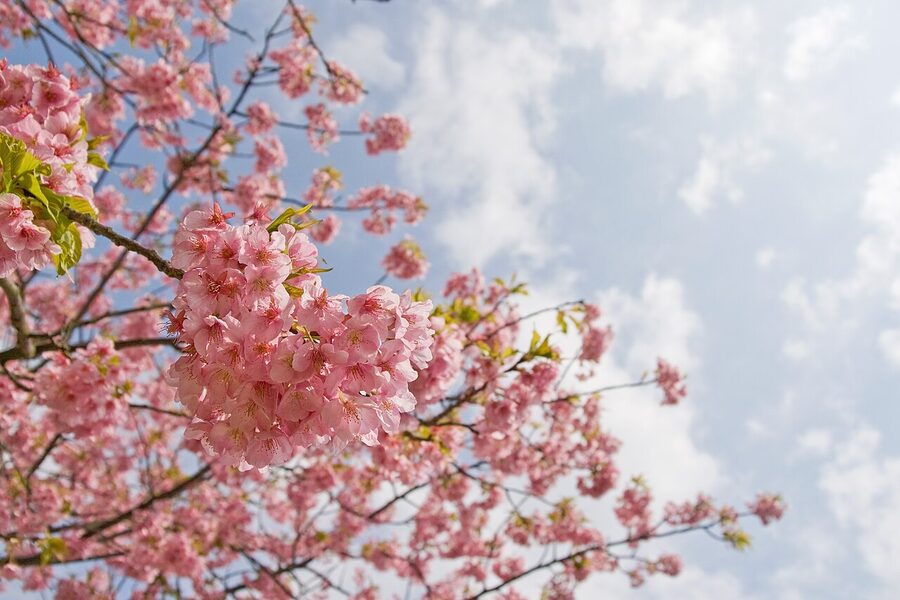
The early-bloom species. Kawazuzakura is a natural cross discovered in Kawazu town on the Izu Peninsula in 1955; it opens roughly mid-February in Izu and runs deeper pink than Someiyoshino. The town runs the Kawazu Sakura Festival from 10 February to 10 March each year and you can sleep on the Odoriko limited express from Tokyo Station to be on the ground in three hours. Kanhizakura is the bell-shaped, magenta-pink Okinawan species: it’s what blooms in Naha in mid-January, and what most “I saw cherry blossoms in Japan in winter!” social posts are actually showing.
What makes a viewing spot actually good
I’ve watched a lot of disappointed travellers stand in front of a perfectly fine row of cherry trees and feel that something promised to them hasn’t materialised. The thing that’s missing is usually one of four ingredients. Good hanami spots have at least three of them.
Density. A single cherry tree in a city park is not hanami. A hundred trees lining a 1-kilometre canal is. The visual effect is cumulative. Someiyoshino was planted in tunnels and avenues precisely because the species reads as a wall of pink rather than as individual flowers.
A second element. The Japanese aesthetic word here is mitate: cherry blossom plus something else (water, castle, mountain, lantern, traditional architecture, rail bridge, river boat). Pure cherry blossom is fine; cherry blossom against a black-tile castle wall is iconic. Trees plus river is good; trees plus river plus a wooden Edo-era bridge is unforgettable.
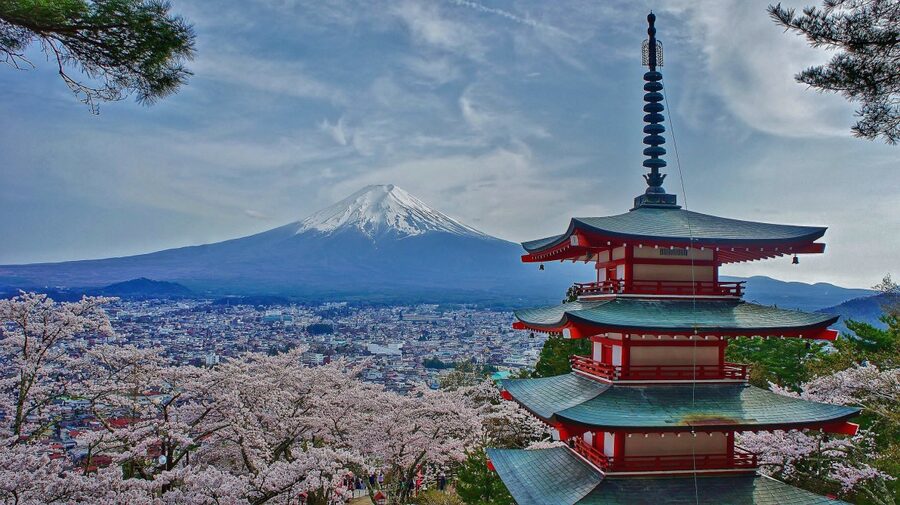
A way to be slow. The good spots all reward staying. A canal you can walk along for forty minutes, a castle moat with benches, a mountain park with paths between groves. Spots that are basically one viewpoint with a queue (parts of Chidorigafuchi at peak, the bottom of Daigo-ji’s avenue) are not where you want to spend your day.
Either deep crowds, or no crowds. Strange but true. The middle category, mildly busy, is the worst. Either commit to the famous spot at the predicted peak with the picnic crowds and the night light-up (Maruyama, Ueno, Hirosaki) and treat the crowd as part of the experience, or get up early and go somewhere unrated. The “popular but not too popular” alternatives in your guidebook will usually be neither popular enough to be alive nor empty enough to be peaceful.
The big-name spots, ranked by what they actually deliver
Working through the most-cited cherry blossom destinations in Japan, with verdicts from someone who has stood at all of them in different years.
Yoshinoyama, Nara prefecture: the king
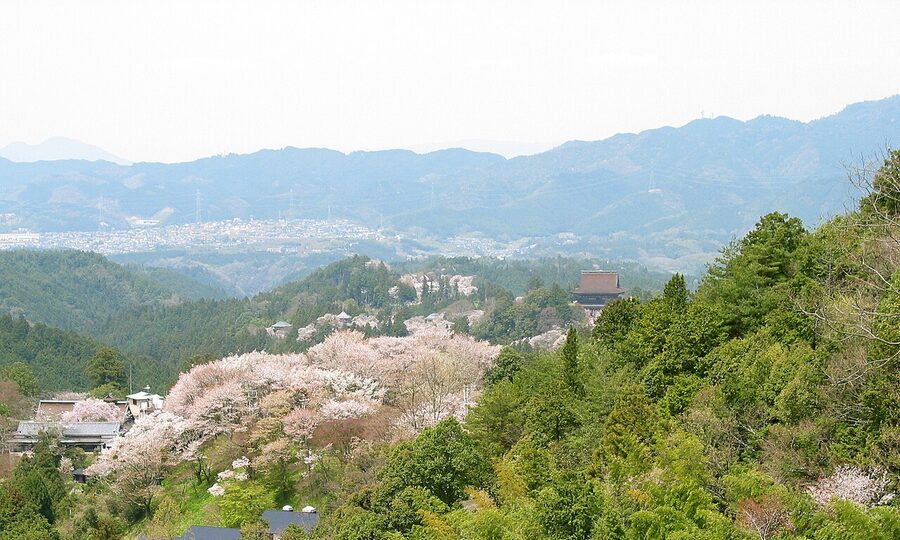
The single most photographed cherry blossom site in Japan. Approximately 30,000 trees, mostly yamazakura, planted across four named bands of the mountain over a thousand-year period. Bloom timing typically runs about a week behind Osaka because of altitude. Three nights minimum to do it properly: one night low, one night mid-mountain, one for the upper area. Day-tripping from Osaka or Kyoto is possible but you’ll see one band, fight crowds at the cable car, and miss the upper grove which is the quietest. Best base: a shukubo (temple lodging) on the mountain itself; bookings open about a year ahead and the inns fill in October for the following spring. From Osaka via Kintetsu, change at Kashihara-jingu-mae for the limited express to Yoshino Station, then bus or cable car. Total time roughly 1h 50m.
Hirosaki Park, Aomori: the festival benchmark
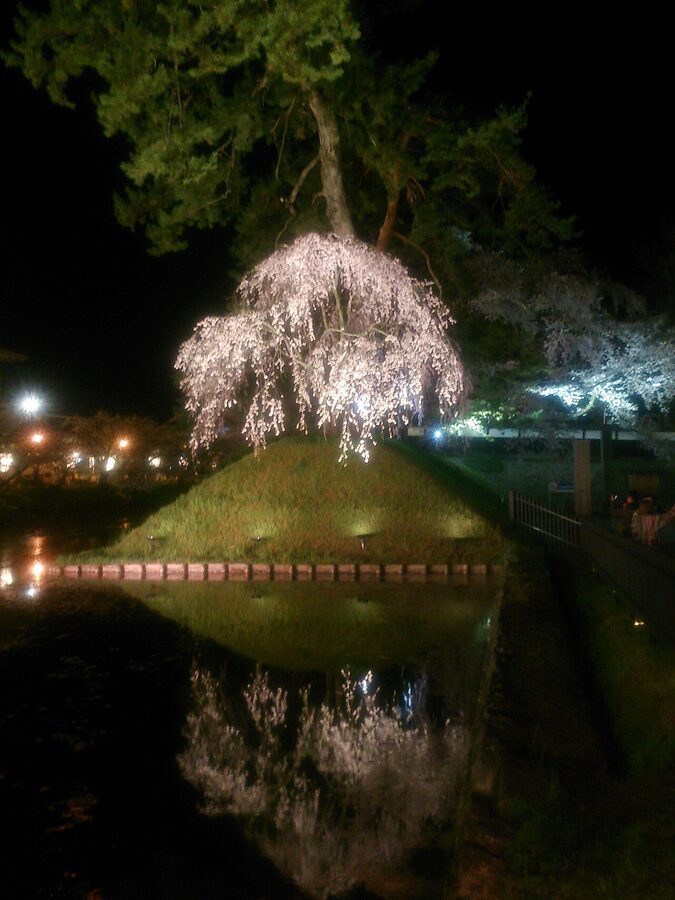
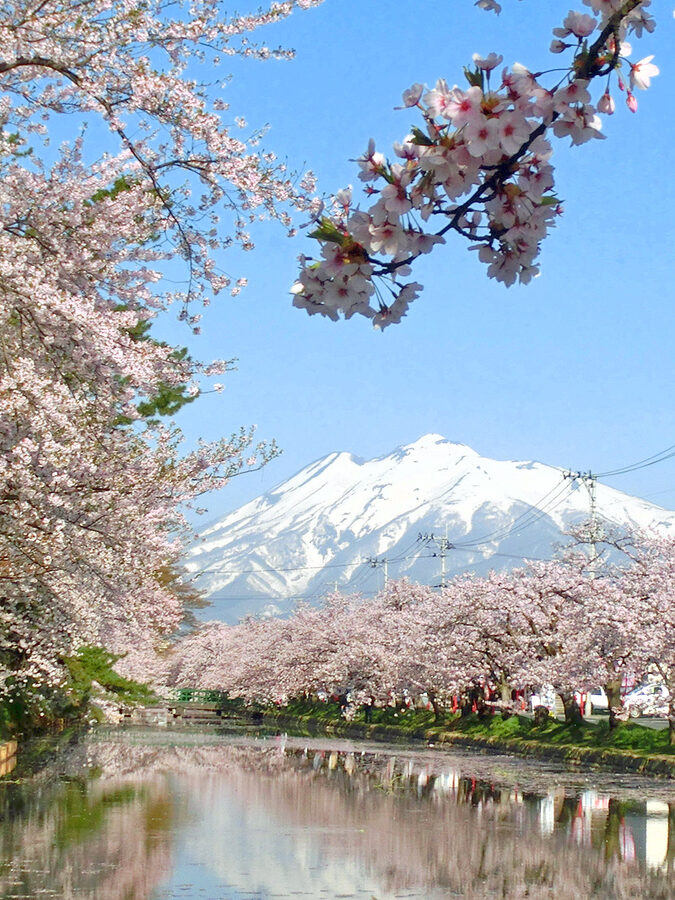
2,600 trees of 52 varieties around a five-bailey castle, with the inner keep open as a museum. The festival runs roughly 19 April to 5 May. Two specific things to know: the night light-up is the best in Japan, and the hanaikada (“flower raft”) moat, when fallen petals form a continuous pink mat on the water, usually peaks 3 to 5 days after the Hirosaki kaika date. If you can be flexible by a few days, target the petal-fall, not the peak. Total visitor numbers run about 2 million across the festival fortnight; weekend afternoons are oppressive but Tuesday and Wednesday mornings before 09:00 are workable. From Tokyo via JR: Tohoku Shinkansen to Shin-Aomori (3h 10m), local 40m to Hirosaki. Inns book up six months out for the festival weeks.
Kakunodate, Akita: the samurai-district angle
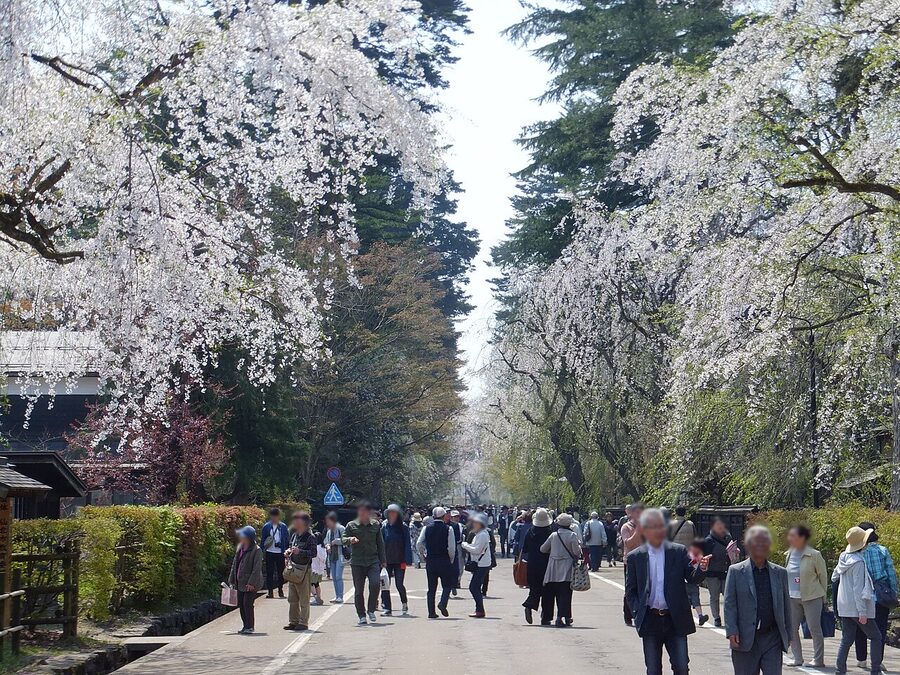
If you’re prepared to base out of Tohoku for a week, Kakunodate is worth two nights in its own right. The samurai district has the country’s most concentrated weeping-cherry corridor: about 400 trees lining the streets between low black wooden walls of preserved Edo-era homes. Bloom typically a few days after Hirosaki, so the obvious move is to fly into Tokyo, train up to Hirosaki for a night, then south to Kakunodate, then Tokyo onward. Time-wise this is the most efficient cherry tour in the country if you’ve got six to eight days. From Tokyo: Akita Shinkansen direct, 3h 10m. The town itself walks comfortably.
Mount Yoshino vs. Yoshinoyama vs. Yoshino Station
One quick clarification because this trips up almost everyone: Yoshinoyama (吉野山) is Mount Yoshino. The cherry mountain. Yoshino Station is the cable car base at its foot. Don’t confuse it with Yoshino in Kyoto, which is unrelated, or with the Someiyoshino cultivar name, which derives from Yoshino’s reputation but uses imported trees, not the wild yamazakura you’ll see on the mountain itself.
Tokyo’s headline three: Meguro River, Chidorigafuchi, Ueno Park
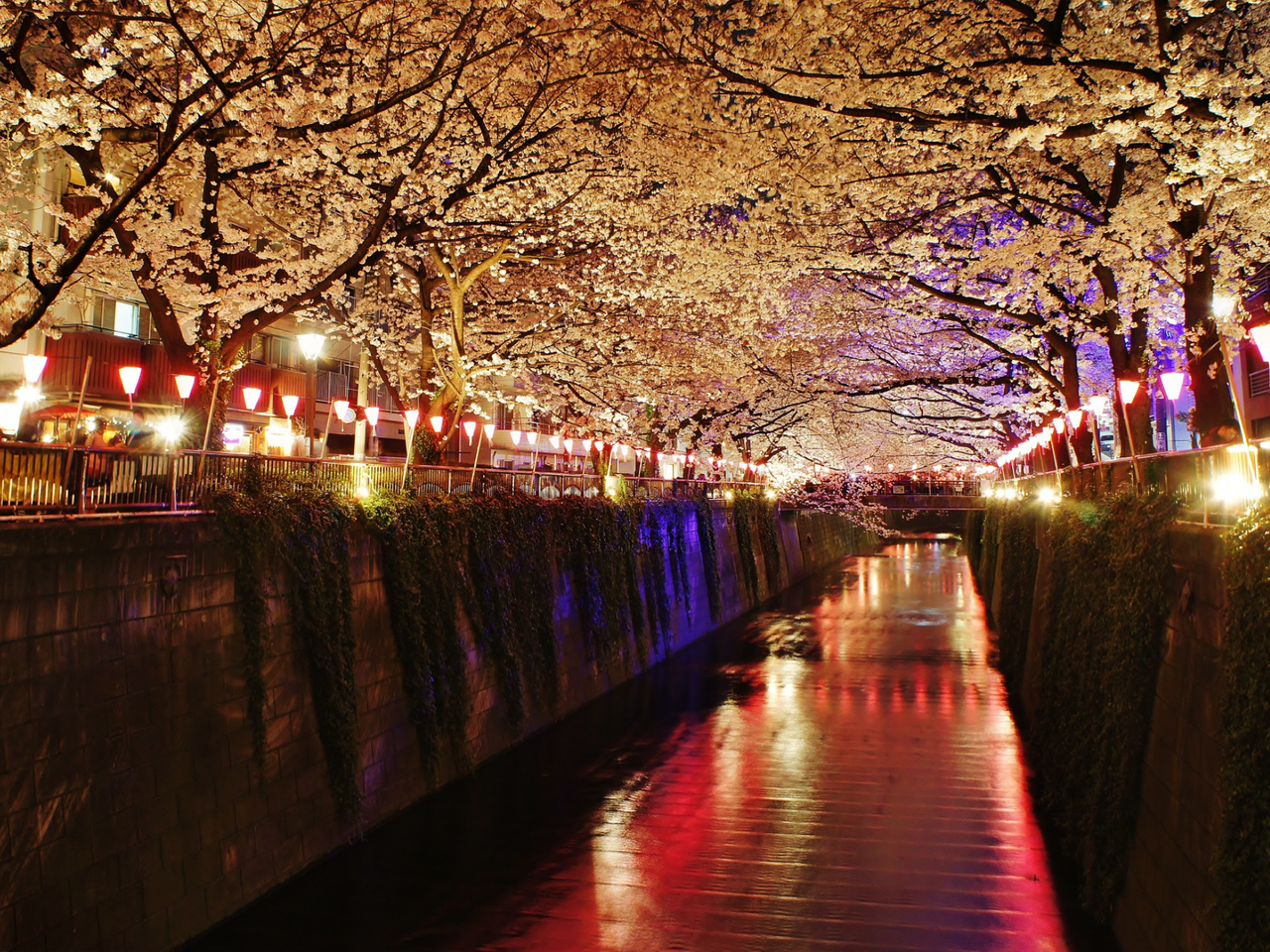
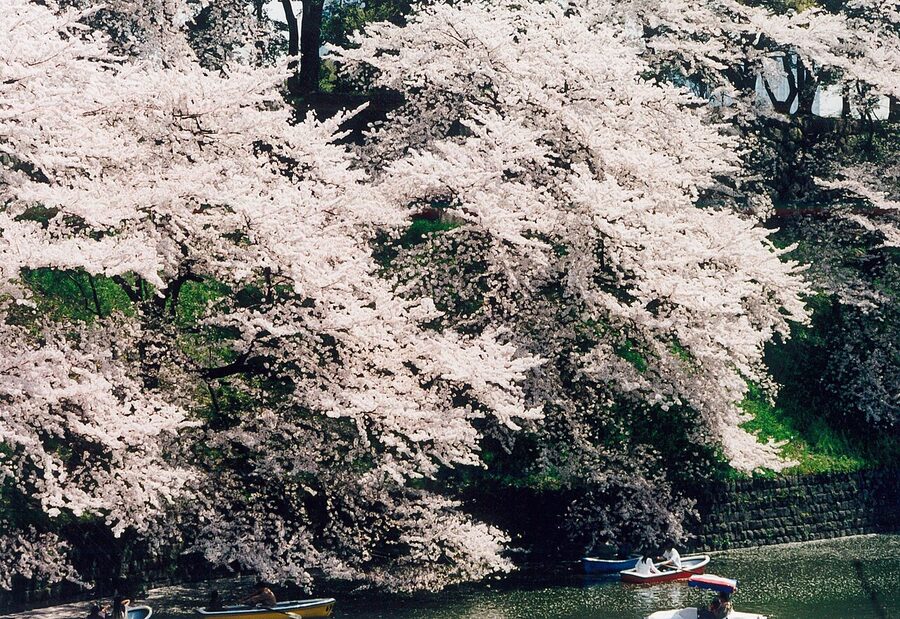
Tokyo’s cherry blossom map is wide and uneven. The three top-rated spots all live up to their billing if you handle them correctly. Meguro River is best at dusk during the festival light-up; Chidorigafuchi rewards renting a rowboat (pre-book online; same-day queues are 3+ hours at peak); Ueno Park works as a midday picnic but loses character after sunset because of the lantern crowds. None of these is enough on its own; the full map and timing strategy is in the Tokyo cherry blossom guide.
Kyoto’s temple-pairing geography
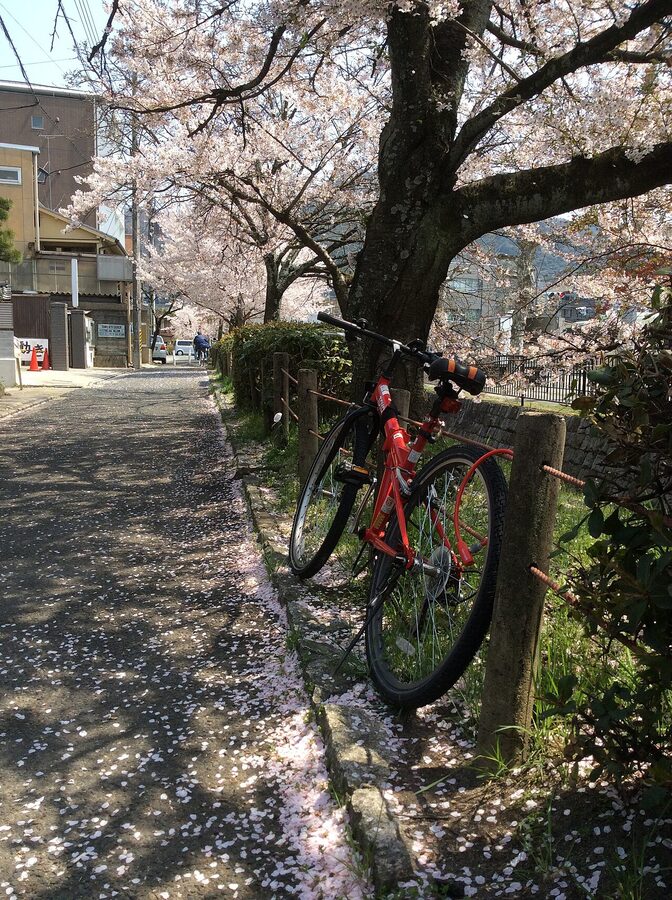
Kyoto’s particular gift is that almost every famous viewing spot is also a famous temple or shrine, which means the architectural backdrop is built in. Maruyama Park’s giant Shidarezakura, Daigo-ji’s mountain temple complex (Hideyoshi held his last hanami party here in 1598), Ninna-ji’s late-blooming Omuro grove, the Philosopher’s Path canal between Ginkaku-ji and Nanzen-ji. The grouping changes the planning logic: you cluster by district rather than spot. Full district-by-district plan in the Kyoto cherry blossom guide.
Hokkaido’s late window
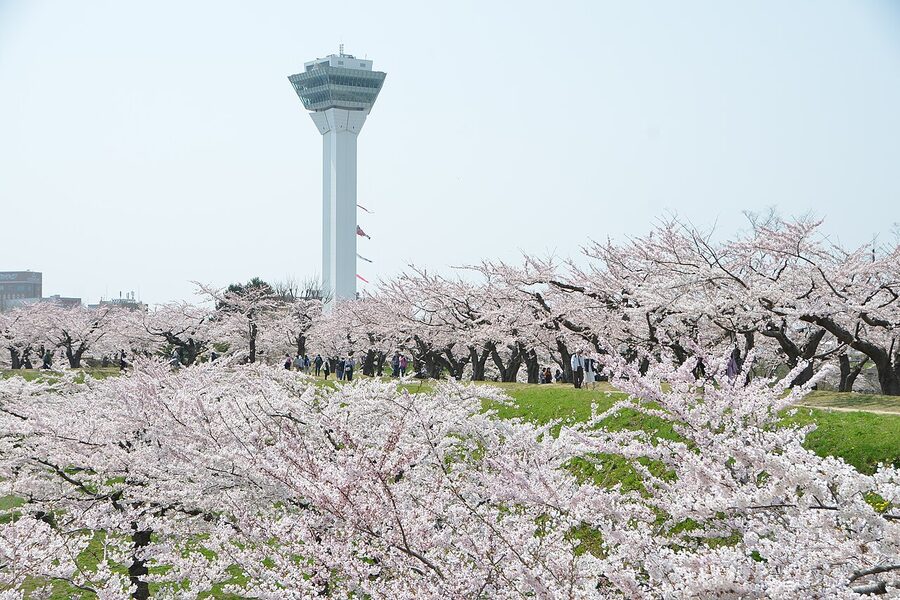
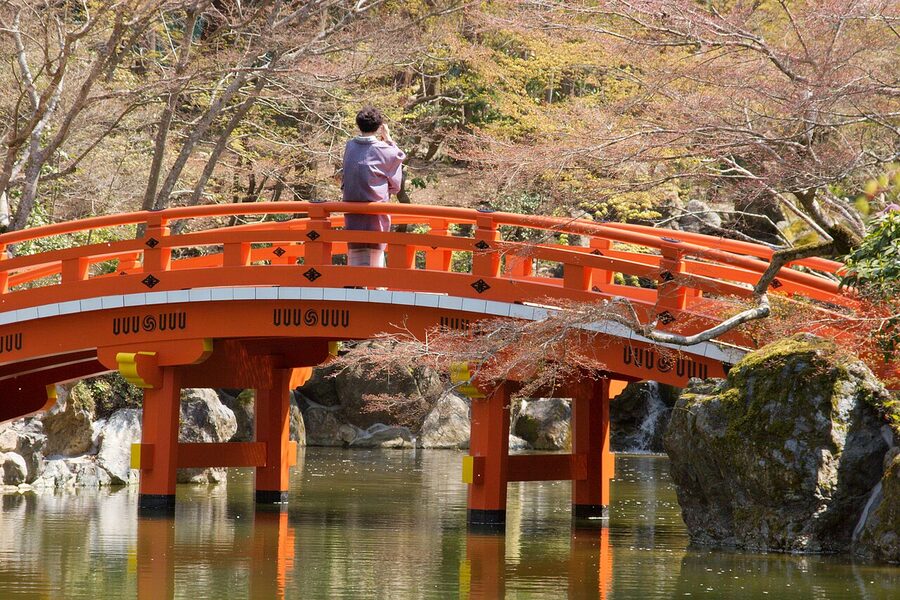
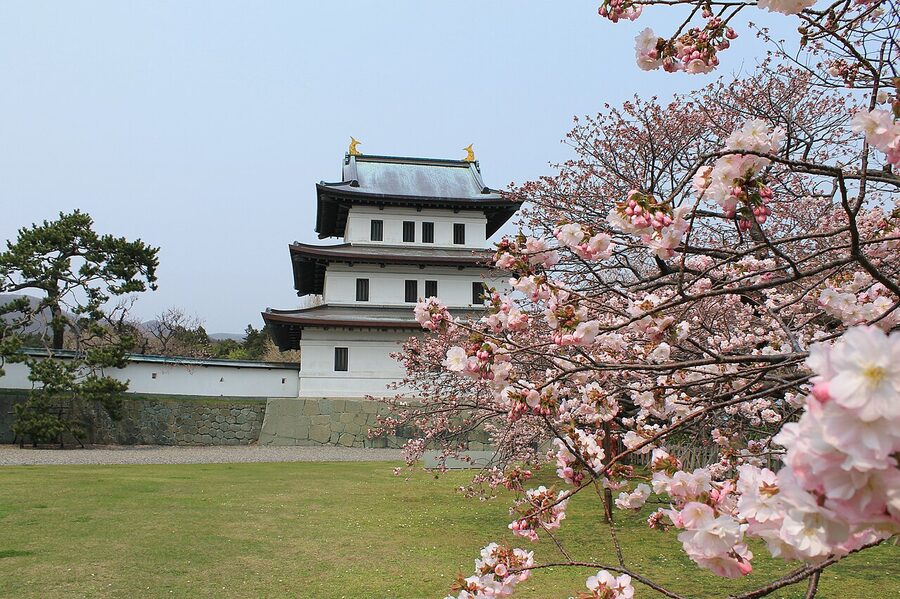
The strongest argument for Hokkaido is timing rather than place: by the time Sapporo and Hakodate bloom, Tokyo and Kyoto are post-peak and the Honshu crowds have flown home. Hokkaido also runs a different mix of species, with ezoyamazakura (Hokkaido mountain cherry, deeper pink than Someiyoshino) as a major component alongside the standard Someiyoshino. Hakodate’s Goryokaku Park, Matsumae’s castle (Japan’s northernmost castle, with 250+ varieties of cherry), and Sapporo’s Maruyama Park / Hokkaido Shrine grouping are the three main bases. Full plan in the Hokkaido cherry blossom guide.
Hanami in practice
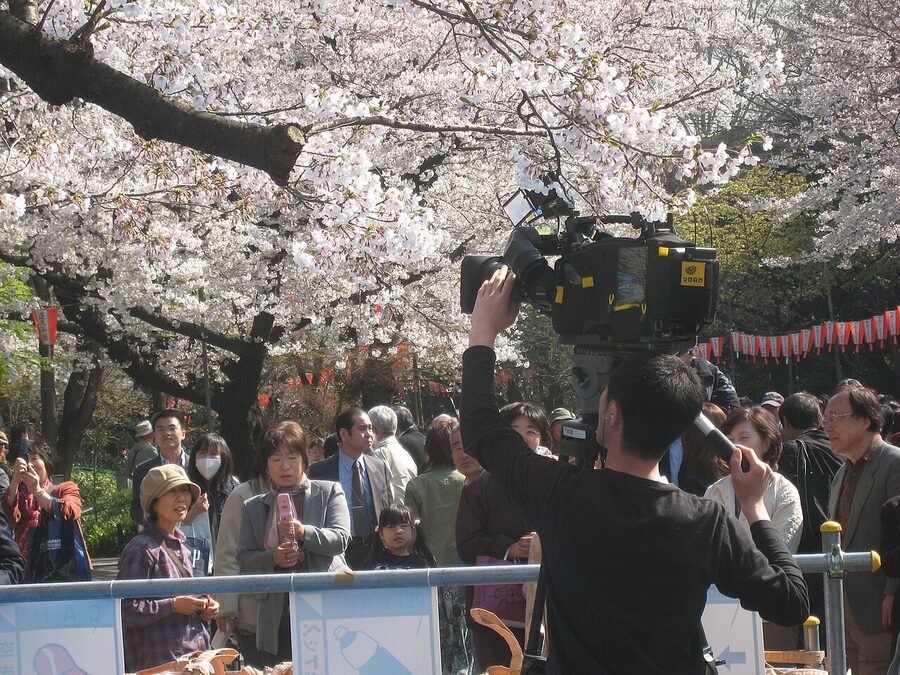
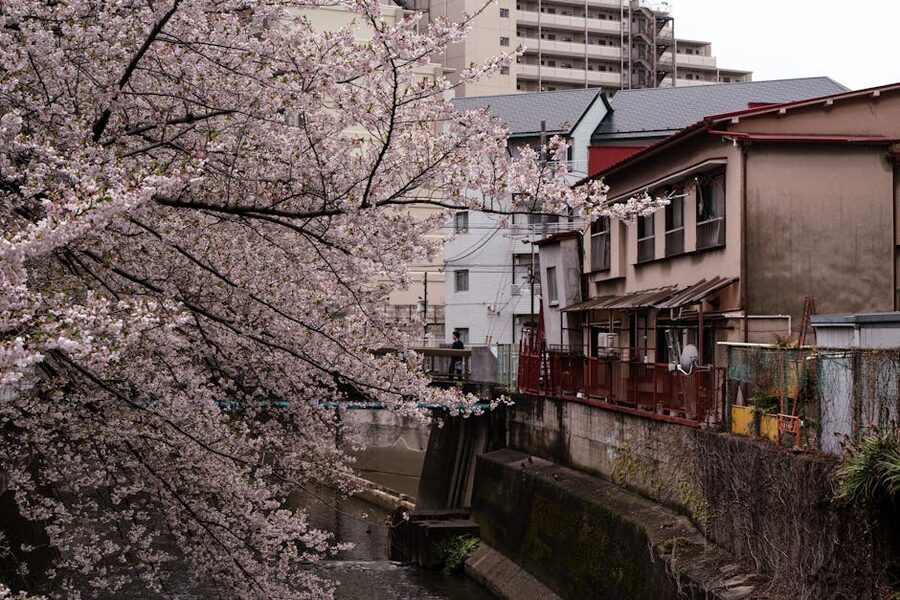
The word hanami literally means “flower viewing”, but in practice it means a picnic on a blue plastic tarp with too much food and not enough warm clothing, surrounded by other people doing exactly the same thing. The tradition runs at least to the 8th century at the imperial court, and to the 17th century as a popular festival open to merchants and farmers. It’s old, it’s deeply embedded, and as a foreign visitor you’re welcome to participate.
The 100-yen shop kit
Here’s what to actually buy at the nearest Daiso, Can Do, or Seria the morning of:
- Blue tarp (rejaa shiito): ¥110 for a 2×2m sheet. Bigger sizes available. Brown sheets are also acceptable; pink and patterned sheets read as overdoing it.
- Disposable plates, cups, chopsticks in a single packaged set: ¥220–330. Don’t bring proper crockery; you can’t wash it.
- A small heated pad (kairo) per person: ¥110 for a pack of two. The ground is colder than the air. April afternoons in Tohoku especially.
- Trash bags: two large ones, ¥110 each. You will need to take everything home with you. There are no public bins at most parks.
For the food: the 7-Eleven, Lawson, or FamilyMart nearest the park will have a “hanami bento” rack the week of peak bloom. ¥800–1,200 buys you a respectable lunch, and the supermarket sushi platters at ¥1,500–2,500 are a step up. A bottle of nihonshu (sake) is part of the deal; canned chu-hi at ¥220 each is the casual alternative. Most parks are pro-alcohol; a few specifically prohibit it (Shinjuku Gyoen does, Yasukuni’s grounds do not).
The unwritten rules
People will tell you hanami has elaborate etiquette. Most of it boils down to: don’t touch the trees, take all your rubbish home, and don’t park your group in the middle of a flowing path. Specifically:
- Don’t break branches or pull off blossoms. A photo of you holding a sprig of cherry blossom will get you yelled at and the photo banned from social media. The trees are aggressively fragile; broken branches don’t regrow flowers for years.
- Take off your shoes when you step onto the tarp. Same etiquette as a Japanese home. Park them at the corner so they don’t get mixed with someone else’s group’s shoes.
- Don’t use musical instruments or run a karaoke speaker. Quiet conversation, laughter, and the ambient noise of the park is the soundscape; one boombox ruins it for the hundred groups around you.
- Don’t claim more space than you’ll use. A group of four does not need a 4×4m tarp. The custom of “marking” a spot the night before with an empty tarp is technically legal but socially eyed; if you’re going to do it, send one person to sit with the tarp from late afternoon onwards.
- Don’t sit on the tree roots. The compaction of foot traffic and group weight on root zones is one of the major causes of cherry tree decline in popular parks.
- Take everything home. Public bins are rare. Bring two large bags, sort plastic from burnable on-site, walk it back to your accommodation or to a station bin if your hotel doesn’t accept guest rubbish.
The single biggest favour you can do for the experience is to slow down. Take three hours, not forty minutes. Eat. Drink. Walk to a different group of trees. Come back. The Japanese phrase for this is mono no aware: an awareness that beautiful things are temporary precisely because they’re temporary. The bloom lasts a week. You’re meant to look at it for longer than the time it takes to compose a photograph.
Yozakura: night cherry blossoms
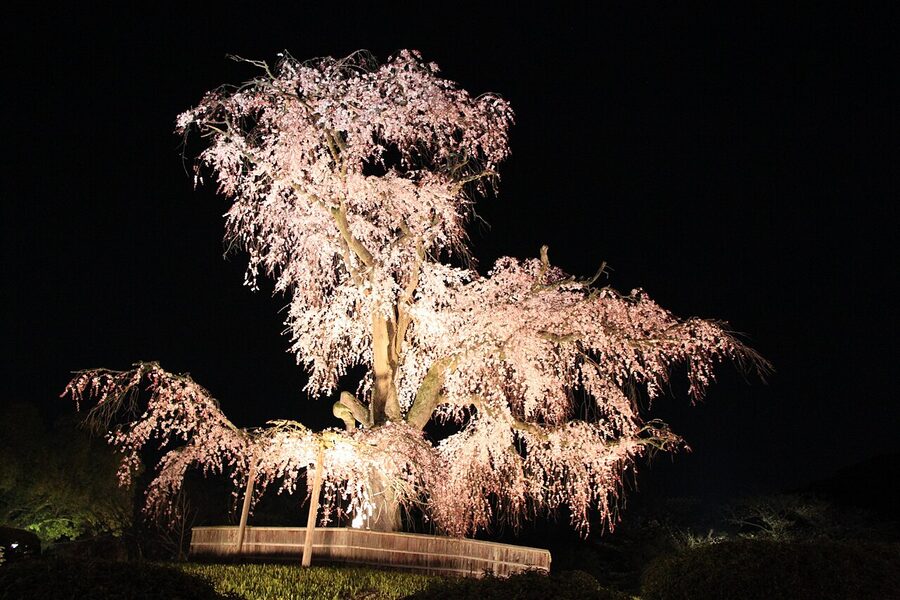
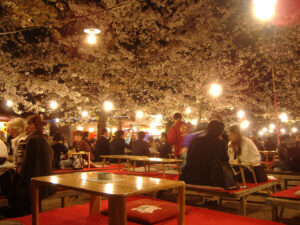
Yozakura means night blossom and is its own thing, not just a darker version of daytime hanami. The trees go strange under coloured lighting, the crowds shift from family-picnic to date-and-drinks, and the photography becomes more interesting because the dynamic range collapses to the lit foreground. The downside is the lighting is often badly done. Some venues use harsh white floods that bleach the petals; a few use uplighting carefully calibrated to read as moonlight, and those are the ones worth your evening.
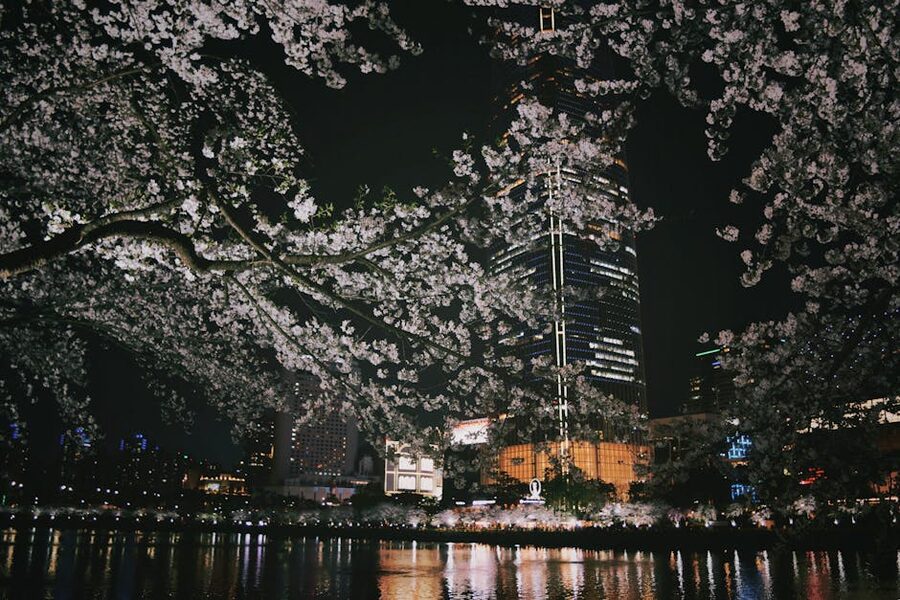
The reliable yozakura venues:
- Maruyama Park (Kyoto): single dominant Shidarezakura, lit beautifully. Free entry. Usually 18:00–22:00 during peak. Get an early dinner in Gion and walk over.
- Chidorigafuchi (Tokyo): the moat illumination is genuinely good, the lighting subtle, the rowboat option transformative. Boats run until 21:30 in peak season; pre-booking essential.
- Hirosaki Park (Aomori): arguably the best in the country. The combination of the castle silhouette, the moat reflections, and a 50-tree light arrangement at the inner gate is unique to here.
- Meguro River (Tokyo): 800 paper lanterns over a 4 km canal. Crowded; arrive at sunset and walk against the flow from Nakameguro toward Ikejiri-Ohashi.
- Takato Castle Park (Nagano): 1,500 Takato Kohigan-zakura (a darker pink local cultivar), 60 minutes by bus from Ina city. Underrated and significantly less crowded than Hirosaki at the equivalent point in its bloom.
What I’d skip: the night light-ups at smaller temples that are essentially LED uplighting under three or four trees with a ¥800 entry fee. The colour temperature is often wrong and the area is too small to walk through without shuffling. Stick to the major parks where the budget is real.
Planning a trip around the bloom
The questions that drive trip dates: how many days, how flexible, and how much risk you’re willing to carry on missing the peak.
The seven-to-ten-day default
Most international travellers come for one to two weeks. If your trip falls anywhere in the last week of March or first ten days of April, you’ll catch peak bloom in at least one major city. The simplest itinerary that hedges across the front: Tokyo (3 nights) → Hakone or Mt. Fuji (1 night) → Kyoto (3 nights) → Osaka (1 night). With Tokyo and Kyoto blooming about 2–5 days apart in any given year, this layout almost always sees the peak somewhere; if you arrive too early for Tokyo you’ll catch Kyoto, and if Tokyo is already past peak you’ll get Kyoto a few days later.
The Japan Rail Pass is worth the math for this kind of multi-city trip. Klook sells the 7-day pass; book before you fly because the pass is mailed to your home country. Same goes for the Tokyo airport transfer: Klook sells the Narita Express round-trip at a discount. For city transit, an IC card via Klook is what you want; pickups at the airport are now standard for foreigners since the local-issuance restrictions of 2024.
The 14-to-21-day “follow the bloom” trip
If you’ve got two weeks or more and you’re willing to plan around the front, the high-quality move is to start south and move north. A typical layout: open in Kyushu (Fukuoka or Kumamoto) in the last week of March, move to Kyoto / Osaka for the first week of April, train to Tokyo for 4 April–9 April, then north to Tohoku (Hirosaki, Kakunodate) for 14 April–19 April. You’ll see four or five peaks rather than gambling on one. The downside is you commit to a longer trip and considerably more train travel; the JR Pass becomes essential rather than optional.
The risk-tolerant “shoulder bloom” trip
If the dates you can travel happen to fall in mid-February or mid-May, don’t write the trip off. Mid-February gets you Kawazu on the Izu Peninsula in full bloom, and a week of Okinawan kanhi-zakura if you can route through Naha or Ishigaki. Mid-May gets you the back end of Hokkaido (Kushiro, Wakkanai, Nemuro), the late-blooming Omuro grove at Ninna-ji in Kyoto, and the post-festival quiet at Hirosaki. Either of these brackets is a meaningfully different cherry-blossom trip; both are quieter and cheaper than the late-March crush.
Hotels: how booking changes during cherry blossom season
Three things change during the fortnight either side of peak bloom in any major city.
Prices climb sharply, often 60–120 percent over baseline. A central Kyoto business hotel that’s ¥14,000 in February is ¥26,000–32,000 in the first week of April, and the upper end of the ryokan and machiya market essentially refuses inventory to short-term aggregators because they’re letting to repeat seasonal bookings. Book six to nine months ahead. Twelve months ahead for famous spots like Yoshino’s mountain shukubo or Hirosaki’s castle-side inns.
Cancellation policies tighten. Many properties shift from same-day or 24-hour cancel windows to 7–14 day windows during the bloom fortnight. Read the fine print before you commit. Refundable rates exist but cost roughly 10 percent more.
The risk of a “missed peak” is real but rarely catastrophic. If you book Tokyo for 3–7 April and the kaika opens 19 March (early, like 2026), you’ll arrive after peak. The trees will still be in late bloom or hanafubuki; the city will still feel like spring, you’ll still see plenty of pink, but it won’t be the magazine cover. If this risk bothers you, build flexibility by basing on JR’s central hubs (Kanazawa, Kyoto, Tokyo) where you can bus an hour to a higher-altitude or more northern spot if your home base is past peak.
What about hayfever, weather, and the small print
Hayfever (kafunshou). Japanese cedar (sugi) and cypress (hinoki) pollen runs from late February through April and overlaps the cherry season completely. About 40 percent of Japanese suffer from kafunshou; you’ll see masks everywhere. If you’re sensitive, bring antihistamines or buy local; pharmacies stock loratadine and fexofenadine generic at ¥1,500–3,000 for a fortnight’s supply.
Weather risk. The largest single threat to your bloom week is wind followed by rain. Either alone is fine; together they strip a tree of its petals in a few hours. Check the forecast on the morning of and reorder your week if a storm system is coming in 48 hours: do your peak-bloom days first, save the museum / shopping / day-trip days for after the weather.
Crowd avoidance: the simple rule is “go early or go late”. Most spots are workable before 09:00 and again after 19:00. The 10:00–17:00 window at famous urban parks during peak is what tour groups occupy. If your hotel does breakfast from 06:30, you can have an entire 7:00 hour at Chidorigafuchi or the Philosopher’s Path practically alone.
The single best advice if you remember nothing else
Pick one major bloom region and commit to it. Trying to chase the front across three regions on a 10-day trip means you’ll do a lot of train travel and not much standing under trees. Trying to “do” all of Japan’s cherry blossom on one trip is the same mistake as trying to “do” Italy or France in two weeks: the planning logic only works if you’ve already decided what you’d skip.
The right cherry blossom trip is the one where you stay long enough in one place to see the bloom shift over four or five days. To watch the buds open on Day 1, the canopy fill on Day 3, the wind start to pull petals down on Day 5, and the river run pink on Day 7. That’s mono no aware as a vacation: not a photograph but a slow accumulation of a season, lived through, and then over.
If you’re looking at the calendar and the only week you can come is mid-March, target Kyushu and call it done. If you’re locked to mid-April, accept Tohoku, and you’ll have a quieter and more interesting trip than the people fighting Ueno Park crowds two weeks earlier. If you’re looking at May, fly straight to Hokkaido. The flowers don’t care about your itinerary; the country has built one for you, two thousand kilometres long, that runs for four months. Pick the segment that matches your dates and let go of the rest.

DSCF2986.jpg)


.jpg)


.jpg)


