Kyushu is bigger than Switzerland, has more active volcanoes than the rest of Japan put together, and gets less than 8% of foreign visitor traffic. Most Japan trips treat it as the Mt. Aso side-trip from Fukuoka. That’s the mistake.
The whole island runs at a different cadence to Honshu. Hakata Station to Kagoshima-Chuo is two and a half hours flat by Shinkansen. From the same Hakata platform you can be in a steaming Beppu hell-pool by lunch, watching ash plume off Sakurajima by sunset, or asleep in a 7,200-year-old cedar forest on Yakushima the next morning. The geology is younger and more volatile here, the food gets harder to find anywhere else as you go south, and the seasons run a fortnight off Honshu’s clock. Plan it like Honshu and you’ll see one prefecture and miss the rest.
In This Article
- Seven prefectures, one island, more than you’ll fit in a week
- Where each prefecture earns its keep
- The Kyushu Shinkansen, Hakata to Kagoshima-Chuo
- The Nishi-Kyushu Shinkansen, opened September 2022
- Mt Aso: the largest active caldera in Japan you can drive into
- Standing on the crater rim
- Daikanbo lookout and Kusasenri grassland
- Beppu and Yufuin: hot springs without the Hakone tax
- Beppu: industrial-scale onsen, the eight hot-spring quarters
- Yufuin: the boutique onsen town with a mountain backdrop
- Kurokawa Onsen: the thatched-roof alternative
- Sakurajima: an active volcano you watch from breakfast
- Yakushima: the world-heritage cedar island
- The Jomon Sugi hike
- If you don’t have a day for Jomon Sugi
- Kuju, Kunisaki, and the in-between mountains
- Takachiho Gorge and the mythological south-east
- Kumamoto Castle and the city as a base
- Regional foods that don’t travel
- Hakata ramen and tonkotsu
- Motsunabe and mizutaki
- Basashi: horse sashimi
- Kagoshima black pork (kurobuta) and shochu
- Champon, sara udon, and Nagasaki’s Sino-Japanese hybrid
- Karatsu pottery and Imari porcelain
- Seasonal pivots: Kyushu’s calendar runs a fortnight off Honshu’s
- Spring (late March to mid-May)
- Summer (June to early September)
- Autumn (mid-October to early December)
- Winter (December to early March)
- Practical: how Kyushu actually works
- Getting there
- Getting around once you’re there
- Where to stay
- Budget
- Three Kyushu itineraries that work
- The 4-day cross-section
- The 7-day full island
- The 10-day deep-dive
- What to combine Kyushu with
Seven prefectures, one island, more than you’ll fit in a week
Kyushu is Japan’s third-largest main island and breaks down into seven prefectures: Fukuoka, Saga, Nagasaki, Kumamoto, Oita, Miyazaki, and Kagoshima. Population around 13 million, area roughly 36,800 square kilometres. For the European reader: it’s bigger than Belgium, bigger than the Netherlands, bigger than Switzerland. The two ends are 500km apart. You don’t see Kyushu in three days.
What does fit in three or four days is one cross-section. Fukuoka in the north, Aso or Yufuin in the middle, Kagoshima or Nagasaki at the far end. A week gives you breathing room to add a real island side-trip (Yakushima, Goto, Amakusa) or one slow town (Yufuin, Kurokawa, Hita). Two weeks lets you do all of it without rushing, which is what Kyushu actually rewards. Things move slower here, the trains take longer, and the small towns are the point.
Visitor numbers tell the same story from a different angle. JNTO data has Kyushu running at well below 10% of inbound foreign tourism. Tokyo, Kyoto, and Osaka swallow most of it. That makes Kyushu’s onsen towns, mountain temples, and city ramen counters quieter than their Honshu equivalents, even at peak. Cherry blossom in late March on the slopes of Kumamoto Castle, autumn colour on the Yabakei gorge in mid-November, October weekends in Beppu: you’ll have proper crowds in two or three obvious places, and almost none everywhere else.
Where each prefecture earns its keep
Fukuoka is Kyushu’s gateway and its biggest city. Hakata ramen, the yatai stalls by the Naka River, Dazaifu Tenmangu day-trips, Itoshima coast on a hire car. If you fly into Kyushu, you fly here. Full unpack in my Fukuoka guide.
Saga sits between Fukuoka and Nagasaki and gets skipped most of the time, which is a shame. Karatsu Castle, the pottery towns of Arita and Imari (Japan’s first porcelain since 1616), Yutoku Inari Shrine, Yoshinogari archaeological park. Worth a half-day if you’re driving the north coast.
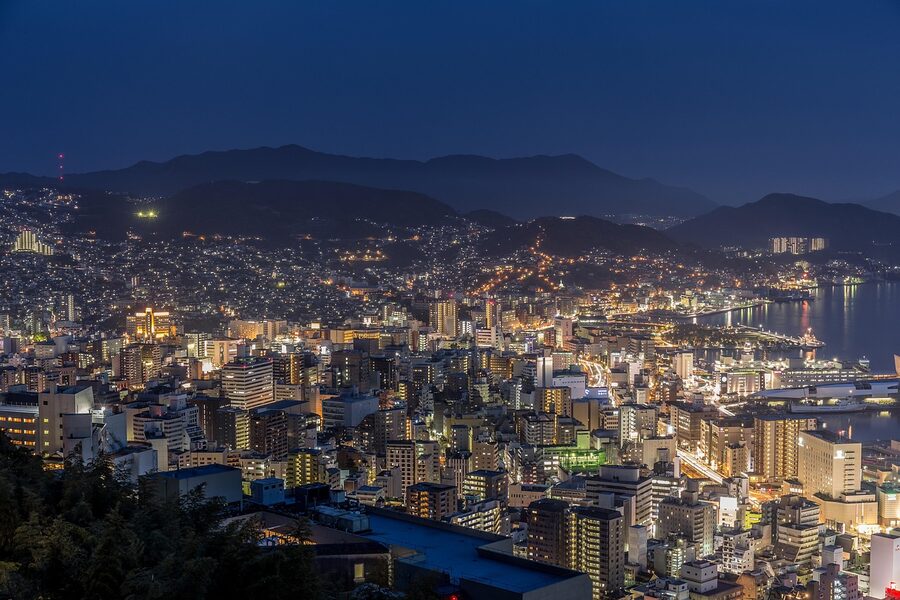
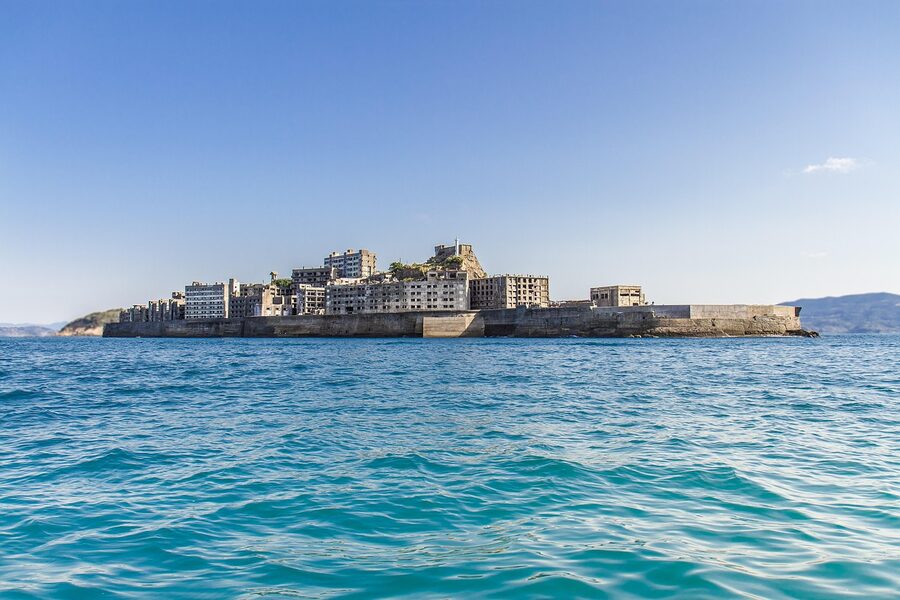
Nagasaki is the most distinctive city on Kyushu. Slope-built, harbour-faced, a Dutch trading post for two centuries when the rest of Japan was closed. Atomic Bomb Museum, Glover Garden, Dejima, Mt Inasa night view, Hashima Island ferry tours. Two nights minimum, see my Nagasaki guide for the unhurried version.
Kumamoto holds Kumamoto Castle, the Aso caldera, the Kuju mountains, and Kurokawa Onsen. The 2016 earthquake damaged the castle keep badly and parts of it are still reopening on a phased schedule, but the central donjon’s been climbable since 2021 and the surrounding park is unrestricted. Inland, the caldera and Kurokawa are why most travellers come.
Oita is hot-spring country: Beppu, Yufuin, Kunisaki Peninsula. More registered springs than anywhere else in Japan. If your Kyushu trip is built around onsen, this is your prefecture.
Miyazaki sits on the south-east coast with a sub-tropical feel and gets less foreign traffic than anywhere else on the island. Takachiho Gorge inland, Aoshima and Udo Shrine on the coast, surfing in summer. The mythology angle is real here, this is where the Japanese creation story is set.
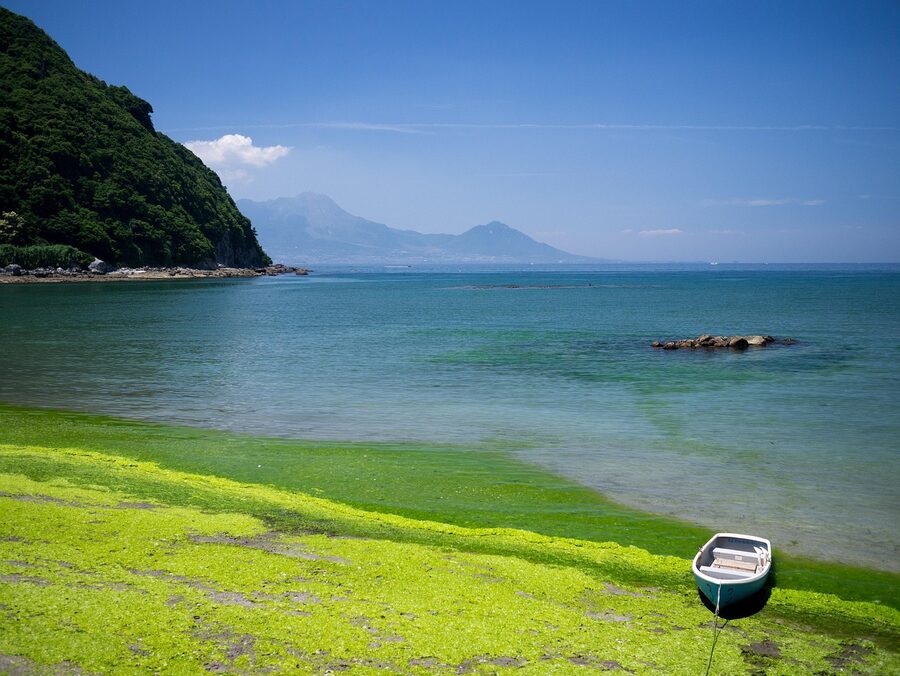
Kagoshima anchors the south. Sakurajima active volcano face-to-face across the bay, Sengan-en garden, Ibusuki sand baths, and the ferry terminals for Yakushima and the Amami island chain. Climate is several degrees warmer than Tokyo, often 4–5 degrees warmer in winter.
The Kyushu Shinkansen, Hakata to Kagoshima-Chuo
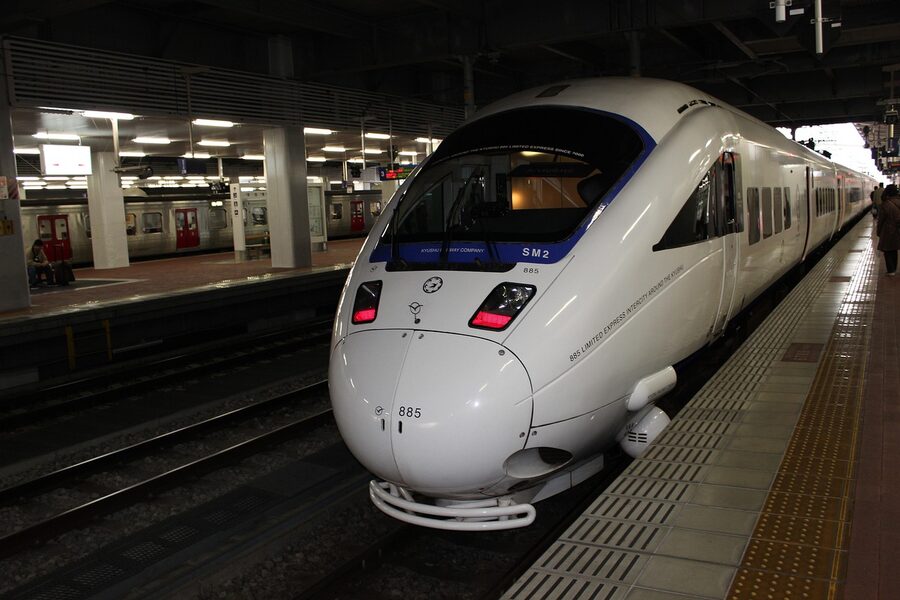
The Kyushu Shinkansen is the spine of any sensible Kyushu trip. It runs from Hakata in Fukuoka south through Kurume, Shin-Tosu, Kumamoto, Shin-Yatsushiro and Shin-Minamata to Kagoshima-Chuo. End to end is 257km. Three service classes share the line: Mizuho is fastest at around 1h 20m Hakata to Kagoshima-Chuo, Sakura is the workhorse most riders use, and Tsubame is the all-stops local.
The pass arithmetic matters here because Kyushu fares add up if you’re hopping cities. JR Kyushu’s own JR Kyushu Rail Pass (international visitors only) sits at ¥22,000 for 3 days all-Kyushu, ¥24,000 for 5 days, and ¥26,000 for 7 days as of 2026 (verified on jrkyushu.co.jp on 2026-05-07, current effective from 1 April 2025). Northern-only and Southern-only sub-passes are cheaper if your trip stays in one half: ¥15,000 for 3-day Northern, ¥12,000 for 3-day Southern. Single Hakata to Kagoshima-Chuo round-trip on the Sakura is around ¥22,000 unreserved, so the all-Kyushu 3-day pass pays for itself the moment you add a side trip.
The national Japan Rail Pass also covers most Kyushu Shinkansen services (Sakura and Tsubame, but Mizuho needs a supplement). If a Kyushu trip is part of a longer Honshu route, the national pass handles it without a separate purchase. Full breakdown lives in my Japan Rail Pass guide; the regional pass detail is in the JR West pass guide, which covers the Sanyo run from Shin-Osaka through Hiroshima down to Hakata, ending exactly where the Kyushu network begins.
The Nishi-Kyushu Shinkansen, opened September 2022
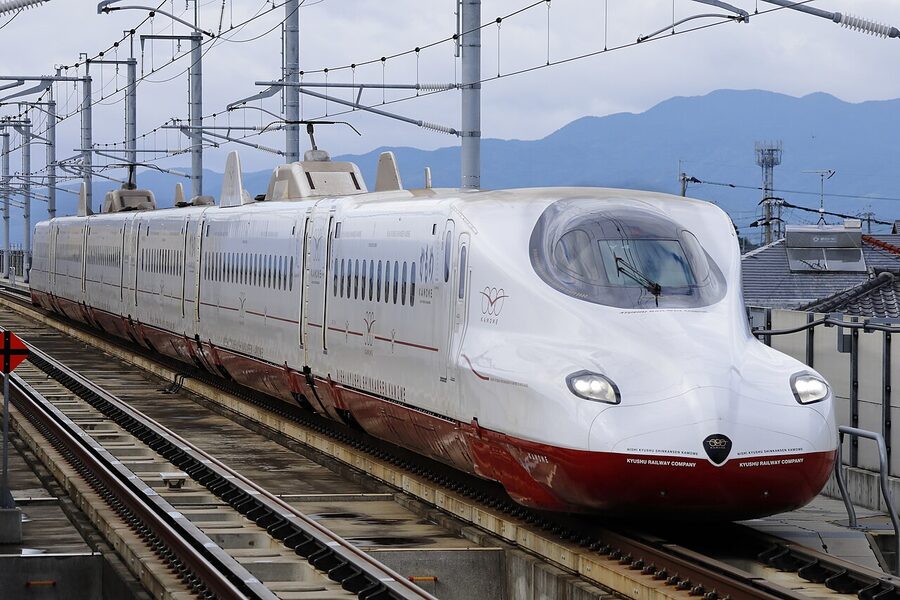
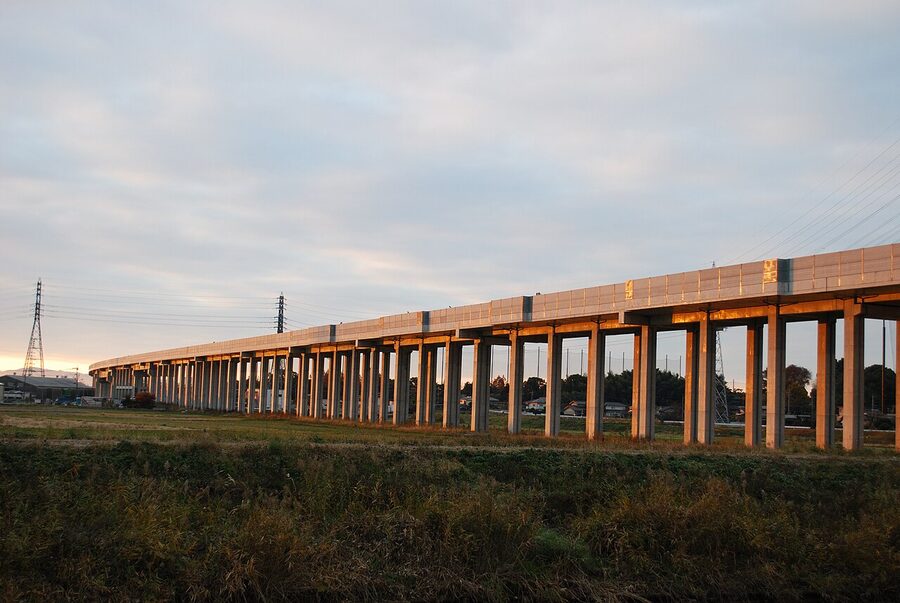
The Nishi-Kyushu (West Kyushu) Shinkansen is the new piece. It opened on 23 September 2022 between Takeo-Onsen and Nagasaki, runs the Kamome service in 23 minutes flat, and uses N700S trainsets with some of the most comfortable interiors on the Japanese network.
The catch is that there’s no direct shinkansen between Hakata and Takeo-Onsen yet. You take the Limited Express Relay Kamome from Hakata to Takeo-Onsen (around an hour), cross the platform, and board the Kamome shinkansen to Nagasaki. Total Hakata to Nagasaki is around 1h 20m, down from the 1h 50m the old Limited Express Kamome managed before 2022. The route construction debate continues (whether the gauge gets standardised across the gap), but for a 2026 trip you take the relay and the cross-platform transfer is signposted clearly in English. JR Kyushu Rail Pass covers it.
Mt Aso: the largest active caldera in Japan you can drive into
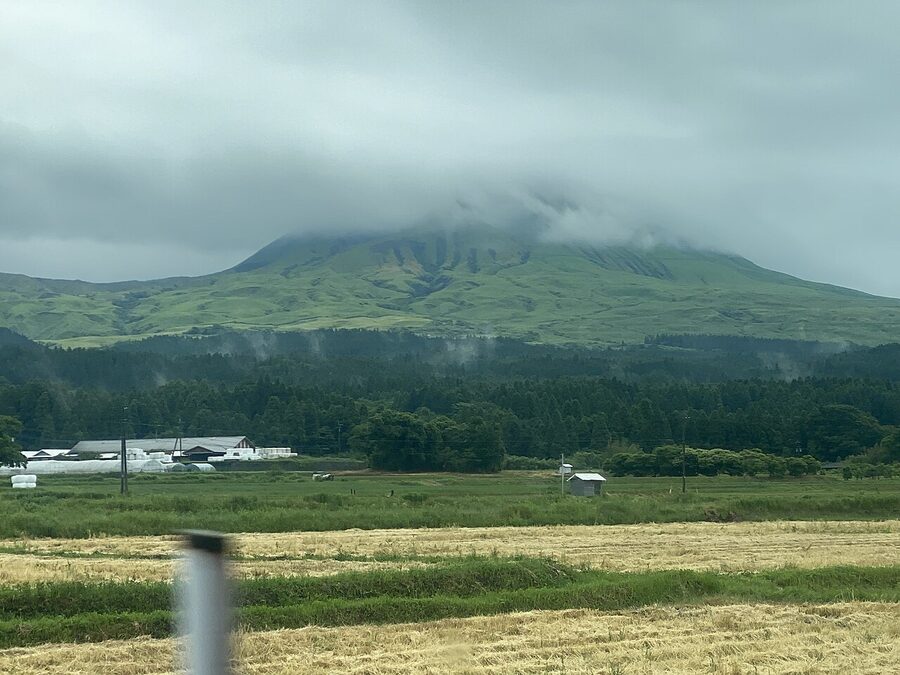
Aso is the geological centrepiece of Kyushu and one of the largest volcanic calderas in the world. The outer rim is about 25km north to south and 18km east to west, formed by four major eruptions between 270,000 and 90,000 years ago. The crucial bit: the caldera floor is fully inhabited. Aso town, the JR Hohi Line, Highway 57, dairy farms, hot-spring inns, and a fair-sized population all sit inside the rim, with the active central cones (Nakadake, Takadake, Kishimadake, Eboshidake, Komezuka) rising in the middle.
The 2016 Kumamoto earthquake closed the JR Hohi Line for years and the trans-Aso direct service from Kumamoto to Oita was only restored in stages, with the full line back to running as the Aso Boy! tourist train as well as regular limited expresses. Check current schedules at jrkyushu.co.jp/english for any 2026 timetable shifts.
Standing on the crater rim
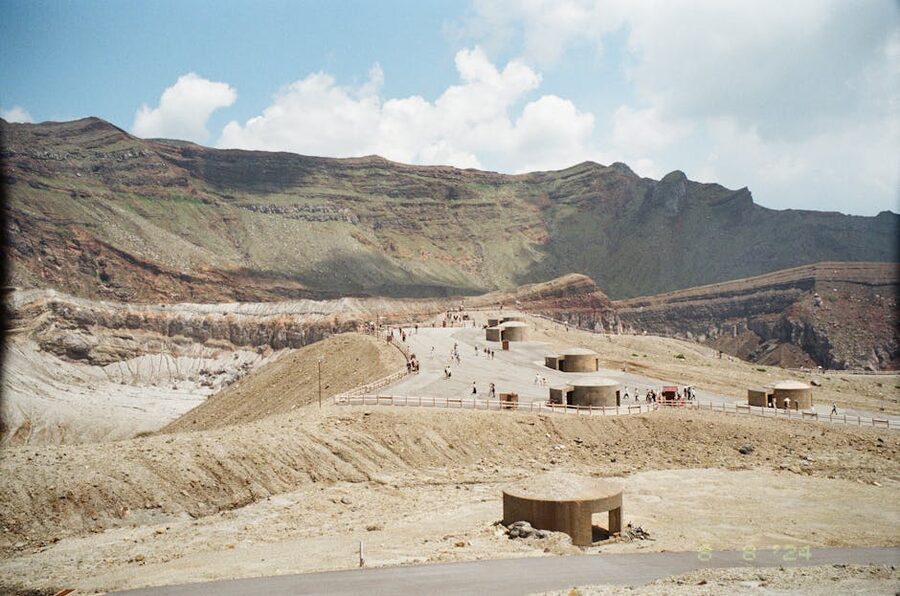
Nakadake is the only currently active vent of the five central cones and the one tourists climb to look at. The caldera rim road around the crater (Yamanami Highway south arm) is open in normal conditions, but the inner crater approach is opened or closed by JMA based on volcanic activity, gas emission, and weather. The Aso Volcano Museum’s website and the Aso Volcano Disaster Prevention Council Twitter feed are the live status sources. When the gate is open, you drive (or take the Aso Volcano Line bus from Aso Station) up to a car park about 1km from the crater rim, then walk the last stretch to the viewing barriers.
Worth knowing: respiratory conditions can be a real problem. Asthma sufferers and anyone with cardiovascular issues are formally advised not to approach the crater. The sulphur dioxide levels at the rim are not a polite warning, the gas concrete shelters along the path are there for a reason. If you wear contact lenses, the gas can be uncomfortable, glasses are easier.
Daikanbo lookout and Kusasenri grassland
If the inner crater is closed (it often is on windy days), the rim viewpoints are still well worth the trip. Daikanbo on the northern rim gives the postcard view of the central cones laid out across the floor, and is open year-round. Kusasenri is a wide grassland on the south-west slope of Eboshidake, with two small ponds and grazing horses; it photographs well in late spring when the green comes through and again in October when the susuki grass turns silver.
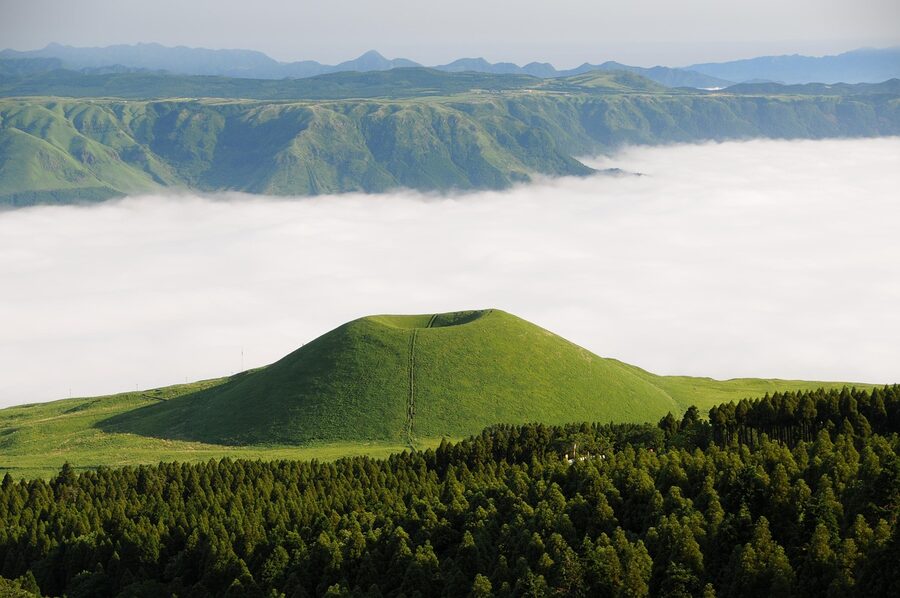
The other underrated stop is Komezuka, a perfect-cone scoria mound shaped like an inverted rice mound (hence the name). It’s small, an easy 15-minute photo stop, and a sharp visual break from the broader caldera shots.
Beppu and Yufuin: hot springs without the Hakone tax
Oita prefecture has more hot-spring water by volume than anywhere else in Japan: the official Onsen Bunka tally puts Beppu alone at over 2,200 individual springs. The two onsen towns to know are Beppu and Yufuin, half an hour apart by car or local train, opposite in temperament.
Beppu: industrial-scale onsen, the eight hot-spring quarters
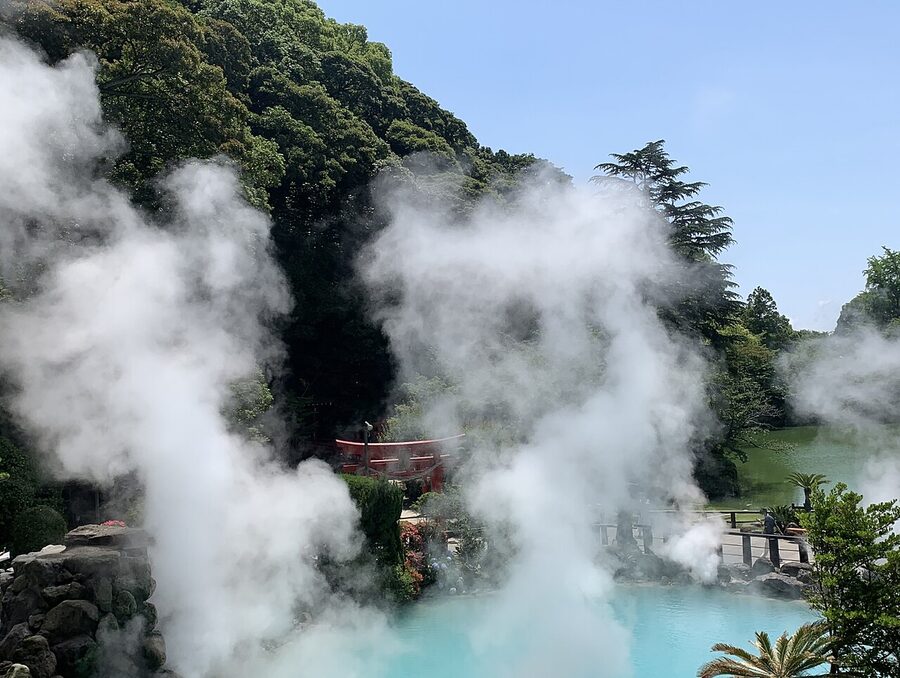
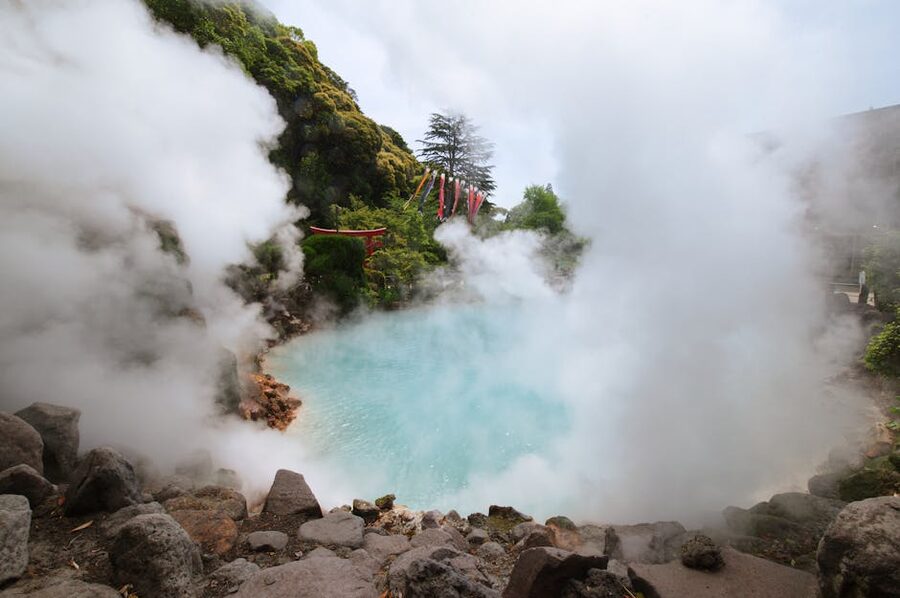
Beppu is the loud one. The whole town steams visibly from underground, and the eight onsen quarters (Beppu Hatto) each have a different mineral character. The Hells of Beppu are seven coloured ponds you look at rather than bathe in: Umi Jigoku (cobalt blue), Chinoike Jigoku (blood red, iron oxide), Shiraike Jigoku (milky white), Oniishibozu Jigoku (grey mud bubbles), Kamado Jigoku (cooking-pot demon), Tatsumaki Jigoku (geyser, every 30–40 min), and Oniyama Jigoku (crocodiles, oddly). The combined seven-Hells admission ticket is ¥2,200 adult, ¥1,000 children, valid for two days, and saves you about a third versus paying per pond. Tour at your own pace via city bus from JR Beppu Station; the route loop is well-signposted.
For actual bathing the must-try is Takegawara Onsen in central Beppu. The original 1879 building was rebuilt in 1938 and looks like a small temple from outside; inside it’s an ordinary public bath at ¥300 for the regular tub or ¥1,500 for the sand bath where you’re buried up to the neck for ten minutes. Towel rental ¥200, no English on the cubbies, point and people will help. It’s the most atmospheric municipal bath in Japan and one of the cheapest.
Yufuin: the boutique onsen town with a mountain backdrop
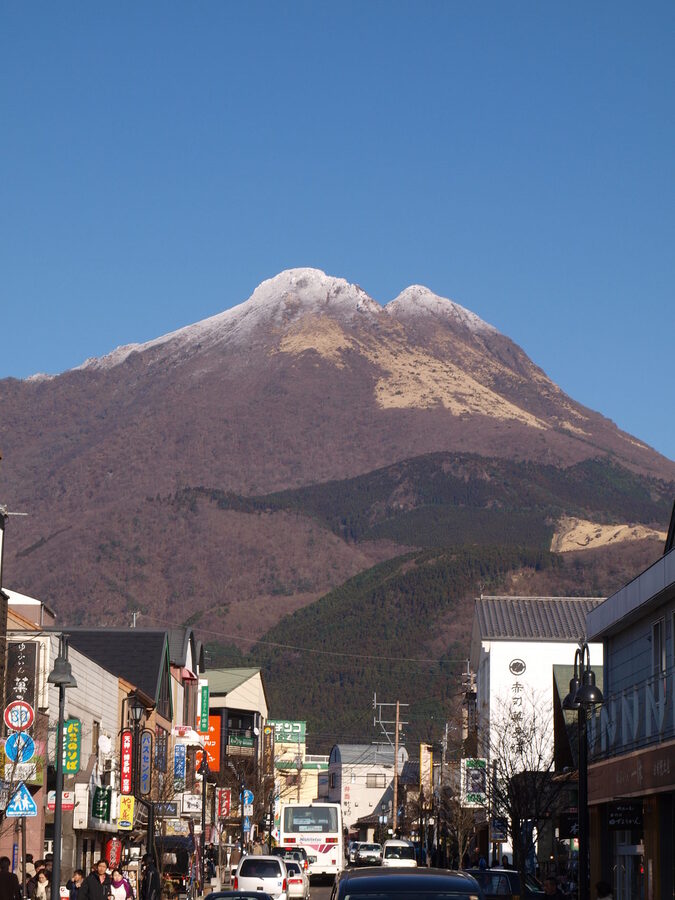
Yufuin is the quiet alternative. The town sits in a small basin under the twin peaks of Mt Yufu, a 90-minute walk-able loop runs from JR Yufuin Station along Yunotsubo Kaido past Lake Kinrin to a string of independent ryokan and small galleries. The Yufuin no Mori limited express from Hakata is worth a trip for itself: timber-panelled cabin, small lounge car, runs three or four times a day either direction, around 2h 15m from Hakata.
The famous ryokan here (Tamanoyu, Sansou Murata, Kamenoi Bessou) book out months ahead and run ¥50,000 to ¥80,000 per person per night with dinner and breakfast. The day-bath rotenburo at Sansou Murata’s affiliated buildings can sometimes be visited as a non-staying guest if you ask politely at the ryokan reception (around ¥2,500–3,500). For a normal-budget ryokan stay, the second-tier inns along the eastern lake walk run ¥15,000–25,000 per person and are completely fine.
Kurokawa Onsen: the thatched-roof alternative

Kurokawa Onsen sits on the Kumamoto side of the prefectural border, an hour by bus from Aso town and 90 minutes from Yufuin. It’s the architecturally consistent one of Kyushu’s onsen towns: traffic restricted, neon banned by local code, around 30 ryokan and a single small commercial street. The Nyuto-tegata wooden bath-token system (¥1,500 for three baths within six months, swap with any participating ryokan) is the right way to sample the variety here without committing to a stay. Day-trippers can reach Kurokawa from Aso town by Kyusanko bus, around 90 minutes. Overnight is better, ryokan run ¥18,000–35,000 per person with meals.
Sakurajima: an active volcano you watch from breakfast
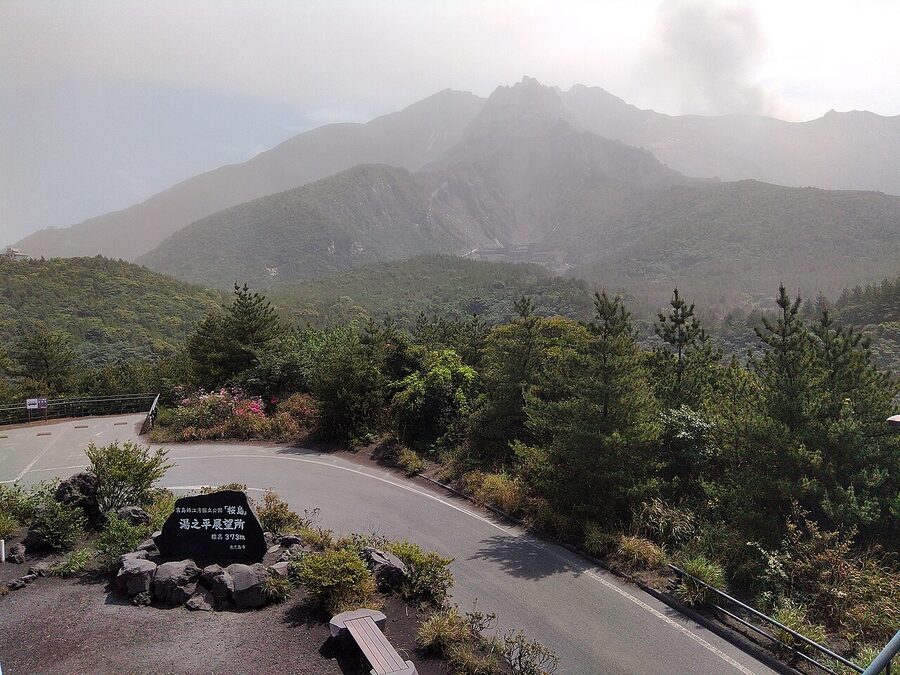
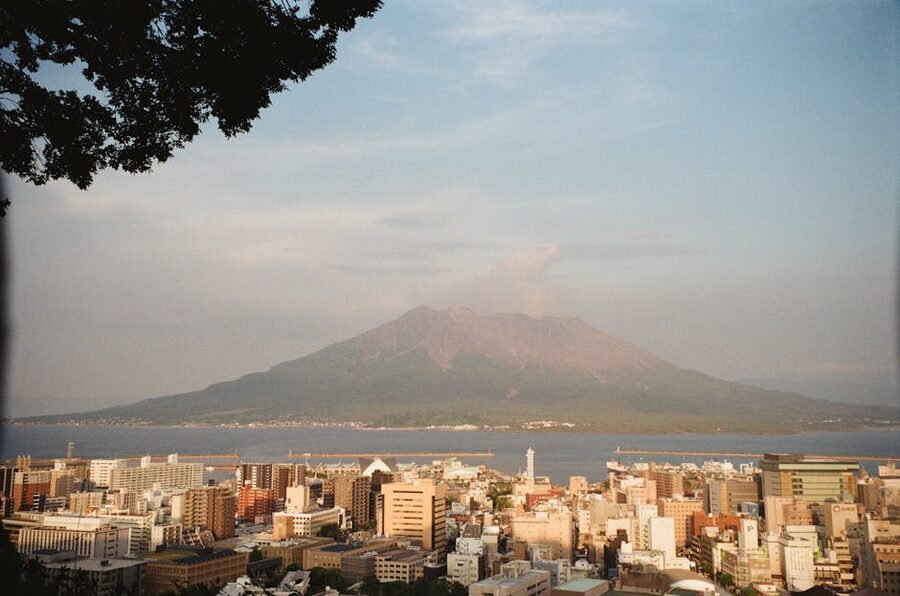
Sakurajima is the volcano that defines Kagoshima. It sits 4km across the bay from the city centre, erupts on average several hundred times a year (most are small, some are not), and was a separate island before the 1914 eruption joined it to the Osumi Peninsula. The 1914 lava flow is still visible as a black flat ridge on the south-east shore.
The standard visit is a half-day loop from central Kagoshima. The Sakurajima Ferry (operated by Kagoshima City) runs from Kagoshima Port to Sakurajima Port, 3.5km across, around 13 minutes. The ferry’s 24-hour operation was revised on 1 October 2025 (verified on city.kagoshima.lg.jp on 2026-05-07), so check the current schedule before late-night plans. You don’t need to book.
On Sakurajima itself, the obvious viewpoint is Yunohira (described above the mid-section of the volcano), reached by the Sakurajima Island View Bus that loops from the ferry port. The bus runs roughly hourly, day-pass ¥500. Other stops on the loop: Karasujima Observatory (the engulfed island the lava swallowed), Akamizu Observatory (the giant scream-shaped sculpture), and the Nagisa Lava Park footpath where the 1914 flow meets the bay.
Practical: keep your laundry indoors if the wind is blowing your way, the ash settles on everything in town. Convenience stores in Kagoshima sell special yellow ash-collection bags (kouhai-bukuro) for residents to bin volcanic ash. The exposed road surface in Sakurajima town can be slippery when ash and rain combine. None of this is dangerous as a visitor, but it’s the texture you don’t get reading the website.
Yakushima: the world-heritage cedar island
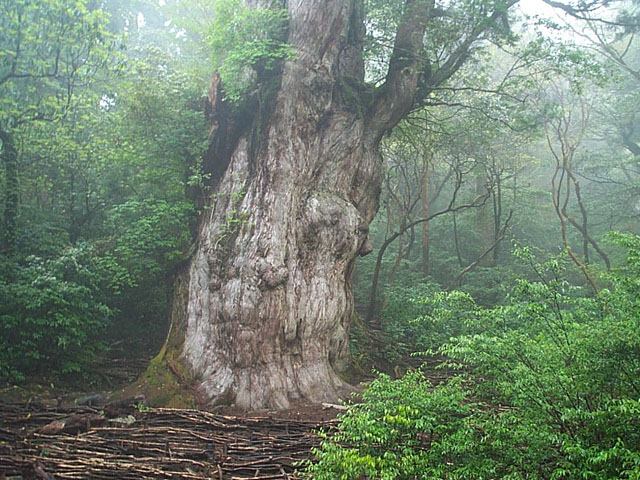
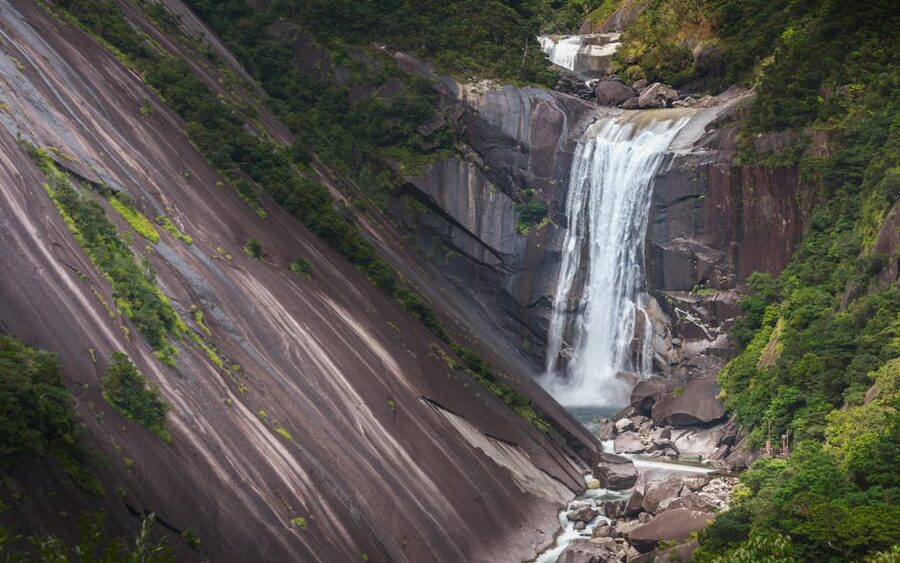
Yakushima is the round island 60km south of Kagoshima that became one of Japan’s first UNESCO World Heritage Sites in 1993. It’s roughly circular, 28km across, and the interior is a raised dome of granite covered in primary cedar forest. Around 21% of the island is the World Heritage core area. It rains a lot here, the local saying is “35 days a month”, and that rain is what feeds the moss layers that make the forest look the way it does.
You get to Yakushima two ways. The fast option is the Toppy/Rocket jetfoil from Kagoshima Port (around 1h 50m to Miyanoura or Anbo, both ports on Yakushima); the slow option is the Hibiscus car ferry which takes around 4 hours but lets you bring a hire car. Jetfoil round trip runs around ¥25,000–28,000 adult; the ferry is roughly half that. Book ahead in summer and on national holidays.
The Jomon Sugi hike
Jomon Sugi is the giant cedar most people come to see, age estimates between 2,000 and 7,200 years (the wide range reflects how hard core-sampling is on a tree this old). You don’t roll up to it in a car. The standard route in is the Arakawa Trail: 22km round trip, walking the disused Anbo Forest Railway tramway for the first 8km then climbing steep boardwalk and stepped trail for the last 3km. Allow 8 to 10 hours of walking. Start in the dark (head torches mandatory before sunrise), bring rain gear regardless of forecast, and pack lunch.
From March to November the road to the Arakawa trailhead is closed to private cars. You take a shuttle bus from Yakusugi Land or from Anbo town for ¥1,500 round-trip (advance ticket required). November to February the road is open to private vehicles. The Yakushima Recreation Forest fee is ¥1,000 per person from 1 March 2024 onwards as part of the trail management funding scheme.
If you don’t have a day for Jomon Sugi
Shiratani Unsuikyo is the moss-forest gorge that inspired the visual look of Studio Ghibli’s Princess Mononoke. The Yayoi Sugi loop here is 4 hours round trip, the Taikoiwa loop is 6, and the trailhead is 30 minutes inland from Miyanoura. Entry ¥500. This is the realistic Yakushima half-day if your itinerary doesn’t have a full pre-dawn start.
Yakusugi Land further south is even shorter, a graded boardwalk circuit from 30 minutes to 2.5 hours through similar (slightly less iconic) forest. Nature trails A, B, and C lengthen progressively. Entry ¥500. Doable in an afternoon after a morning ferry in.
Kuju, Kunisaki, and the in-between mountains
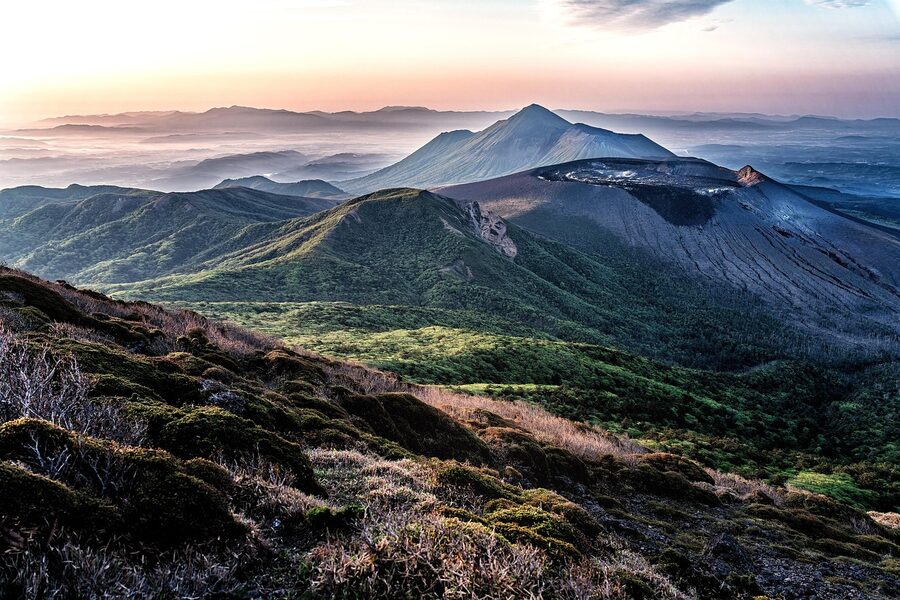
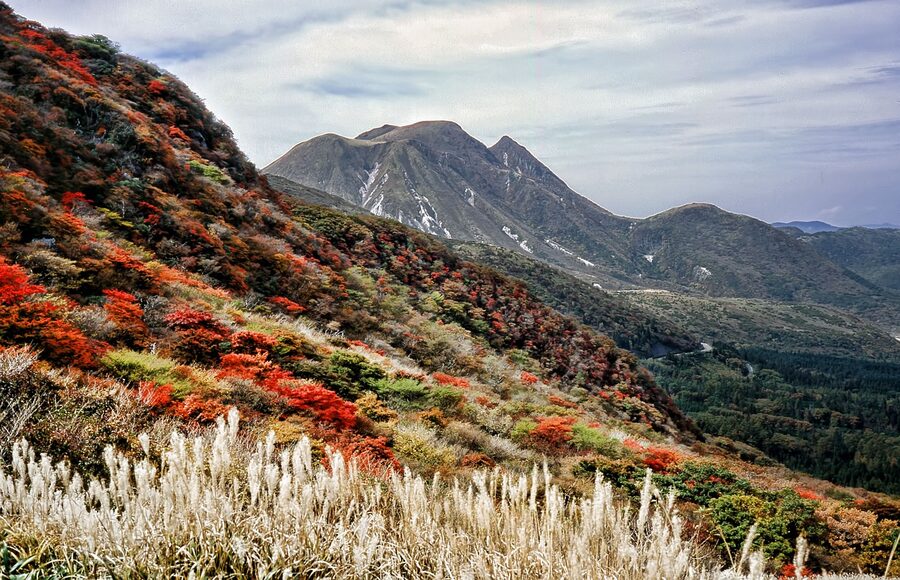
The Kuju mountain range sits between Aso and Beppu and is the highest range in Kyushu (Nakadake at 1,791m). It’s a serious hiking range with proper alpine huts and a season that runs roughly April to November. The Makinoto Pass car park gives the easiest access, with a 4-hour round-trip walk to Mt Kujusan that picks up around 700m of climb. In June and early July the Miyamakirishima azalea covers the slopes pink, which is the season most local hikers come for. October colour is excellent and quieter.
The Kunisaki Peninsula sticks out east of Beppu and is one of the strangest landscapes in Japan: a lava-built circular peninsula with a Buddhist mountain culture (Rokugo Manzan) that pre-dates most of Japan’s better-known mountain temples. The Futago-ji temple complex is the major site, but Fuki-ji (Japan’s oldest extant wooden Buddhist building in Kyushu) and the Kumano Magaibutsu rock-carved Buddhas are both worth working into a half-day driving loop. Bus access is light, this is a peninsula best done in a hire car.
Takachiho Gorge and the mythological south-east
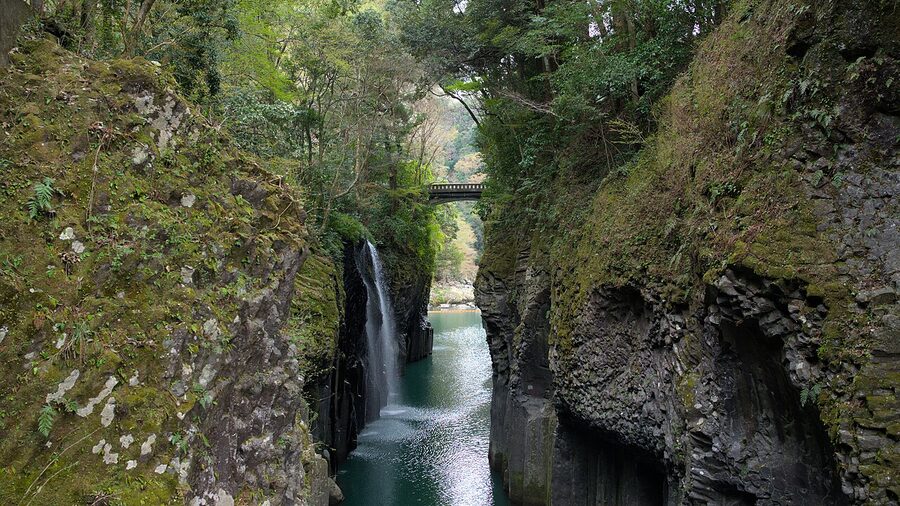
Takachiho Gorge in Miyazaki prefecture is where the basalt columns of an old Aso lava flow were carved by the Gokase River into a narrow corridor topped by the 17m Manai Falls. The boat shot you’ve seen on every Kyushu Instagram feed is real but the practicalities are not always shared. Boat hire is ¥5,100 for a 30-minute slot, three people per boat, advance reservation through the gorge website is essential in spring and autumn (you’ll queue 2–4 hours otherwise). Walking the rim path is free and gives a different angle that arguably photographs better in the morning side-light.
The town of Takachiho also runs a yokagura performance most evenings at Takachiho Shrine: four masked dances retelling fragments of the cave-and-sun-goddess myth where Amaterasu (the sun goddess) was lured out of hiding. ¥1,000 entry, 20:00 start, runs about an hour. Touristy but well-staged, and the shrine itself is worth a daytime visit for the 800-year-old paired chinquapin trees in the compound.
Travel time from Kumamoto is around 2h 30m by car (the JR Hohi Line stops short, you take a bus connection from Aso). From Miyazaki city it’s a similar 2h drive west. Most travellers stay one night, which makes sense.
Kumamoto Castle and the city as a base
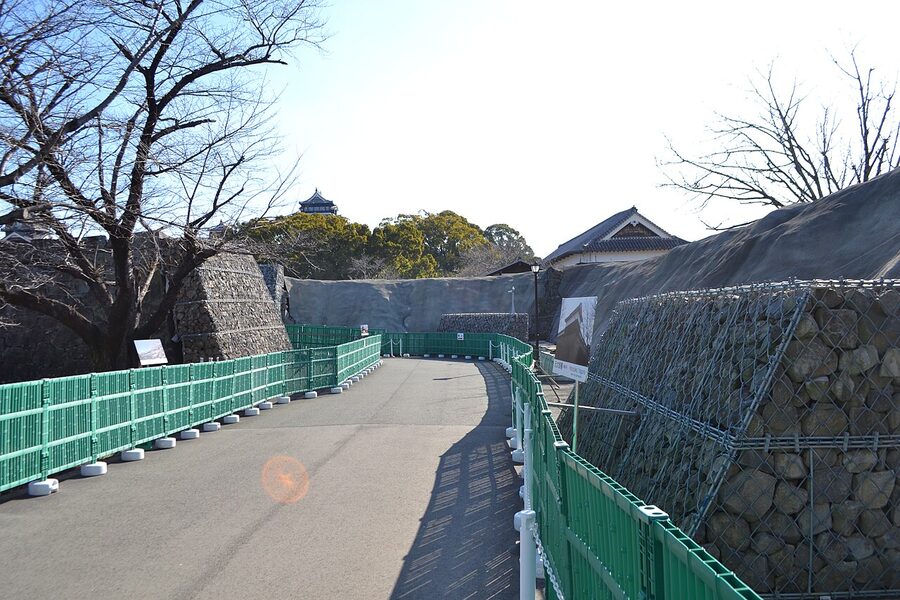
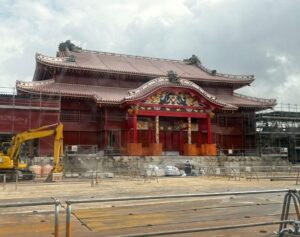
Kumamoto Castle is one of the three so-called premier castles of Japan (with Himeji and Matsumoto), and it took the heaviest damage of any major castle in the 2016 Kumamoto earthquake. The 2016 quake collapsed sections of the long stone wall, knocked turrets off their foundations, and dropped tiles off the central donjon. Restoration is officially scheduled out to around 2052 in phases. The central keep reopened to interior visitors in spring 2021 (admission ¥800 adult, ¥300 child), and the surrounding park is unrestricted year-round.
This is one of those places where the active restoration work is part of the story. Walking the southern approach you can see specific sections of the castle in different states of repair, with photographer-style information boards explaining how the masonry was numbered and reset stone by stone. The approach across Yobimon-bashi bridge in cherry blossom (around 25 March in normal years) is one of the better hanami photographs anywhere in Kyushu, and the late-March crowds are still well below Tokyo or Kyoto levels.
For a city base, Kumamoto sits on the Kyushu Shinkansen (50 minutes from Hakata, 45 from Kagoshima-Chuo) and connects east to Aso and west to the Amakusa islands. The city’s underrated attraction is Suizenji Jojuen, a 17th-century stroll-garden built around a miniature reproduction of the 53 stations of the Tokaido road, with a small Mt Fuji-shaped hill in the middle. ¥400 admission, takes about 45 minutes to walk through.
Regional foods that don’t travel
The food map of Kyushu changes shape every couple of prefectures, and a fair amount of what’s good locally barely exists outside the island. Knowing what to look for where is a third of the trip.
Hakata ramen and tonkotsu
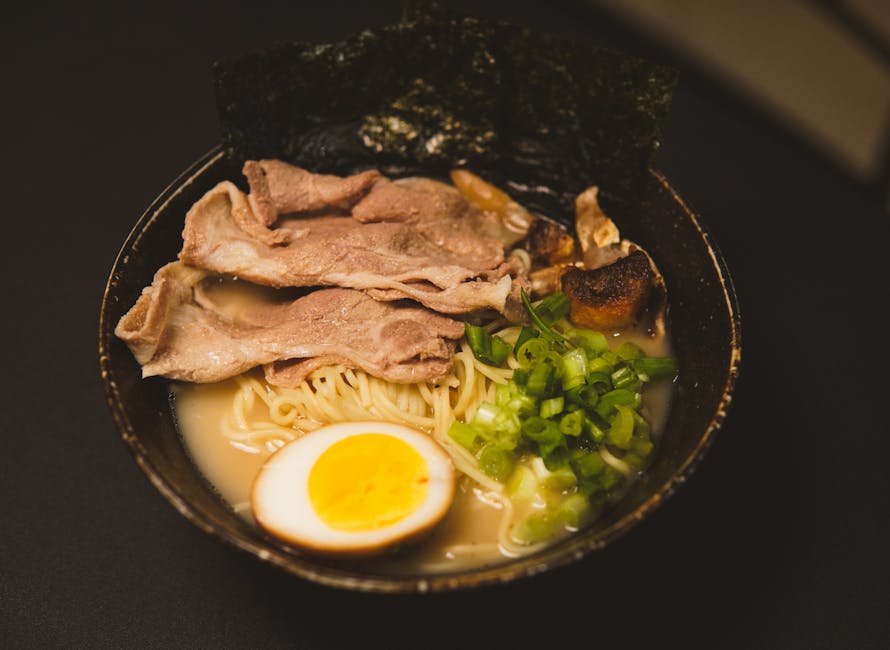
Hakata ramen (the Fukuoka style of tonkotsu) is the regional dish that travelled. It’s defined by a milky, long-boiled pork-bone broth, very thin straight noodles, and the kaedama system: when you’ve eaten the noodles but the broth is still good, you order kaedama (around ¥150) and a fresh ball of noodles arrives in your bowl. Hakata Issou, Ichiran (touristy but well-run), and Shin-Shin are the chains that get most of the foreign-tourist attention in Hakata. Ippudo, founded in Fukuoka in 1985, has the best small-format branches around the city.
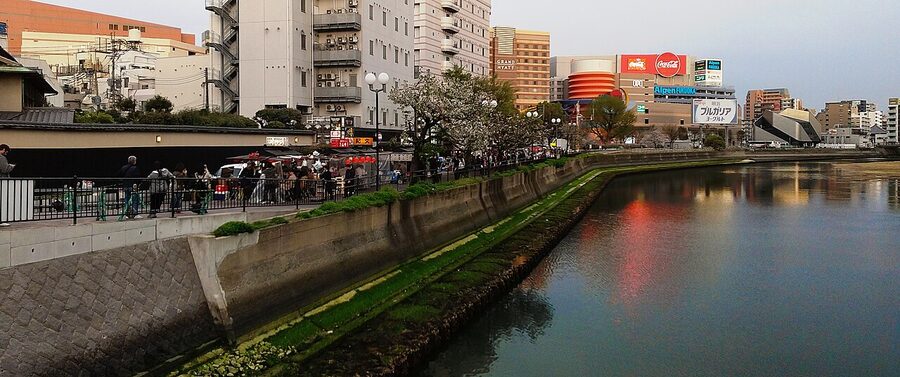
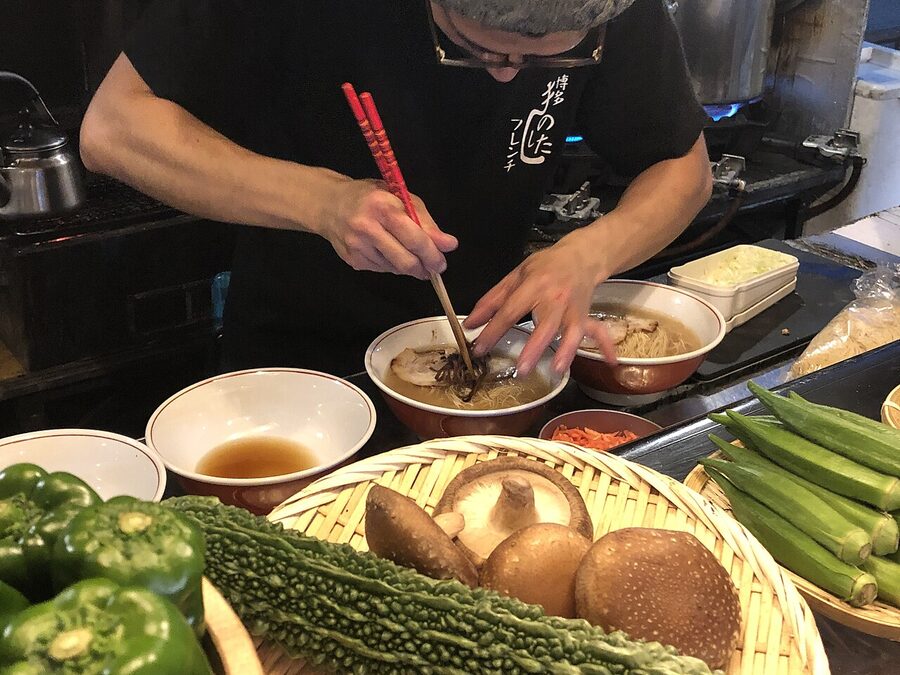
The yatai stalls along the Naka River in Nakasu are the other tonkotsu experience, covered in detail in the Fukuoka guide. Around 100 stalls operate in central Fukuoka, the highest density anywhere in Japan, and the river-side row is the photogenic one. They open from sundown (around 18:00 in summer, 17:00 in winter) and most close around 02:00. Single-row counter seating, eight to ten seats, no English menu but plenty of pointing-friendly displays. Reckon ¥1,500–2,500 per person for ramen plus a couple of yakitori sticks plus a beer.
Motsunabe and mizutaki
The two named-pot Fukuoka dishes are motsunabe (offal hot-pot, mainly cow intestine in a soy or miso broth with cabbage, garlic chives, and chillies) and mizutaki (chicken, water-based, very plain). Motsunabe sounds gut-clenching but the prepared offal is clean, mild, and barely chewy: closer to a tender brisket than anything offaly. Reckon ¥2,500–3,500 per person for a shared pot. Onda or Yamaya are the Fukuoka chains most often recommended.
Basashi: horse sashimi
Kumamoto is the Japanese capital of horse meat. Basashi is the raw sashimi version, served thinly sliced with grated ginger, garlic, and sweet soy sauce. The taste is closer to lean beef than to anything gamey, and the texture sits between a fillet steak tartare and a tuna sashimi. Counter places near Kumamoto Station and the central Shimotori arcade run ¥1,500–2,500 for a small plate. If raw horse is a step too far, the same ingredient turns up in basashi sushi rolls and tatakiyaki seared variants that are easier on the imagination.
Kagoshima black pork (kurobuta) and shochu
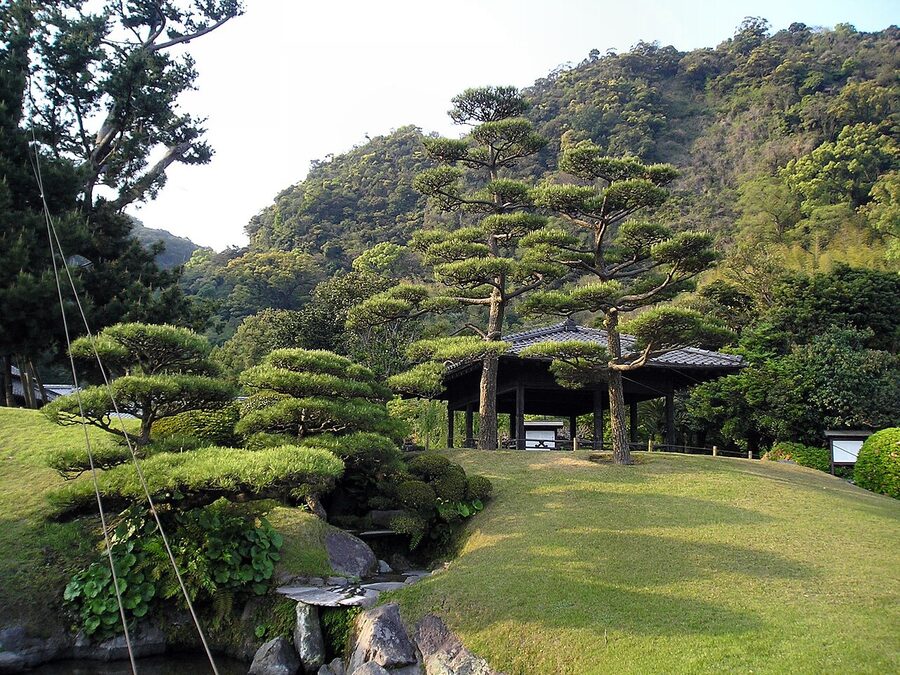
Kagoshima’s pork is the regional pride: Berkshire-derived black-pig kurobuta, fattier and sweeter than standard Japanese pork. The signature preparation is shabu-shabu (briefly cooked in boiling water at table) but kurobuta tonkatsu (deep-fried breaded cutlet) is the easy entry point. Tonkatsu Tonkichi and Wakana are two reliable Kagoshima downtown options around ¥2,200–3,000 for a kurobuta cutlet set.
Shochu is the southern Kyushu drink. While other regions distil shochu from rice or barley, the southern prefectures (Miyazaki, Kagoshima) make imo-shochu from sweet potato. Stronger than nationally average shochu, around 25% ABV, with a distinctive sweet-earth nose. Drink it oyuwari (mixed with hot water) or rokku (over ice). Convenience stores sell single-shot bottles for under ¥200, and Sasakura bar in Kagoshima has over 500 varieties on the menu.
Champon, sara udon, and Nagasaki’s Sino-Japanese hybrid
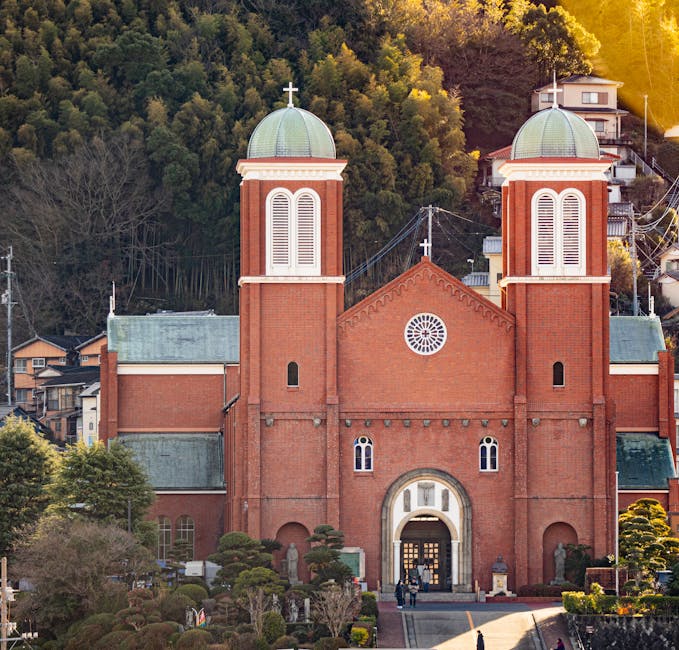
Nagasaki was the only port open to Chinese and Dutch traders during the Edo period, and the food shows. Champon is a thick noodle dish in milky pork-and-seafood broth, originally a Chinese student dish reworked for local taste in the 1890s. Sara udon is the same flavour profile but with crisp-fried noodles instead of soup. Both invented at Shikairo restaurant in Nagasaki Chinatown, which still operates. Reckon ¥1,200–1,800 per bowl. Castella (sponge cake), brought by the Portuguese in the 16th century, is the dessert side of the same trading-port story. Detailed restaurant picks in the Nagasaki guide.
Karatsu pottery and Imari porcelain
Saga prefecture’s craft heritage is mostly clay. Karatsu has been making rough, tea-ceremony-style stoneware since the 16th century. Arita and Imari (next prefecture over) produce the fine white porcelain Japan started exporting to Europe in the 1650s, the kind your grandmother had a saucer of. Visit the Kyushu Ceramic Museum in Arita (free entry, 09:00–17:00, closed Mondays) for the historical sweep, then the Tonbai-bei walls of Arita town (kiln-debris brick walls) for the lived-in version. The annual Arita Pottery Fair (29 April–5 May) sees over a million visitors and is the cheapest place to buy serious pottery in Japan.
Seasonal pivots: Kyushu’s calendar runs a fortnight off Honshu’s
One of the practical reasons to plan Kyushu separately is the climate. The whole island sits on the Pacific side of Japan around latitude 31–34°N, several hundred kilometres south of Tokyo. Winter is mild, summer is long and hot, and the seasonal markers are systematically a week or two off from Honshu.
Spring (late March to mid-May)
Cherry blossom hits Kyushu first. The Japan Meteorological Agency (JMA) tracks the sakura-zensen (cherry blossom front) annually, and the first trees in mainland Japan typically open in Fukuoka or Kumamoto around 22–25 March, full bloom 26 March to 2 April. Kumamoto Castle, Kintai-bashi at the edge of the Sanyo region, Maizuru Park in Fukuoka, and Tatsuno Park in Saga are the named viewing spots. Plum blossom comes earlier (Dazaifu Tenmangu in mid-February through early March, with around 6,000 trees). For full national context see the cherry blossom Japan guide.
April and May are the easy weeks. Daytime temperatures around 18–23°C, low humidity, the wisteria at Kawachi Fujien (north Fukuoka, late April to early May, advance ticket required) is one of the famous flower scenes in Japan. Golden Week (29 April–5 May) is the only crowded stretch.
Summer (June to early September)
Tsuyu (rainy season) hits Kyushu first, typically from early June to late July. Daily rain is normal, sometimes heavy. From late July through August it’s hot and humid, regularly 32–35°C, with the south (Kagoshima, Miyazaki) running a degree warmer than the north. Sakurajima is more eruptive in summer, the ash drifts more. Typhoons cluster from August into September; these affect ferries, mountain trails, and occasionally shinkansen scheduling. Watch the weather windows.
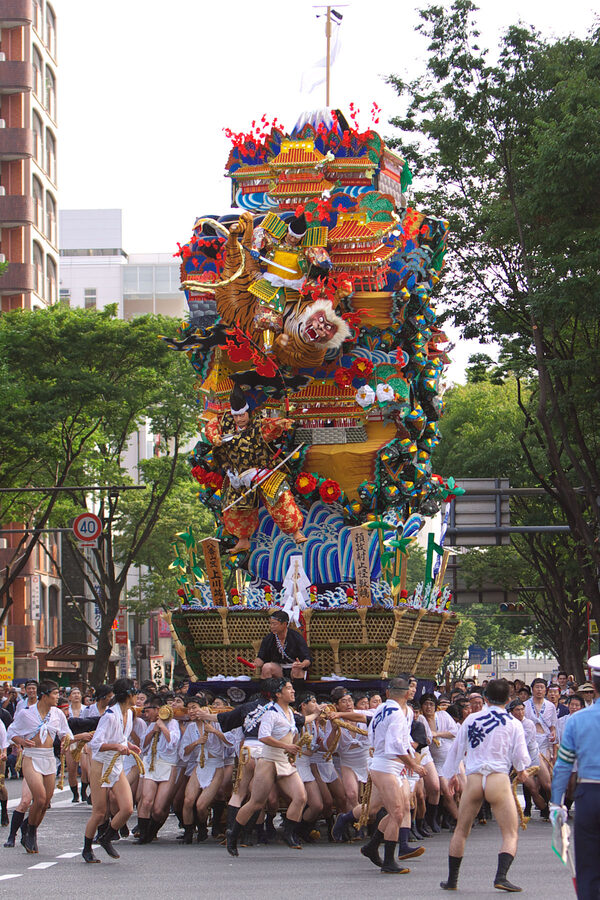
The summer redeeming feature is festivals. Hakata Gion Yamakasa (1–15 July, Fukuoka) is the headline: 28-tonne floats, 5km sprint pre-dawn on 15 July, 1,300 years old. Tobata Gion in Kitakyushu, Beppu Onsen Festival in early April, Yamaga Toro lantern festival in mid-August (Kumamoto): all worth planning around if your timing fits.
Autumn (mid-October to early December)
Kyushu autumn colour runs roughly two weeks behind Tokyo’s. Kuju mountains and Aso are early (mid-October at higher elevations); Yabakei gorge in Oita and the temple gardens of Takachiho hit peak around mid-November; the city parks of Fukuoka and Kumamoto colour in late November. Average daytime temperatures 15–22°C, low humidity, mostly clear skies. With Honshu’s foliage already fading, this is when shoulder-season Kyushu is at its quietest and most pleasant.
Winter (December to early March)
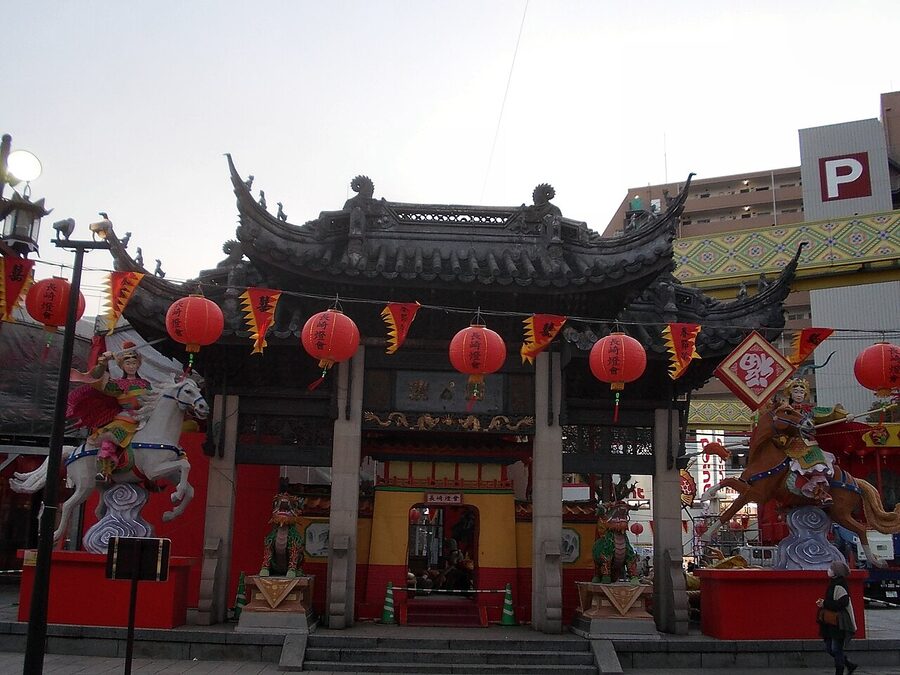
Mild on the coast, around 4–9°C in the cities, occasional snow in the mountains. The Kuju and Aso ranges get snowfall and sometimes close roads, but Beppu, Fukuoka, and Kagoshima rarely see snow on the ground. Yufuin and Kurokawa in winter are particularly good: snow on a thatched ryokan roof, steaming open-air rotenburo, the kind of postcard you came for. The Nagasaki Lantern Festival (Lunar New Year, around 9–23 February in 2026) draws a million visitors over two weeks.
The other reason winter works in Kyushu is that the rest of Japan is harder. Hokkaido is great but expensive and infrastructure-heavy; Tohoku is genuinely cold and quiet to a fault. Kyushu in February is roughly Mediterranean weather, with proper hot springs and far fewer tourists than spring or autumn. If you’ve seen Kyoto and Tokyo, this is the off-season case.
Practical: how Kyushu actually works
Getting there
Fukuoka Airport (FUK) is the obvious entry point. Among the world’s closest airport-to-city links: 5 minutes from terminal to Hakata Station on the subway Kuko Line, ¥260 fare. International flights from Seoul, Shanghai, Taipei, Hong Kong, and Bangkok land regularly; longer-haul travellers usually transit Tokyo, Osaka, or Seoul. Kagoshima Airport (KOJ) at the south end is the second-largest, plus smaller airports at Kumamoto, Nagasaki, Miyazaki, and Oita.
By rail, the Sanyo Shinkansen from Shin-Osaka runs through Hiroshima down to Hakata in around 2h 25m on the Nozomi (around ¥15,400 unreserved). From Tokyo, Shin-Osaka transfers add another 2h 30m. Total Tokyo to Hakata is around 5h with one transfer. The whole national-pass argument lives in the Rail Pass guide; for west-Japan-only trips the regional JR West pass ending at Hakata is a strong fit.
Getting around once you’re there
The Kyushu Shinkansen plus JR Kyushu’s network of limited expresses (the named scenic trains, Yufuin no Mori, Aso Boy!, Sonic, Kamome relay) covers most cities and the major onsen towns. Fast, comfortable, and the tourist-train fleet is one of the most diverse in Japan. The JR Kyushu Rail Pass (international visitors only, prices above) is the cheapest way to use it for any trip longer than two days that hits more than two cities.
Bus fills the gaps the train doesn’t reach. Highway bus from Hakata Bus Terminal serves Aso town, Kurokawa Onsen, Takachiho, and Yufuin directly without rail transfer. SunQ Pass (3-day ¥11,000, 4-day ¥14,000) covers most highway buses across all seven prefectures and is the right answer if your trip leans on bus more than train.
Hire car is the underrated option for Kyushu specifically. The Kunisaki Peninsula, Sasebo coast, Itoshima, the Aso rim road, and the rural sections of Saga and Miyazaki are all materially easier with a car. Toll roads accept ETC (rentable, automatically charged) or cash; carry physical cash for older expressway booths. Drive on the left, international permit required.
Where to stay
City hotels in Fukuoka, Kagoshima, Kumamoto, and Nagasaki run roughly ¥9,000–18,000 per night for a comfortable mid-range double, lower than equivalent Tokyo or Kyoto. The Ritz-Carlton Fukuoka opened in 2023 and is the highest-end option in the city; the Marriott Nagasaki (opened 2024) anchors the new harbour-side development. For sibling-brand reliability, JR Kyushu’s own JR Kyushu Hotels (Blossom in Hakata, Hotel Kumamoto, etc.) sit on top of the stations and are excellent for transit-heavy trips.
Onsen ryokan in Yufuin, Kurokawa, Beppu, Ureshino, and Ibusuki are where the real overnight experience lives. Mid-range ryokan including dinner and breakfast (the famous one-night-two-meals format) runs ¥15,000–30,000 per person; high-end ryokan (Sansou Murata, Tamanoyu, Wasureno-Sato Gajoen) run ¥50,000–100,000 per person. Per-hotel breakdowns in the city guides; this hub piece keeps the listings short.
Budget
Daily costs run ¥10,000–25,000 per person, similar to the rest of Japan but a touch easier in Kyushu. Hakata ramen is ¥800–1,200 a bowl. A solid izakaya dinner with two beers is ¥3,500–5,000. Local trains and city buses use the same IC card system as the rest of Japan (Sugoca is the JR Kyushu card, but Suica, Pasmo, Icoca, and other national cards interchange without issue).
Cash culture is real in Kyushu, more so than central Tokyo. ATMs at 7-Eleven and Family Mart accept foreign cards, opening hours are 24/7 in cities. Rural hot-spring towns and small ryokan often request cash for any in-house extras (drinks, sake, the rotenburo entry surcharge), so keep ¥30,000–50,000 in cash on a multi-day rural leg.
Three Kyushu itineraries that work
The 4-day cross-section
Day 1: Fly into Fukuoka, eat ramen on the yatai row in Nakasu, sleep in Hakata.
Day 2: Shinkansen to Kumamoto (50 min), Kumamoto Castle and Suizenji garden, evening basashi.
Day 3: Bus or rental car to Aso, walk Daikanbo and the rim road, overnight in Aso town.
Day 4: Cross-island to Beppu via the Yamanami Highway (or train via Kumamoto if no car), Hells of Beppu, Takegawara onsen, fly out from Oita Airport. Total cost roughly ¥90,000–130,000 per person plus flight.
The 7-day full island
Adds Yufuin (Day 4-5), Kagoshima and Sakurajima (Day 5-6), and Nagasaki on the way back via the Nishi-Kyushu Shinkansen (Day 7). 7-day all-Kyushu pass ¥26,000 plus seat reservations covers most rail. Drops the high-end ryokan luxe of a 10-day trip but keeps every major sight.
The 10-day deep-dive
The 7-day route plus Yakushima (3 nights from Day 6, returning to Kagoshima for the southern run), or alternatively Takachiho and the Miyazaki coast (3 nights). This is the version where the island actually lands. Yakushima and Takachiho are the inland two destinations that most rushed itineraries cut, and where most of the post-trip stories actually come from.
What to combine Kyushu with
The natural Honshu pairing is Hiroshima and Miyajima, since the Sanyo Shinkansen drops you straight into Hakata. A Tokyo-Kyoto-Hiroshima-Kyushu run on a 14-day national rail pass is the textbook two-week first-time Japan trip, with Kyushu as the rural finale. Two other angles worth considering:
Combine with Okinawa if you want the deep-south arc. From Kagoshima Port the Marix or A-Line ferry runs overnight to Naha (around 24 hours, sleeper berths available); the daily Skymark and JAL flights from Fukuoka or Kagoshima to Naha take 1h 20m and run from around ¥15,000.
Combine with Tokyo direct if your trip is short. Skymark and ANA fly Haneda to Fukuoka in 2h, around ¥20,000–35,000 depending on season. Tokyo » Fukuoka » Kagoshima » Tokyo as a one-week loop with no Honshu sights is unconventional but works: you skip the Kyoto crowd and put the time into Kyushu’s spread instead.
One last thing. The Kyushu I keep coming back to isn’t the famous-sight version, it’s the hour-after-dinner one. Walking back from a Beppu hell-pond past the rising steam from a public bath at the corner. The 30-second eruption of a ferry’s horn pulling out of Sakurajima Port at dusk. The first sake from a small Yufuin ryokan after a long day. Plan for the sights, but leave the slow hours in. They’re what the island actually rewards.