
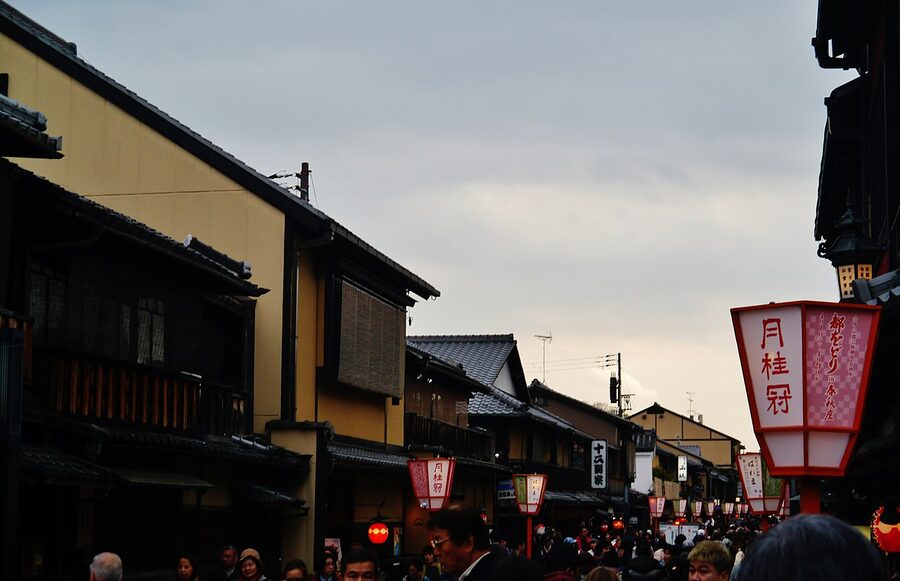
The wooden geta clack on Hanamikoji at 18:30 is a sound your ear catches before your eye does. Two short steps, a pause, two more. Then the lantern shadow you’re walking toward shifts, and a maiko in a teal kimono crosses the lane ahead of you, head down, kanzashi pin trembling at her temple. The teahouse door slides open, slides shut, and she’s gone. Maybe nine seconds. The street smells of grilled hamo and gardenia and the faint vinegar of an evening rain on stone.
That moment is what people come to Gion hoping to find, and most of them stand in the wrong place at the wrong time of day to find it. Gion is also the most photographed neighbourhood in Japan that has actively asked tourists to stop photographing it. Both things are true at once. This guide walks you through the district the way a long-staying visitor walks it: by route, by hour, by what’s worth your time and what isn’t, with the etiquette explained without scolding.
If Gion is on your itinerary, the wider Kyoto travel guide covers the geographic split, the bus-versus-train decision, and the two-day vs four-day question. The temples guide handles Kiyomizu-dera, Kinkaku-ji, Fushimi Inari, and the rest. This one is about the small triangle of streets where the geiko and maiko still actually live and work.
In This Article
- Where Gion actually is
- How to get there
- When to actually walk it
- Hanamikoji and the photography reality
- The Ichiriki Chaya corner
- What to do at the south end
- Gion Shirakawa: the prettier side
- Tatsumi Bridge to Shinbashi
- Pontocho across the river
- Yasaka Shrine and Maruyama Park
- Chion-in’s enormous gate
- Yasaka pagoda: the Higashiyama postcard
- The geiko and maiko spotting reality
- How to actually meet one
- Where to actually eat
- Top tier: kaiseki
- Middle tier: obanzai
- Bottom tier: oden, yakitori, ramen
- Gion Matsuri: the festival month
- Where to base for the festival
- Etiquette without the lecture
- Other corners worth a walk
- Minamiza, the kabuki theatre
- Yasui Konpiragu, the relationship-cutting shrine
- Nishiki Market, ten minutes’ walk west
- What it costs and what it’s worth
- One last small thing
Where Gion actually is
Geographically, Gion is a strip about 700 metres long and three streets deep, sitting in the Higashiyama ward of central Kyoto. Shijo-dori is the spine. Yasaka Shrine pins the east, the Kamo River pins the west. To the north of Shijo, parallel to the river, the Shirakawa canal cuts through the area called Gion Shinbashi, which is the prettiest stretch of all. To the south of Shijo, Hanamikoji runs as a narrow flagstone lane down to Kenninji temple. That’s the shape, and it’s smaller than your map app suggests.
Here’s the bit that confuses first-timers. Pontocho, on the west bank of the Kamo, is not technically Gion. It’s its own narrow alley running parallel to the river and it has its own distinct geisha district called Pontocho, one of the five Kyoto kagai. But every guide groups them together because you cross the river in 90 seconds and they share the same evening crowd. I’ll handle Pontocho here too.
Gion itself splits administratively into Gion Kobu (south of Shijo, the bigger and more famous half) and Gion Higashi (north of Shijo, smaller, more residential). When people say “Gion” without qualification they usually mean Gion Kobu, and Hanamikoji is its main street.
How to get there
Three options, and the train is faster than the bus despite what Google Maps will tell you. From Kyoto Station: the Karasuma subway to Shijo Station, then the Hankyu line one stop east to Kyoto-Kawaramachi (about 10 minutes total, ¥220 + ¥160). Walk five minutes east across the Kamo and you’re at the western edge of Gion. The Keihan line from anywhere south stops at Gion-Shijo Station, which puts you on the Gion side of the river immediately, exit 6 or 7. Bus 100 or 206 from Kyoto Station to the Gion stop is the third option, takes about 20 minutes, and is reliably packed with tourists in the evenings. I’d take the train and use the buses elsewhere in Kyoto. The Kansai Railway Pass covers Hankyu and Keihan, so if you’ve already got one this becomes the obvious choice.
When to actually walk it
Two windows. 06:30–08:30 in the morning, and 17:00–18:30 in the evening. The first gives you the empty stone lane with the wooden teahouses still asleep, no one in your shot, light coming over the rooftops sideways. The second gives you the lanterns lighting up at dusk and the brief twenty-minute window where the geiko and maiko walk to their first engagements of the night. Between 09:30 and 16:00 Gion is wall-to-wall with day-tour groups in rented kimono, and the magic is gone.
If you can do exactly one walk through Gion, I’d pick the morning. It’s quieter, the air is cooler, and you can sit on the bench at Tatsumi Bridge for ten minutes without anyone behind you. The evening is more atmospheric but you’ll be sharing it with three thousand other people thinking the same thing.
Hanamikoji and the photography reality
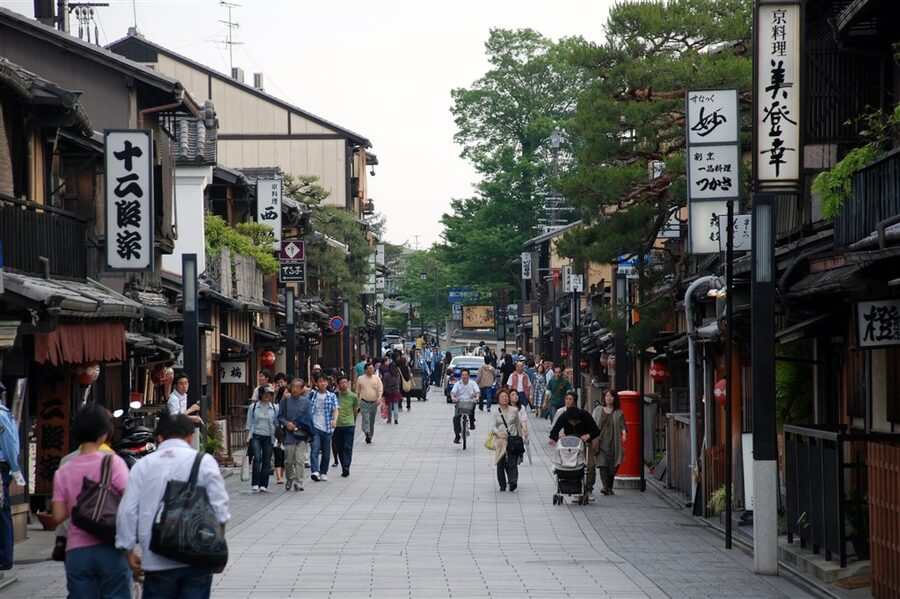
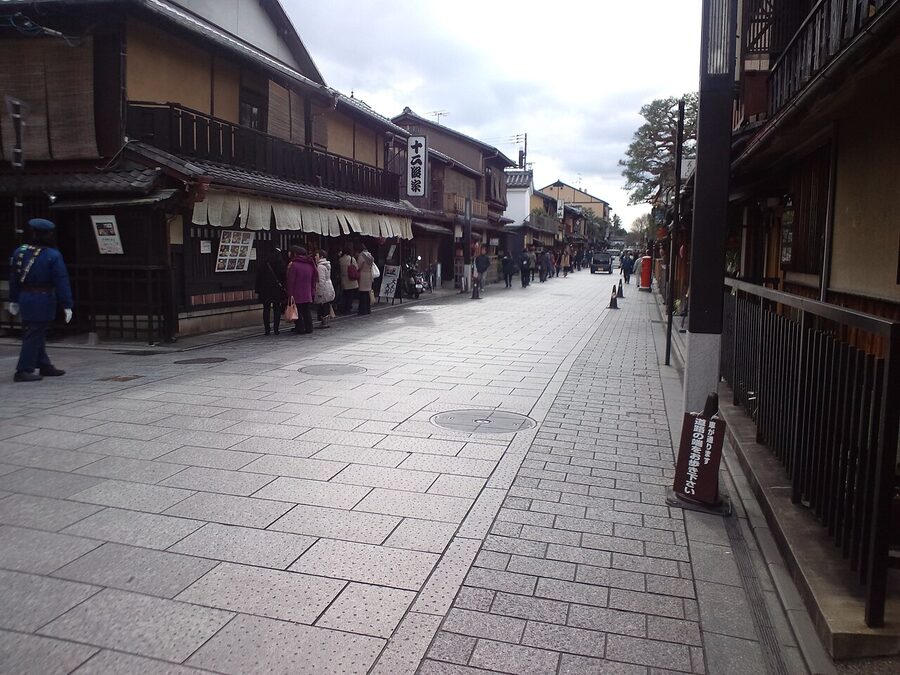
Hanamikoji is the lane every Kyoto guidebook puts on its cover. From the corner of Shijo-dori, where the red-walled Ichiriki Chaya teahouse pins the intersection, it runs roughly 350 metres south to the gate of Kenninji temple. Power lines go underground here. The whole strip is a designated historic preservation district. The buildings are wooden machiya, narrow at the front and long at the back, originally taxed by street frontage, which is why they all have the same five-to-six-metre face onto the lane.
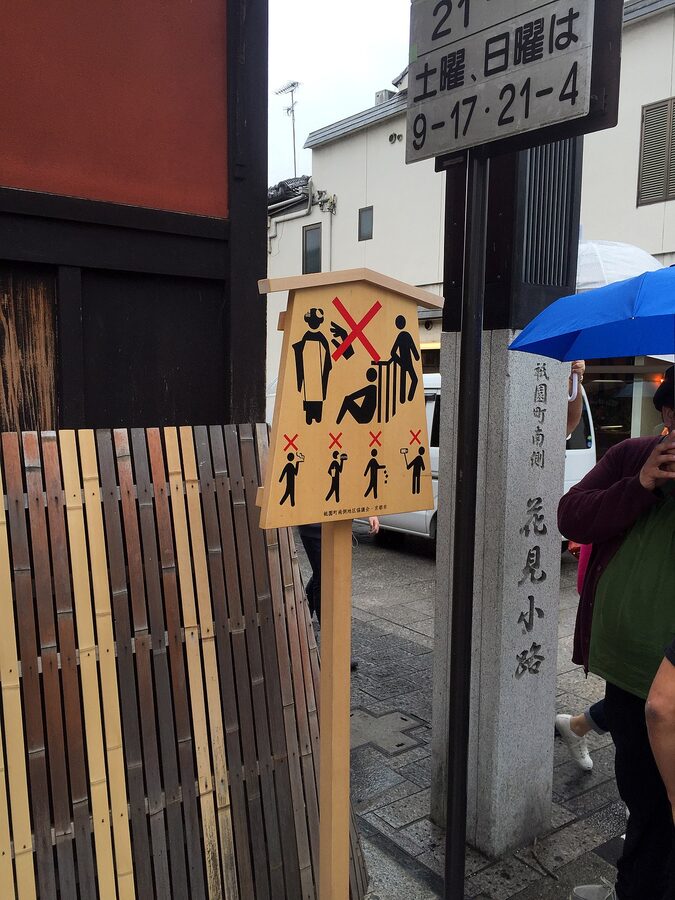
The thing you need to understand before you walk it: in March 2024 the Gion-machi Minamigawa District Council closed the side alleys off Hanamikoji to non-residents. They put up signs in English, Chinese, and Japanese on the entrances of every private alley reading something close to “This is a private road, so you are not allowed to pass through it. There will be a fine of ¥10,000”. The fine isn’t a Kyoto City municipal one, it’s a private trespass penalty enforced by the residents’ council. The reason: years of tourists chasing maiko down those alleys for selfies, grabbing kimono sleeves, blocking ochaya doorways.
What the rule actually means in practice. The main flagstone street of Hanamikoji is public and you can walk and photograph it freely. The little alleys that branch off it, the ones with stone lanterns and bamboo fences and “no entry” signs, are private property and you cannot enter them. The geiko and maiko walk those alleys to get to and from their teahouses. Photographing a maiko on the public street without consent is rude but not illegal; entering a private alley is a fineable trespass.
I’ve seen the signs. They’re unmissable, a brown plastic board at every alley mouth with the rule in four languages and a small icon of a crossed-out camera. If you see one, don’t enter. If the alley has no sign, look at the ground: a flagstone curb cutting across the lane perpendicular to the public street is the threshold. The Japanese term is shidou, meaning private road. Treat any narrow lane behind the public storefronts as off-limits unless you can see signage saying otherwise.
The Ichiriki Chaya corner
At the Shijo-Hanamikoji intersection, on the south-east corner, the red plaster wall behind the bamboo fence is Ichiriki Chaya. It’s been there in some form since the early 1700s. It’s the most exclusive ochaya in Kyoto, and the place where, in the kabuki and historical lore, Oishi Yoshio of the 47 Ronin pretended to drink himself stupid for over a year while he waited for the right moment to kill his lord’s enemy. You cannot enter. You almost certainly cannot eat there. It’s introduction-only and the per-head cost runs into the high hundreds of thousands of yen. But the wall itself, with the small brass nameplate and the corner curve, is worth a photo from the public footpath. Stand on the north side of Shijo-dori and shoot south-east; you’ll get the wall, the alley, and the row of wooden facades down Hanamikoji in one frame.
What to do at the south end
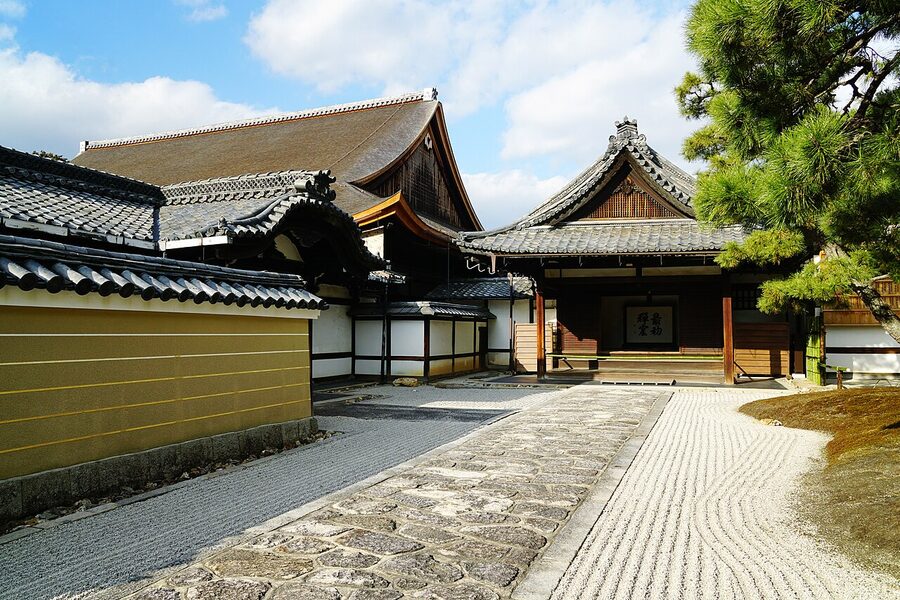
At the bottom of Hanamikoji, the lane opens onto the back gate of Kenninji. It’s the oldest Zen temple in Kyoto, founded in 1202 by Eisai, who also brought tea cultivation back from China. Open 10:00 to 17:00 daily, ¥600 admission. The big rock garden is good. The double-headed dragon painting on the lecture hall ceiling, by Junsaku Koizumi from 2002, is the better reason to go. Tripod photography forbidden, hand-held photos allowed in most halls but not in front of the principal Buddha images. It’s twenty minutes if you walk it briskly and an hour if you sit in the rock garden. Most tour groups skip it, which is the point.
Gion Shirakawa: the prettier side
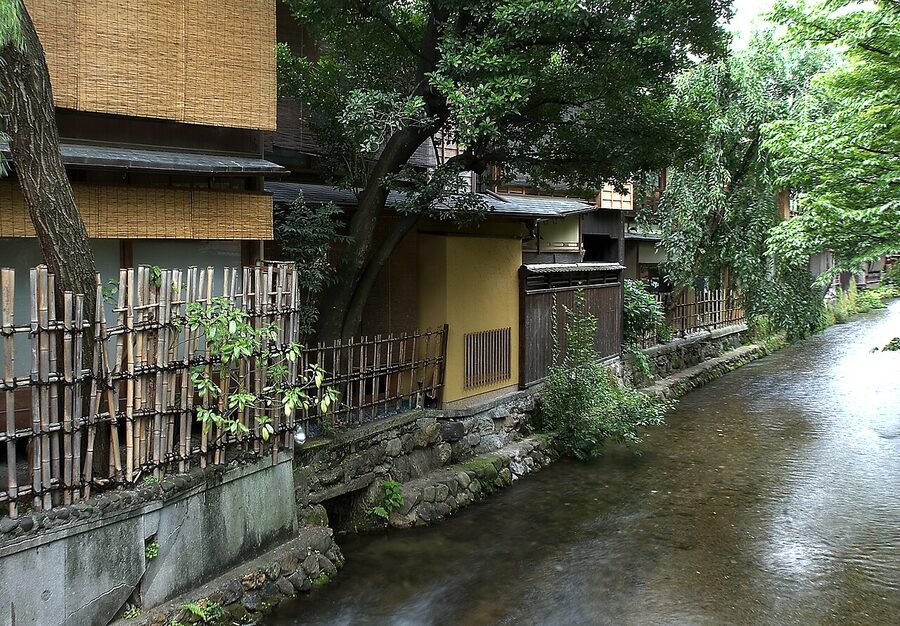
If Hanamikoji is the headline shot, Shirakawa is the article you actually want to read. Cross Shijo to the north side, take the small lane that drops down to the canal called Shirakawa-minamidori, and the noise drops by half. The Shirakawa is a narrow stone-walled canal, willow trees on the south bank, the rear of the ochaya overhanging the north bank. It’s the section that makes the cover of every Kyoto book that the photographer was allowed to choose, because it photographs better at every hour than Hanamikoji does.
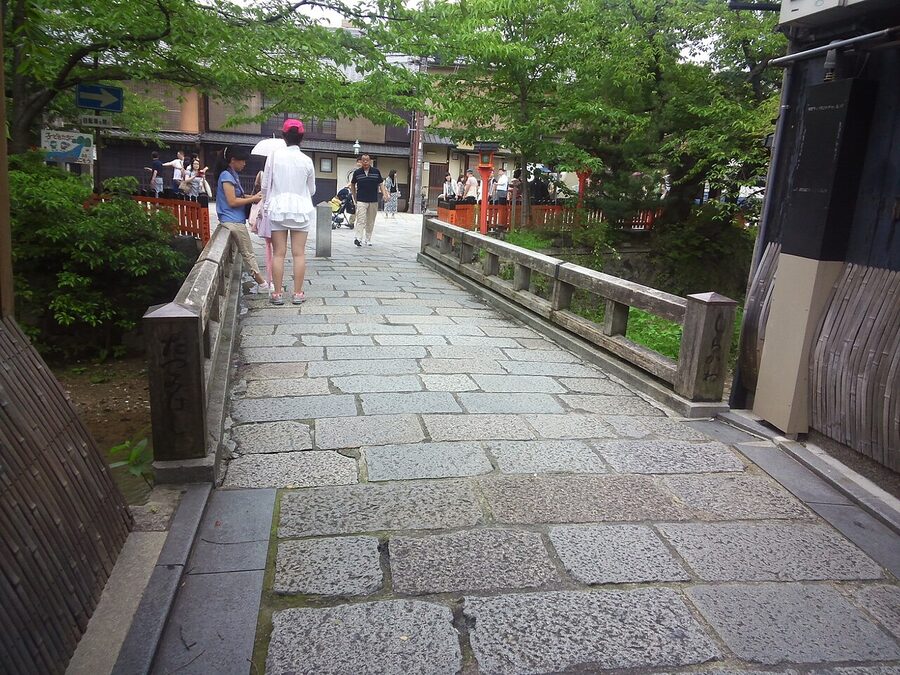
Walk it east to west. Start at the corner of Higashi-oji and Shijo, drop down into the canal-side lane, and follow the water for about 250 metres. You’ll cross Tatsumi Bridge, a small humpbacked stone bridge with a tiny shrine on the south side called Tatsumi Daimyojin, dedicated to the protective deity of the geiko quarter. Maiko traditionally pray here for skill in dance and music. There’s almost always a small queue of people taking selfies on the bridge in the evenings. In the morning it’s empty.
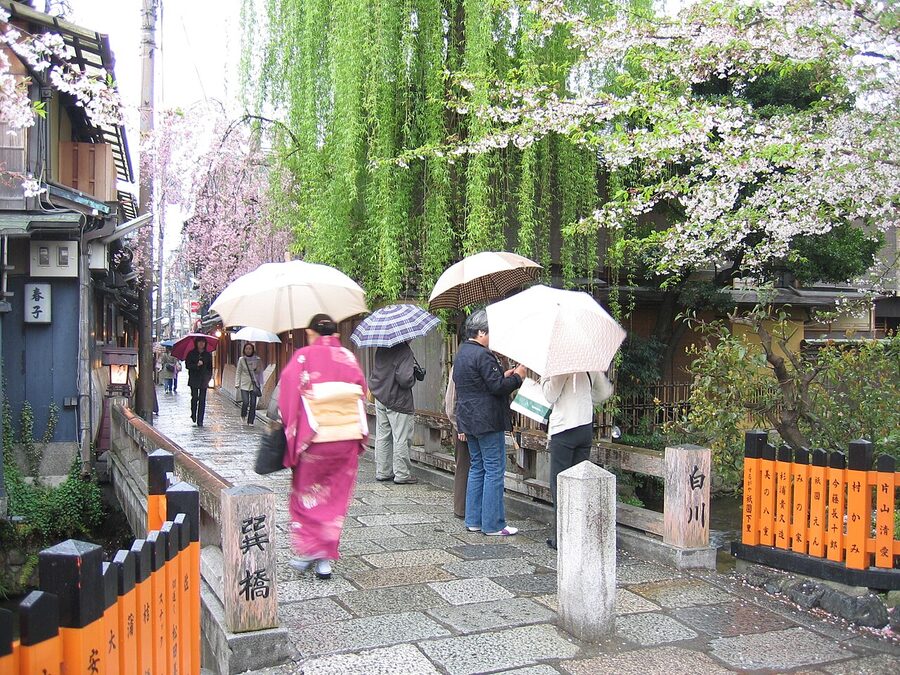
April changes the canal completely. The willows are joined by sakura along the south bank and the ochaya windows light from inside as evening falls. If your trip overlaps the bloom, this stretch is one of the best places in central Kyoto to see it, and it usually peaks one or two days after the city peak. The Kyoto cherry blossom guide handles the broader timing question and a couple of less-trampled spots if Shirakawa is too packed for you.
Tatsumi Bridge to Shinbashi
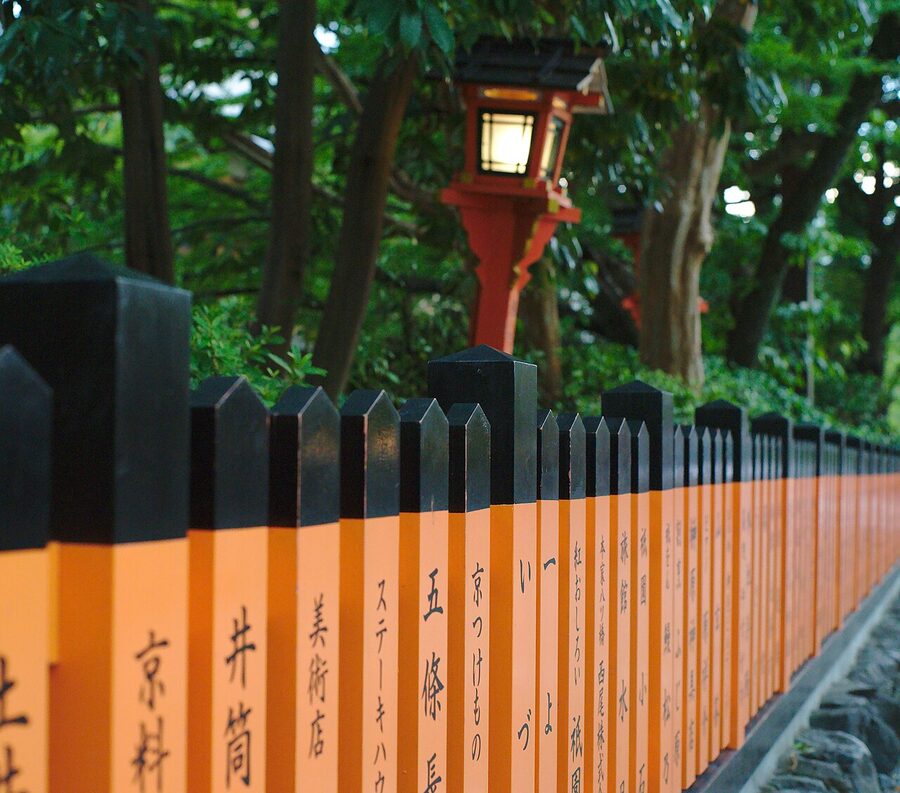
From Tatsumi Bridge, follow the canal another minute west and you’re on Shinbashi-dori, a flagstone lane that runs parallel to the canal one block north. Shinbashi is technically Gion Shinbashi, the smaller and quieter geisha sub-district, and the stretch from the bridge to where it meets Nawate-dori is the single most concentrated piece of pre-1868 Kyoto streetscape that survives in the city centre. The whole lane is a Preservation District for Groups of Traditional Buildings. Walking it slowly takes ten minutes. Walking it slowly with photos takes thirty.
Pontocho across the river
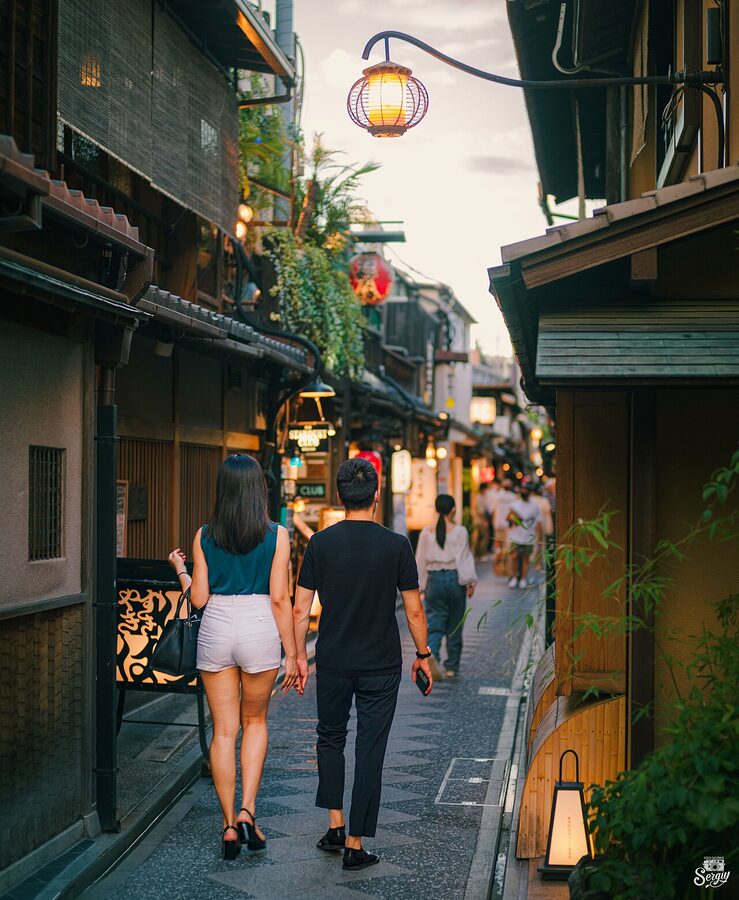
Cross Shijo-Ohashi bridge over the Kamo and turn right immediately into the narrow alley running north. That’s Pontocho. It’s about 500 metres long, one room wide, and a different texture from Gion: tighter, louder, more practical, more places you can actually book a meal in. The geisha district aspect is real but understated; the geiko houses cluster at the north end near the Pontocho Kaburenjo theatre. The southern two-thirds of the lane is restaurants of every price tier from a 1,200-yen yakitori counter to a 30,000-yen kaiseki.
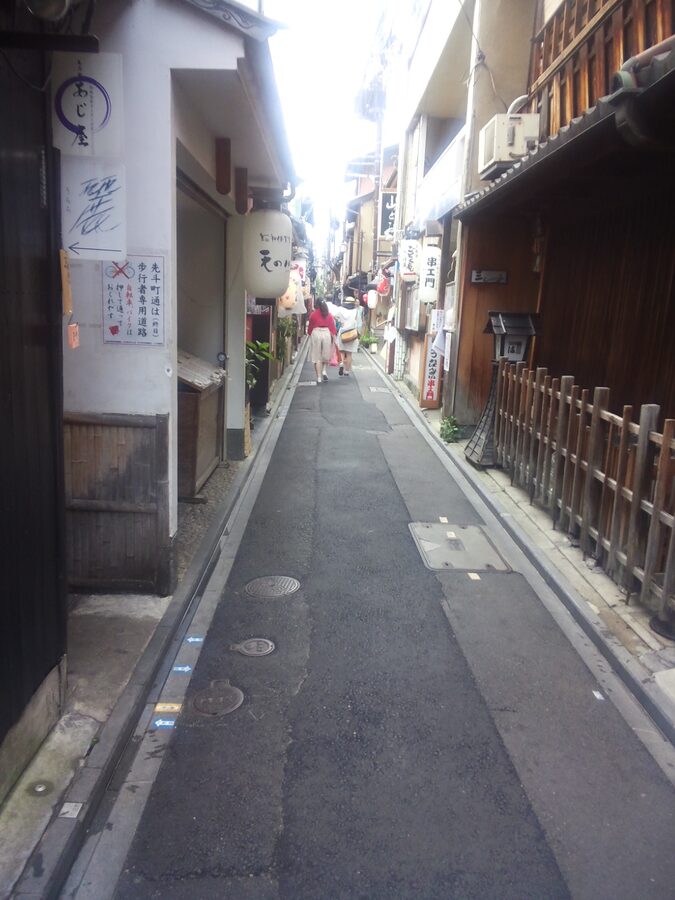
Two practical things about Pontocho. First, in summer (May to September), the restaurants on the river side build out wooden platforms over the Kamogawa called kawadoko or noryo-yuka. Eating on one is a specific Kyoto-summer ritual. Reservations needed weeks ahead at the better places, and a small surcharge applies. Second, the Pontocho Kaburenjo theatre at the north end is where you can see the Kamogawa Odori dance performances every May 1st–24th. Tickets run roughly ¥2,500 to ¥5,000 and a tea ceremony version costs a bit more. It’s one of five annual geiko-and-maiko dance performances across the Kyoto kagai, and a much more reliable way to see real geiko on stage than walking the streets hoping.
Yasaka Shrine and Maruyama Park
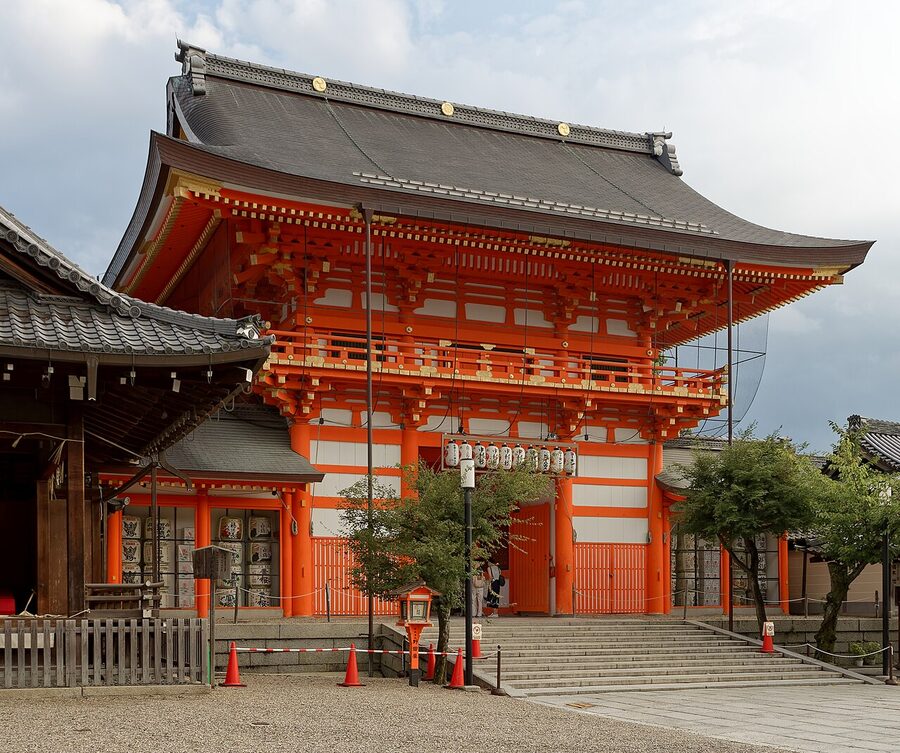
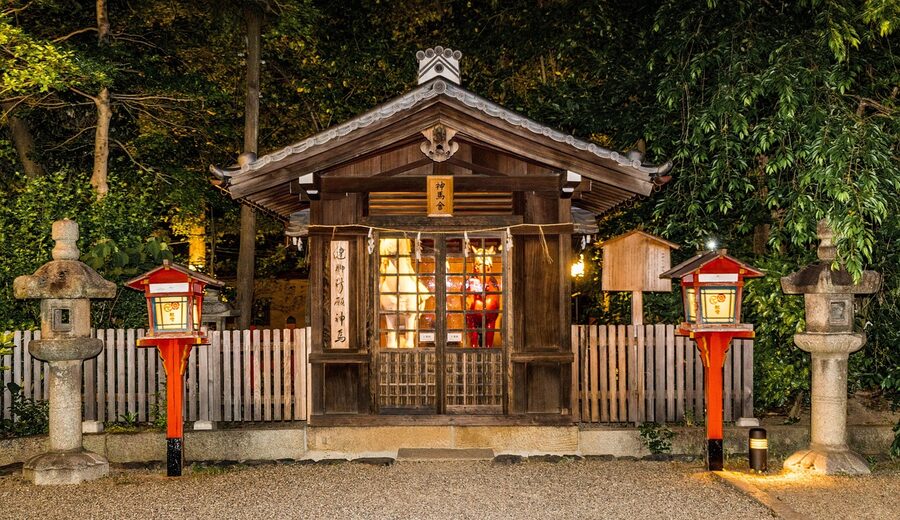
The east end of Shijo-dori dead-ends at the bright vermilion two-story gate of Yasaka Shrine, also called Gion-san by the locals. The shrine is open 24 hours, free, and walking through after dark when the lanterns are lit is one of the few central-Kyoto experiences that genuinely improves at night. The main hall, the Honden, is a national important cultural property; the dance stage in the centre courtyard is hung with several hundred white paper lanterns donated by Kyoto restaurants and ochaya, each painted with the donor’s name in black ink.
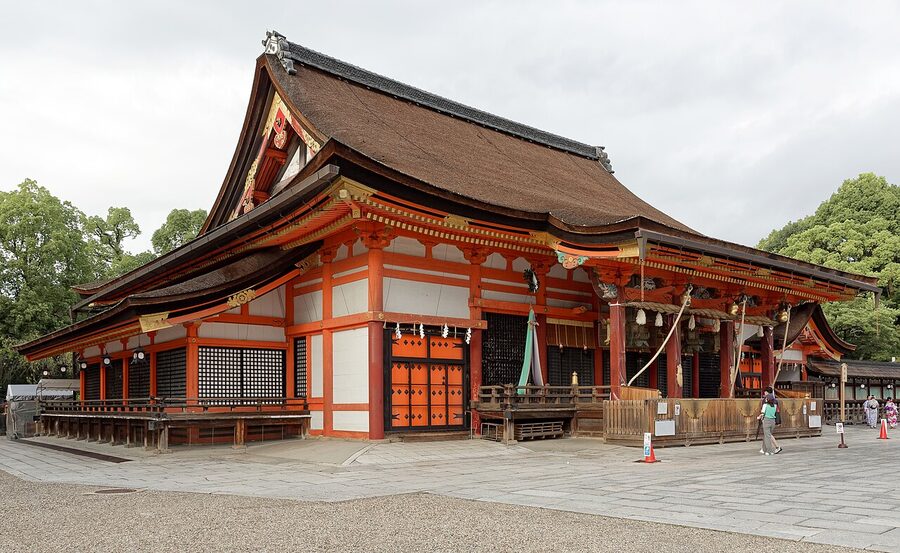
Yasaka is the spiritual home of the Gion district. It’s also the host shrine of Gion Matsuri, which I’ll cover below. Officially Yasaka-jinja, it took its current name in 1868 when shrines and temples were administratively separated; before that it was called Gion-sha and the matsuri was a Buddhist-Shinto syncretic festival. The shrine office is open 09:00 to 17:00 if you want a stamp in your goshuin-cho book.
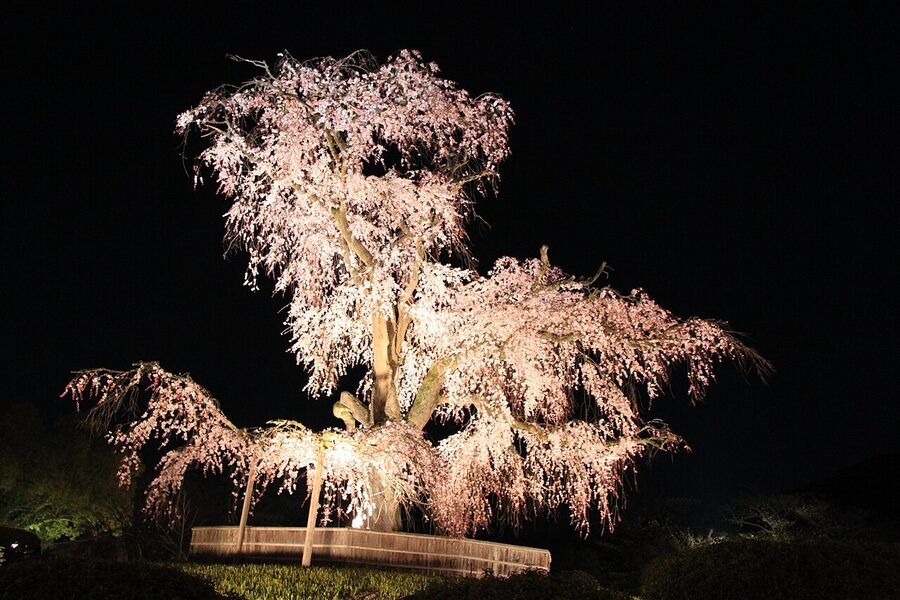
Walk east through the shrine grounds, past the Honden and the small Ebisu sub-shrine, and you exit into Maruyama Park. It’s the city’s oldest public park, opened 1886, and the centrepiece is a single weeping cherry tree (shidare-zakura) under which thousands of locals picnic during the brief sakura week. The current tree is the second-generation, planted in 1949; the first lasted into the 1940s. Outside cherry season the park is a calm middle-of-the-day rest stop with a few restaurants, a pond, and a path that loops around to Chion-in to the north and Kodaiji temple to the south.
Chion-in’s enormous gate
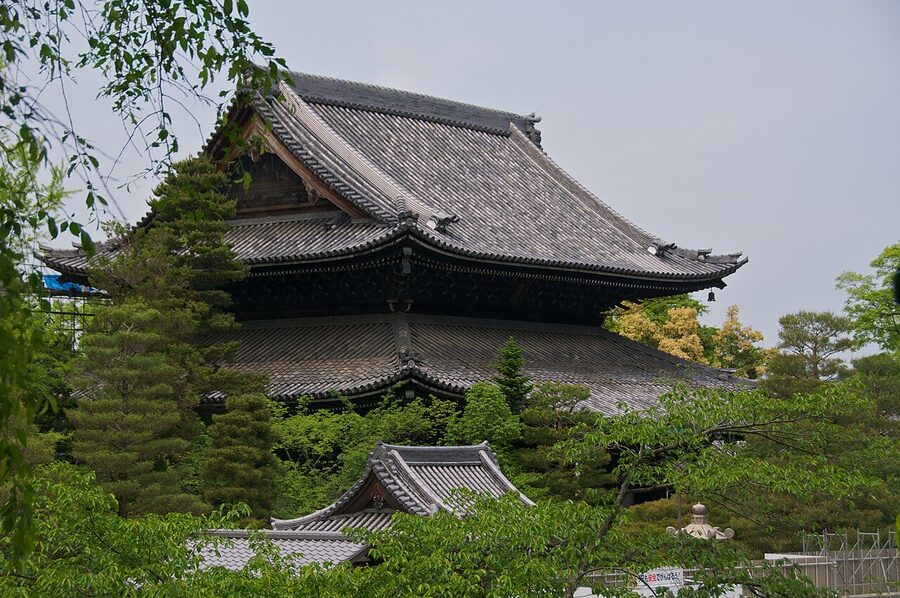
Walk five minutes north through Maruyama and you arrive at the back of Chion-in’s compound. Don’t enter from the back. Loop around to the south and approach from the front. The reason is the Sanmon, the temple’s main gate. It’s 24 metres tall, 50 metres wide, and the largest surviving wooden temple gate in Japan. Walking up the long stone staircase from Shimogawara-dori with that thing growing as you climb is a moment of physical scale you don’t get from any of the smaller Higashiyama temples.
Chion-in is the head temple of the Jodo (Pure Land) sect of Buddhism, founded in 1234 by the disciples of Honen. The compound covers something like 70,000 square metres. Free admission to the main grounds and the Mieido (the principal worship hall, which reopened in 2020 after eight years of restoration). The two formal gardens, Yuzen-en and Hojo Garden, are ticketed at ¥500 each or ¥800 for both, open 09:00–16:00.
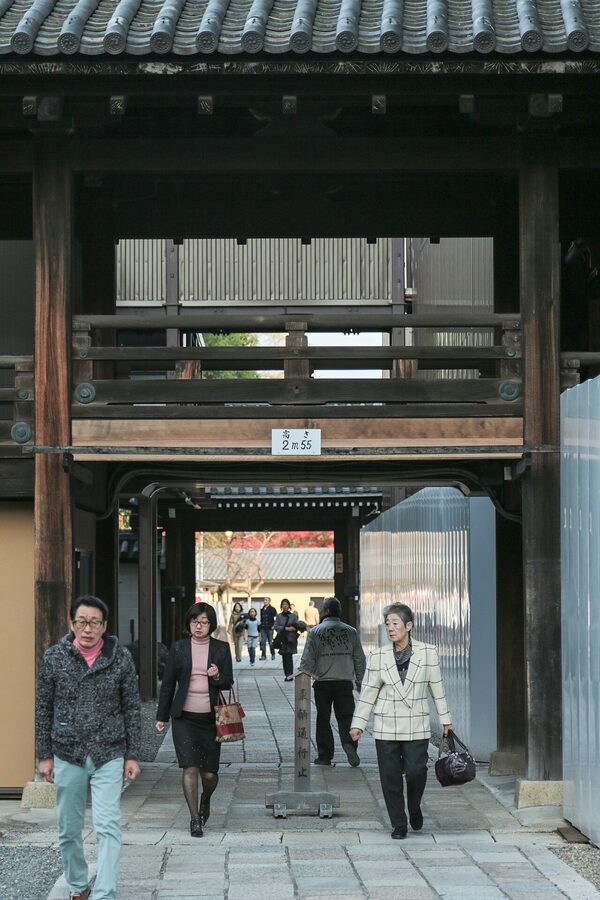
Climb up to the bell tower behind the Mieido. The Ozaiku-no-Kane bell, cast in 1636, weighs roughly 70 tonnes and is the second-largest in Japan. They ring it 108 times on New Year’s Eve, and the NHK live broadcast has been doing the same camera angle for 60 years. Worth the small uphill detour even if you’re not there for the ringing.
Yasaka pagoda: the Higashiyama postcard
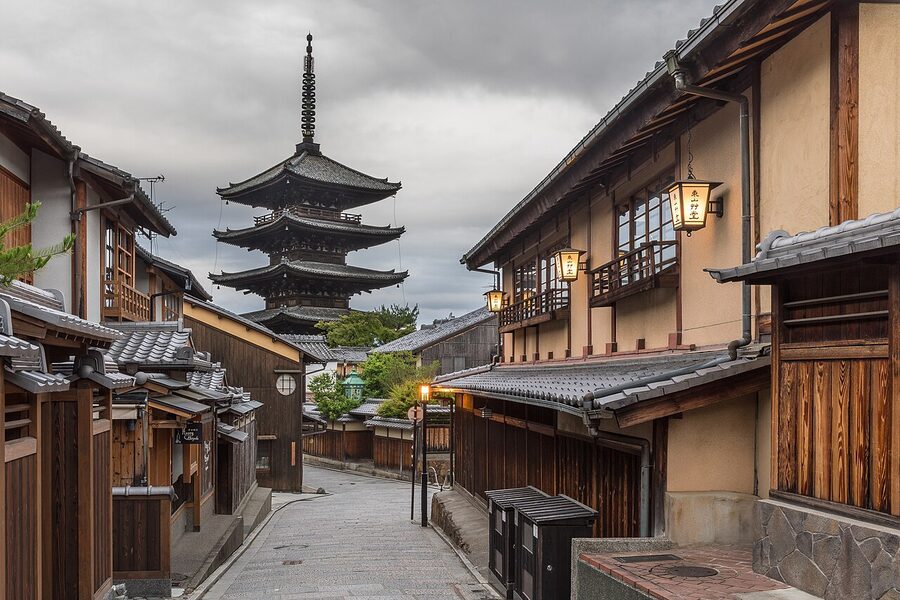
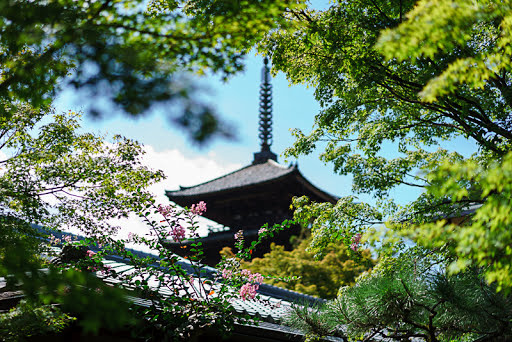
Six minutes south of Maruyama, on the way to Kiyomizu-dera, the five-story Yasaka-no-To pagoda rises out of a sloping street called Yasaka-dori. Officially it’s part of Hokan-ji temple, but the pagoda is what people come for. It’s the iconic Higashiyama postcard image: the pagoda framed against a tightening lane of wooden machiya, mountains in the distance. The interior is open to visitors only on irregular dates, ¥400 when open, but the photograph is the point.
Stand on Yasaka-dori looking north-east, ideally at 06:30 or after 17:30. Between 09:00 and 16:00 the street is one continuous queue of kimono-rental tourists getting their photographs taken in the same composition, which is its own form of cultural performance worth observing for about three minutes before you go and find an emptier corner.
The geiko and maiko spotting reality
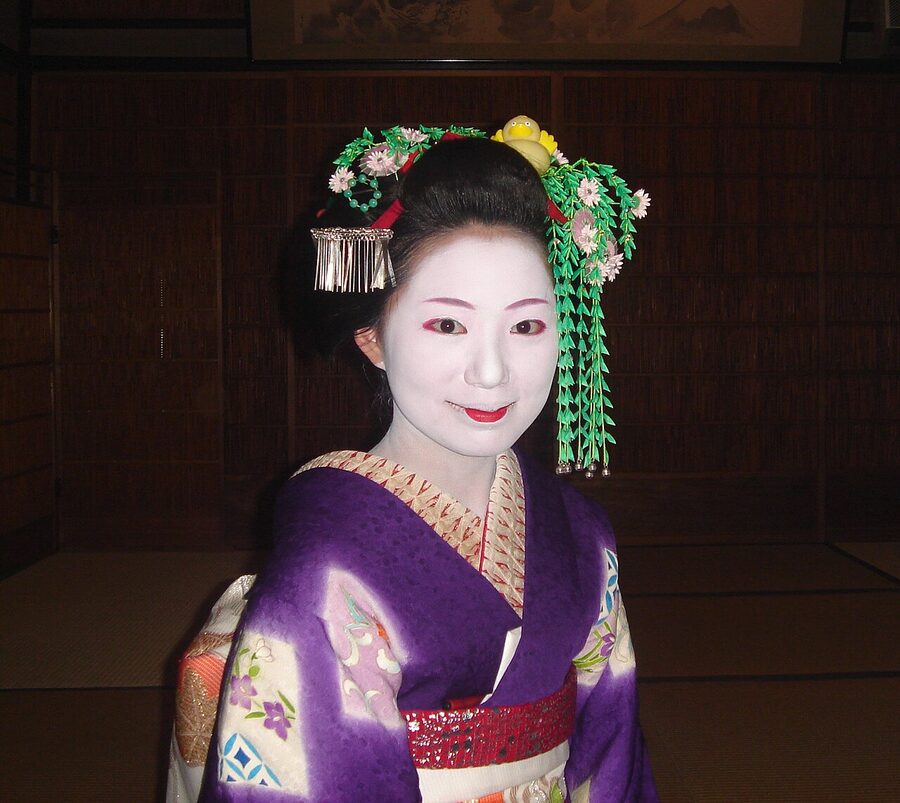
This is the part most guides don’t tell you straight. There are roughly 70 fully qualified geiko and 30 maiko apprentices currently working in Gion Kobu, plus another 40 or 50 across the other four kagai (Pontocho, Miyagawacho, Gion Higashi, Kamishichiken). On any given evening, perhaps 20 or 30 of them are walking briefly between an okiya (the lodging house where maiko live) and an ochaya (the teahouse where they’re booked). The walk takes two to four minutes per person. They stop for nothing. They pass through the public street and disappear into a teahouse.
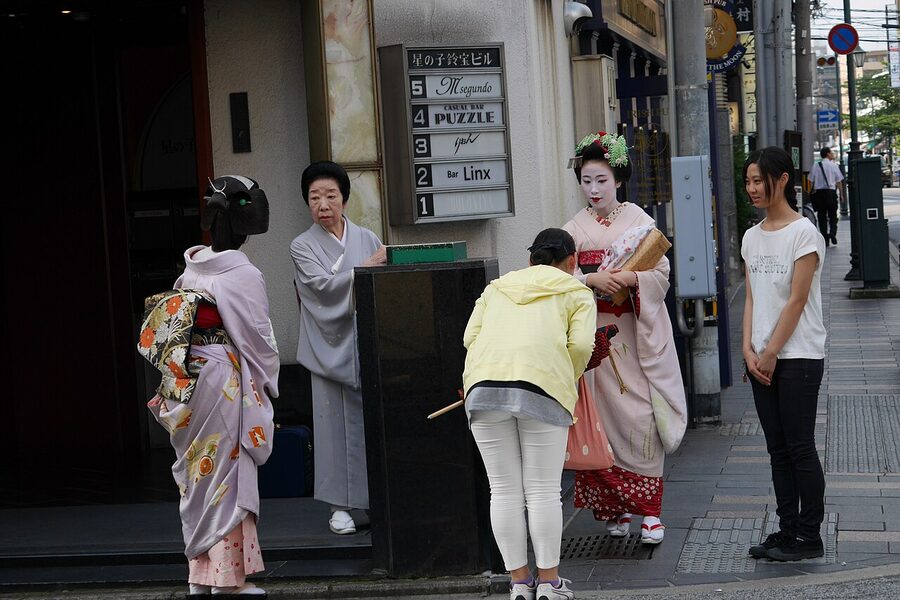
Statistically, your odds of seeing one if you stand on Hanamikoji between 17:30 and 18:30 are reasonable. Maybe 60 percent for one quick passing in an hour. Your odds of getting a clear photograph that isn’t a blur of the back of a kimono are much lower, and your odds of getting one ethically (no chasing, no flash, no shouting) lower still. If you do see one, the right behaviour is to step aside, not approach, and let her pass. They’re going to work. They’re not props.
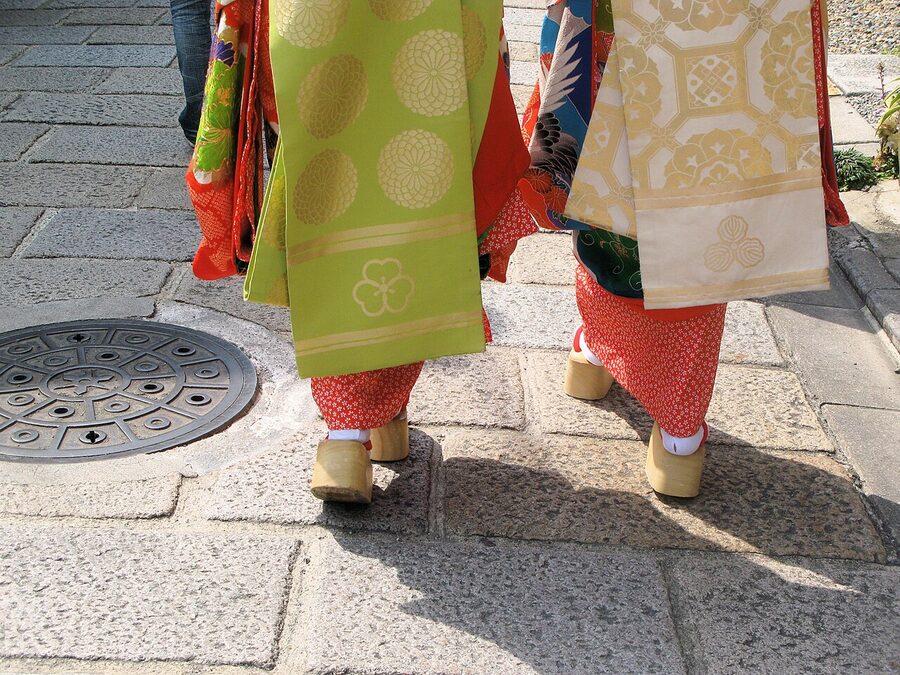
You also need to be able to spot the difference between a real maiko and a kimono-rental tourist in maiko makeup, because Gion is full of the latter. The cues. A real maiko wears a heavy traditional obi tied in the long darari style that hangs almost to the ankles; rental kimono have short hand-tied bows. A real maiko wears tall wooden okobo sandals, 10cm high, undecorated black for early apprentices; rental costumes use modern flat geta. A real maiko has her own hair worn in formal style, pinned with seasonal silk flower kanzashi; rental costumes use wigs. And a real maiko walks fast, head down, in a straight line. A rental customer poses for selfies on Tatsumi Bridge.
How to actually meet one
Three sensible ways. Cheapest is the annual public dance performances. Each of the five Kyoto kagai stages one. The Miyako Odori in April (Gion Kobu, the biggest), Kyo Odori in early April (Miyagawacho), Kitano Odori late March to early April (Kamishichiken), Kamogawa Odori in May (Pontocho), and Gion Odori in November (Gion Higashi). Tickets run from about ¥2,500 for a back-row seat to ¥6,500 for a stage-front seat with tea ceremony. You’re seeing 30 or more performers, several maiko, on stage in costume for ninety minutes. Far better value than chasing a glimpse on the street.
Mid-tier is a maiko cultural-show experience at a venue. The Gion Corner cultural performance hall used to do this nightly, but the venue has been closed for renovation since 2023 and as of writing has not reopened, so check the current status before planning around it. Several Klook and GetYourGuide listings cover one-hour maiko-show events at alternative venues, typically ¥3,500 to ¥6,000, with the maiko performing two or three dances and answering questions through an interpreter. Worth doing if you have a single evening. (Klook and GetYourGuide both list current options.)
Most expensive, and most authentic, is dinner with a maiko at a venue like Gion Hatanaka, a ryokan-cum-restaurant on the Higashiyama side that runs a thrice-weekly “Kyoto Cuisine and Maiko Evening” open to non-Japanese-speakers, around ¥22,000 per person including a six-course kaiseki dinner. There’s typically a two-hour event with two maiko and an interpreter; you eat the kaiseki, watch dance, play the parlour games (konpira fune-fune usually). Reserve at least two weeks ahead. (Check Agoda for the ryokan’s room availability if you want to combine it with an overnight stay; the dinner can be booked separately.) The most reliably authentic of the easily-bookable options.
Where to actually eat
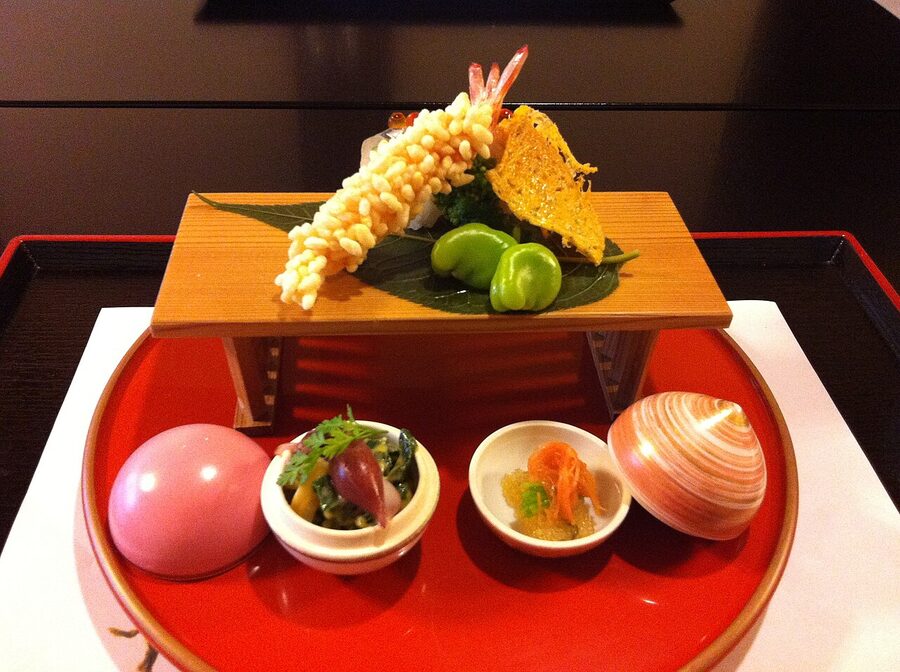
Eating in Gion divides into three price tiers and you should know which you’re shopping in before you walk into a place.
Top tier: kaiseki
A traditional kaiseki dinner in Gion proper starts at around ¥18,000 per head and runs to ¥35,000 or more at the established names. Lunch is roughly half of dinner. What you’re paying for is twelve courses of seasonal Kyoto cuisine, beautifully plated, served in a private tatami room by a kimono-clad attendant. It’s the meal you book once a trip, not three nights running.
Names that take English-speaking guests with reasonable advance booking. Gion Sasaki (three-Michelin-star, omakase only, around ¥33,000 dinner, reserve 2–3 months ahead). Mizai (one star, classical kaiseki, ¥22,000 dinner). Hyotei (technically just outside Gion in Nanzenji but counted with the area, four centuries old, ¥28,000 dinner, lunch from ¥9,000 in the annex). For Gion Hatanaka, the maiko-dinner option at ¥22,000 covers the cultural component and is the easiest one to book in English.
Middle tier: obanzai
If kaiseki is special-occasion, obanzai is the everyday Kyoto cooking that locals actually eat. Small dishes of seasonal vegetables, simmered tofu, grilled fish, simmered duck, served family-style and priced sensibly. Obanzai Sakai on Hanamikoji (lunch from ¥1,500, dinner around ¥5,000), Cafe Kosci on Shijo (a Kyoto-style bistro, ¥3,500 set), and Gion Karyo (lunch sets ¥3,000–5,000) cover the range. Lunch is the move: many Gion restaurants do a much more accessible lunch course than dinner, and you walk in without a reservation.
Bottom tier: oden, yakitori, ramen
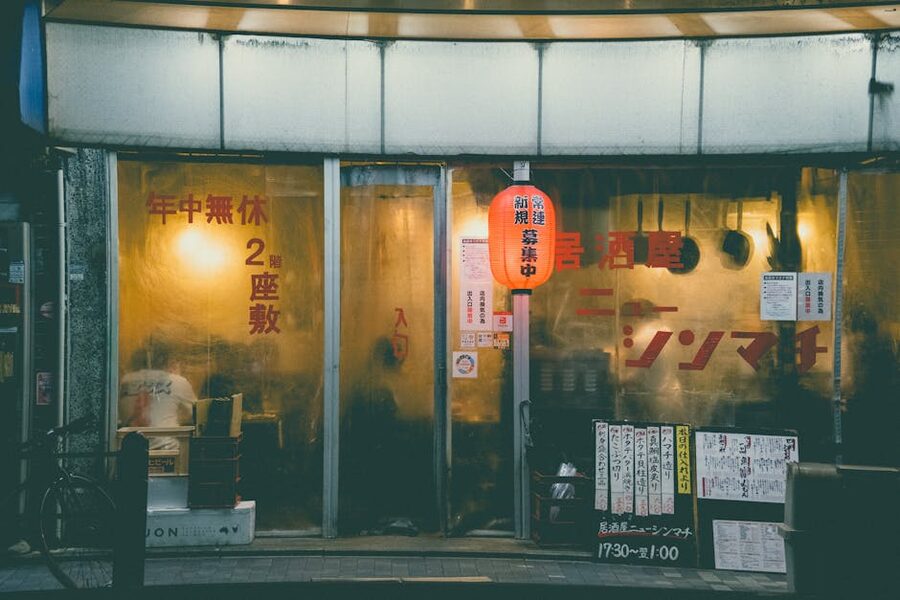
For an actual cheap dinner in Gion you walk three minutes south to Yasaka Dori or two minutes west to the Kawaramachi side. Gion Tanto for okonomiyaki (¥1,500 set, almost always a queue). Yagenbori Komaki for oden in a wooden ochaya-style space (the dinner counter set runs ¥3,800). The yakitori counters along the small streets between Hanamikoji and Higashioji-dori are the closest you’ll get in central Gion to where the locals actually drink. Most of these don’t have English menus. Point and smile works.
Pontocho across the river (which I covered above) is a wider price spread, with several ¥1,200 yakitori counters and chains right alongside the high-end kawadoko-deck kaiseki places. If you’re cost-conscious, eat in Pontocho and walk Gion.
Gion Matsuri: the festival month
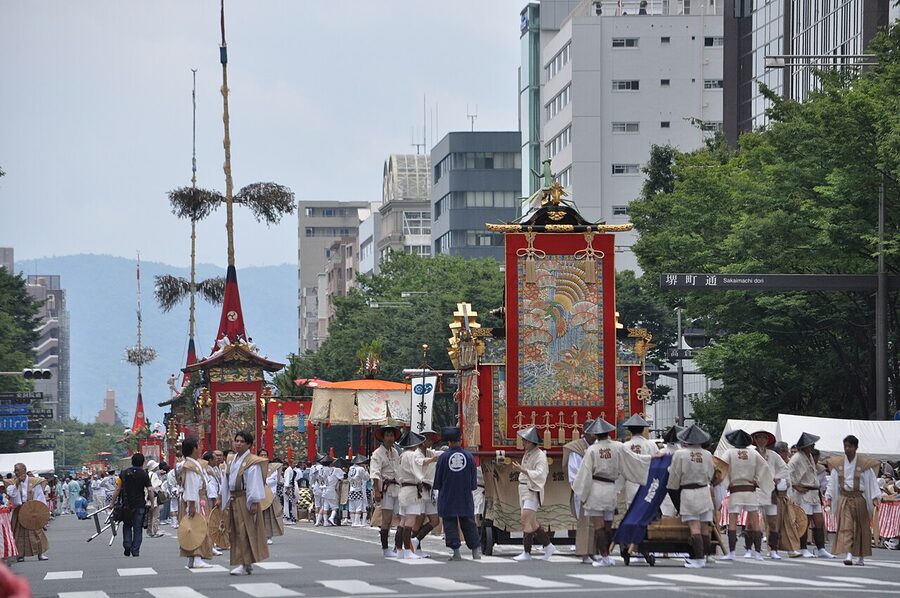
If you’re in Kyoto in July, Gion Matsuri is the festival you’ll be told about by everyone you meet. It’s the festival of Yasaka Shrine, runs the entire month of July, and traces back to the year 869, when an outbreak of plague led the emperor to send 66 ceremonial halberds (one for each province of Japan) to the Shinen-en garden in a purification rite. The current form, with elaborate floats called yamaboko, has run more or less continuously since the 9th century with breaks during wars and one notable break for COVID in 2020 and 2021.
The two key dates: 17 July is the Yamaboko Junko (the great float procession) of the Saki Matsuri, the first half. 23 floats. They start at 09:00 from Shijo-Karasuma, parade up Karasuma to Oike, east along Oike, then south down Kawaramachi back to Shijo. Watching it from anywhere along that route works; the corner of Shijo and Kawaramachi where the floats turn is the most dramatic and most crowded. 24 July is the Ato Matsuri procession, the second half, with 11 floats, the same route in reverse. The 24th is meaningfully less crowded than the 17th and gives you a better viewing experience.
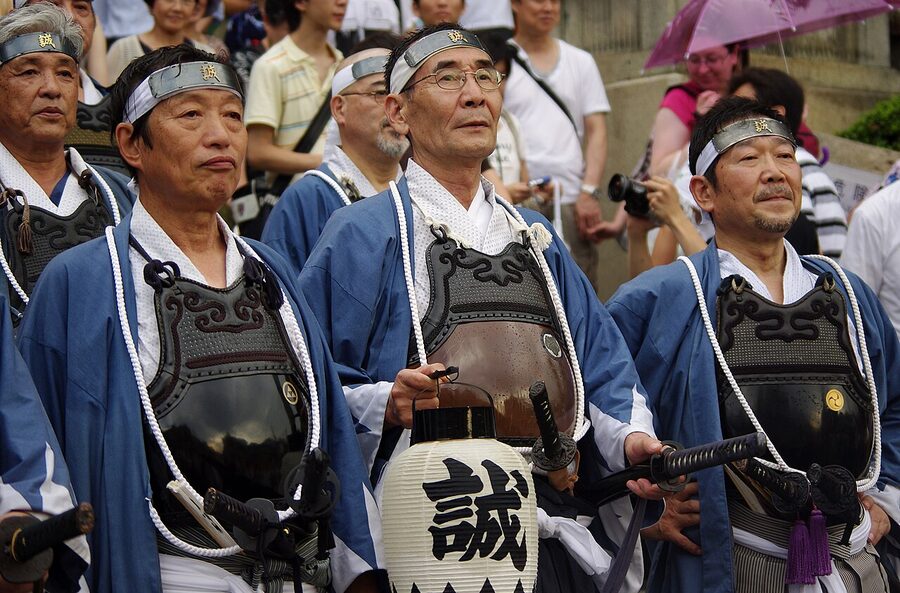
Equally important and often missed: the Yoiyama nights on 14, 15, 16 July (and 21, 22, 23 July for the Ato Matsuri). The streets in the central business district are closed to traffic, the floats are parked along the avenues with their interiors lit and decorated, you can climb up into many of them for ¥1,000 to ¥2,000, and yatai food stalls line every block. It’s a festival night with hundreds of thousands of people in yukata. If your dates only allow you to pick one, pick the night of 16 July: the floats are at peak decoration, the streets are full, and the next morning’s procession is the climax.
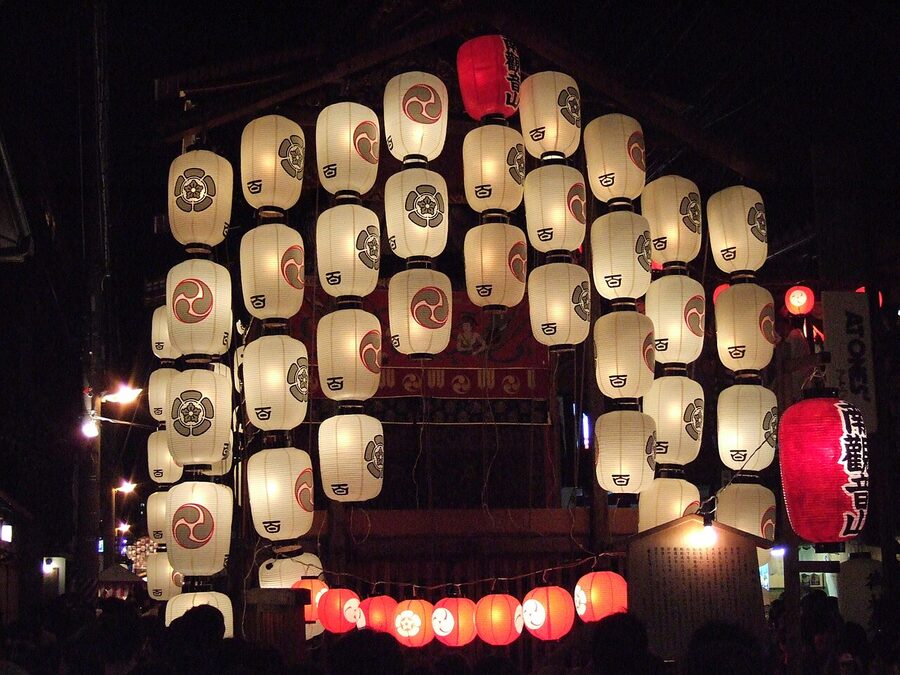
Practical notes for Matsuri visitors. Hotels in central Kyoto book up six to nine months ahead for the 14–17 July window. The temperature on 17 July averages 33°C with high humidity, so plan for water, hats, and breaks. The nearest shaded refuge from the procession route is the Kyoto City Hall plaza on Oike-dori. The Mikoshi Togyo on the evening of 17 July, when the three portable shrines from Yasaka are paraded back to Otabisho on Shijo, is a less-touristed counterpoint to the morning float parade and runs from about 18:00.
Where to base for the festival
The smart play is to stay in central Kyoto (Karasuma, Kawaramachi, Gion proper) so you can walk to and from the procession routes without depending on transport. The buses are rerouted, the subway gets crammed, and walking 15 minutes home in a yukata after Yoiyama is part of the experience. Gion Hatanaka (Agoda) is at the southern Higashiyama edge of Gion and survives the festival traffic better than the central locations. If you want a wider hotel set, the Booking.com listings under their Gion district page covers everything from capsule hotels to the high-end machiya rentals.
Etiquette without the lecture
I’m not going to recite the rules. Five things matter and they’re all common-sense.
Don’t enter private alleys with a “no entry” sign. The fine is ¥10,000 and you’ll know it when you see the sign. If you’re uncertain whether a lane is private, treat it as private.
Don’t photograph maiko or geiko without consent. They’re working. The 2024 rules technically allow photography from the public street but the local council and the residents would all rather you didn’t, and a passing geiko cannot give meaningful consent in the half-second she takes to pass you. The compromise most thoughtful visitors land on: photograph the architecture, the lanterns, the streetscape; if a maiko walks into your frame, lower the camera.
Don’t touch a maiko’s kimono. This sounds obvious. The 2024 council statement said it explicitly because it had become a recurring problem. The kimono is silk, layered, and worth more than the visitor’s flight.
Don’t block the door of an ochaya. Maiko, geiko, and their guests need a clear path in and out. If you see a wooden door open and a kimono-clad attendant bowing someone in or out, step back across the street.
And if you do meet a maiko, the Japanese form of polite distance is to step aside and slightly bow your head as she passes. She won’t acknowledge you. That’s correct. She’s in the equivalent of stage costume on her way to a performance. The respect goes both ways.
Other corners worth a walk
Minamiza, the kabuki theatre
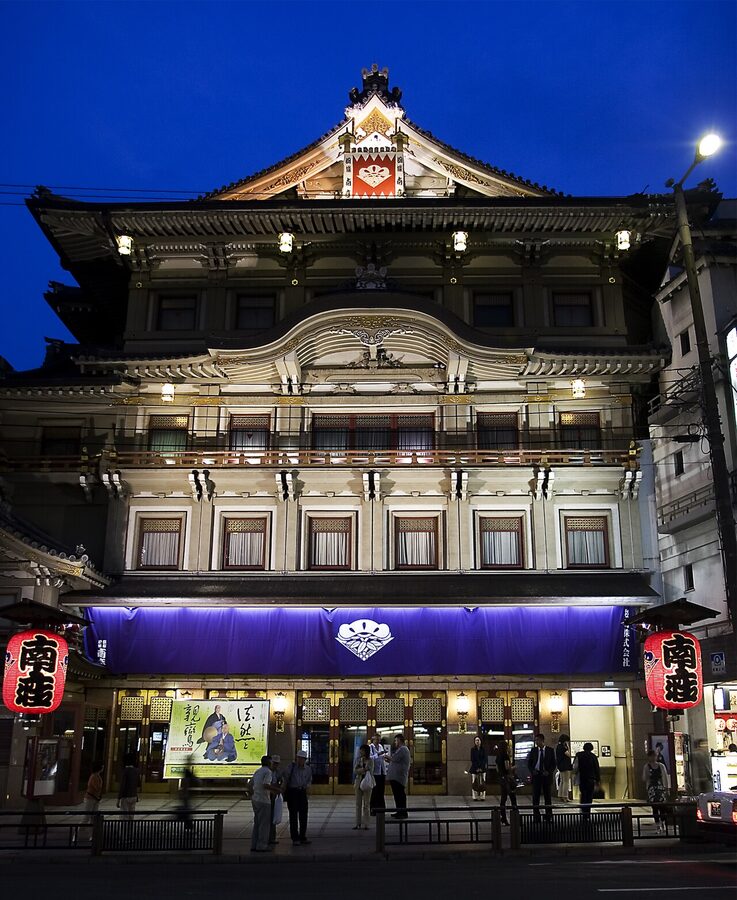
On the south-east corner of Shijo-Ohashi, the green-tiled gabled roof you see is Minamiza, the oldest continuously operating kabuki venue in Japan. They run a full programme each December (Kao-mise, the year’s most prestigious kabuki run), spring and summer programmes, and occasional matinee programmes designed for non-Japanese-speaking audiences with English audio guides for ¥800. Tickets from ¥4,000 for a back-row seat to ¥25,000 for a centre stalls. Worth one show if you’ve never seen kabuki.
Yasui Konpiragu, the relationship-cutting shrine
Five minutes south of Hanamikoji, off Yasaka-dori, there’s a small shrine called Yasui Konpiragu where the central feature is a roughly 1.5-metre-high stone covered in small white wooden ema tablets. You write your wish on a tablet, crawl through the hole in the stone from the front, and crawl back through from the back. The first half cuts a bad relationship, the second half forms a good one. It’s deadly serious to the locals queuing for it and slightly comic to anyone watching for the first time. Free. Open daylight hours.
Nishiki Market, ten minutes’ walk west
Across the river and three blocks west of Pontocho, Nishiki Market is the 400-year-old narrow covered market that runs five blocks east-west. Most of the actual food shopping is done by Kyoto restaurant chefs in the morning. By the time tourists arrive, most stalls have pivoted to small-plate snacks for visitors: skewered eel, sesame ice cream, fresh tofu, soy-pickled cucumbers on a stick. Ten minutes’ walk from Gion, half an hour to graze through. Worth it as a separate breakfast or lunch detour.
What it costs and what it’s worth
Here’s the rough budget for a two-evening Gion visit if you want the proper experience.
- Walking the district: free
- Yasaka Shrine and Maruyama Park: free
- Chion-in main grounds free, gardens ¥500–800
- Kenninji temple: ¥600
- One-hour maiko cultural show (when venues are running): ¥3,500–6,000
- Mid-tier obanzai dinner with drinks: ¥5,000–7,000
- Kaiseki dinner at Gion Hatanaka with maiko entertainment: ¥22,000
- One of the seasonal Odori dance performances: ¥2,500–6,500
If you do all of the above plus two evenings walking the district, you’re looking at roughly ¥40,000 per person, plus accommodation. If you cut the maiko-dinner you halve it. The walking, the shrines, the Yoiyama nights of Gion Matsuri, and the Higashiyama postcard moments are all free; the cultural-performance and kaiseki components are where the spend is. If you have a third day, west-Kyoto is a different mood entirely; the Sagano-Arashiyama district sits a 25-minute train ride from Gion and rewards a half-day on foot.
One last small thing
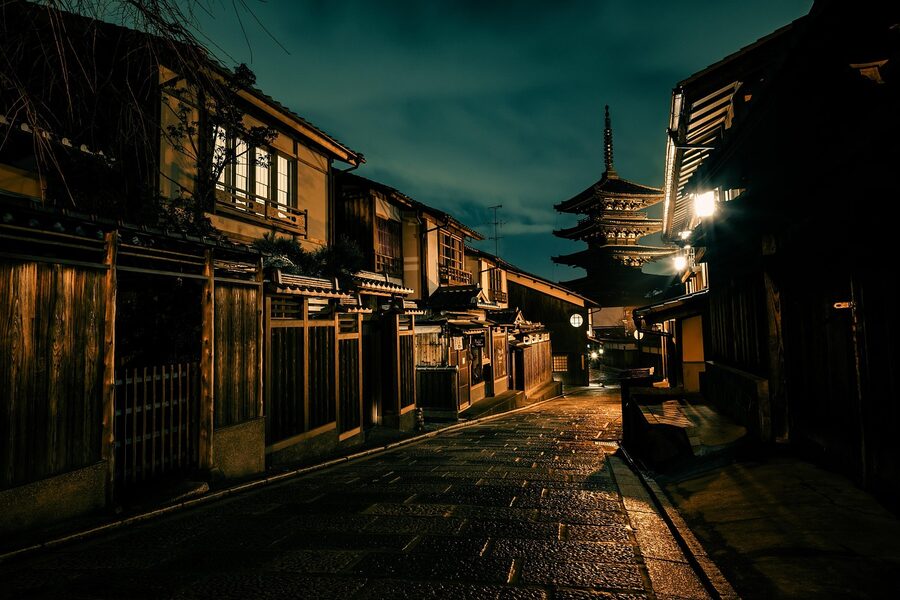
If you only have one evening in Gion, here’s the route I’d actually walk. Start at Kawaramachi station around 17:15. Walk east, cross Shijo-Ohashi over the Kamo, dip into Pontocho northbound for ten minutes, then back south across Shijo. Cross into Gion proper, drop down to the Shirakawa canal, follow it east to Tatsumi Bridge, ten minutes. Up the slope to Shijo, cross into Hanamikoji at the Ichiriki corner, walk south to Kenninji, ten minutes. Loop back east through the small lanes towards Yasaka pagoda, stand at the postcard angle for five minutes, then up Yasaka-dori to Maruyama Park and Yasaka Shrine. Make it to Yasaka by 19:00 when the lanterns are fully lit. Find dinner. Walk home along the canal.
That’s about 90 minutes of moving and four hundred years of city.


.jpg)


.jpg)
.jpg)


.jpg)
.jpg)
,_Kyoto,_Japan.jpg)


.jpg)


